University of Waterloo, Orioles partner on AI project to track pitcher biomechanics

Advertisement

Advertise with us

Staying competitive in the American League East means staying on the cutting edge of technology.

Read this article for free:


or

Already have an account? Log in here »

To continue reading, please subscribe:

Subscribe and receive a limited-edition Free Press branded hat or tote.

Digital Subscription

One year of digital access for only $205*

  • Enjoy unlimited reading on winnipegfreepress.com
  • Read the E-Edition, our digital replica newspaper
  • Access News Break, our award-winning app
  • Play interactive puzzles

*First annual payment billed as $205.00 + GST for one year. This annual subscription will automatically renew at $233.00 + GST every 52 weeks (10% off the regular annual price of $259.35). Offer available to new and qualified returning subscribers only. Cancel any time.

To continue reading, please subscribe:

Add Free Press access to your Brandon Sun subscription for only an additional

$1 for the first 4 weeks*

  • Enjoy unlimited reading on winnipegfreepress.com
  • Read the E-Edition, our digital replica newspaper
  • Access News Break, our award-winning app
  • Play interactive puzzles
Start now

*Your next Brandon Sun subscription payment will increase by $1.00 and you will be charged $17.95 plus GST for four weeks. After four weeks, your payment will increase to $24.95 plus GST every four weeks.

Hey there, time traveller!
This article was published 06/05/2025 (512 days ago), so information in it may no longer be current.

Staying competitive in the American League East means staying on the cutting edge of technology.

That’s why the Baltimore Orioles have partnered with researchers at the University of Waterloo to develop artificial intelligence technology, called PitcherNet, that will help the Major League Baseball team track the biomechanics of pitchers at every level of the organization, from the collegiate ranks and through its minor-league system.

PitcherNet takes the main camera feeds fans are used to seeing — either from behind the pitcher or behind the batter — and combines it with video footage shot on a smartphone by a scout or team official. Using AI, PitcherNet then extrapolates the pitcher’s entire throwing motion, recreating the level of detail that the 12-camera Hawk-Eye system is capable of producing.
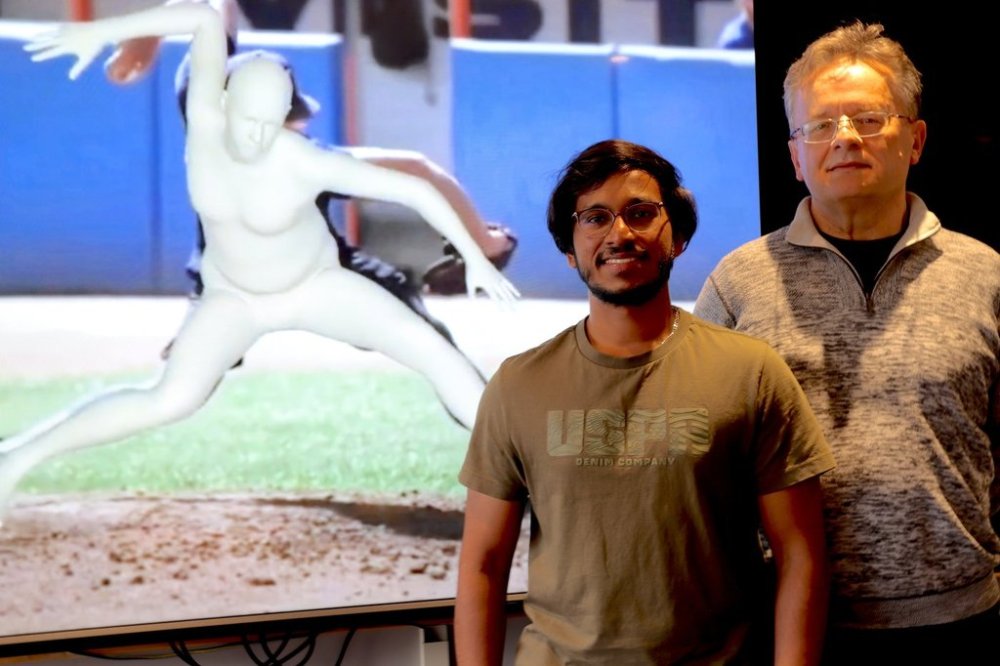
University of Waterloo researchers John Zelek, right, and Jerrin Bright pose for an undated handout photo in front of an onscreen example of the software they engineered to analyze baseball pitchers. To help train AI algorithms at the heart of the technology, researchers created three-dimensional avatars of pitchers so their movements could be viewed from numerous vantage points. THE CANADIAN PRESS/HO-University of Waterloo, *MANDATORY CREDIT*

“What we do is we try to extract 2D information, 2D joint position information, and then extrapolate using 3D avatars,” said Waterloo PhD student Jerrin Bright. “The 3D avatars are like blobs encompassing a human itself and we use those blobs to basically find the 3D human pose, which can be represented with the shape of the person, so that’s the idea behind it.”

Sig Mejdal, the Orioles assistant general manager, said that in his experience it’s a necessity to evolve, even in a sport as old as baseball.

“It’s mandatory. It’s completely mandatory,” said Mejdal, who worked for NASA and Lockheed Martin’s satellite operations unit at Onizuka Air Force Station in Sunnyvale, Calif., before moving to the St. Louis Cardinals and then the Houston Astros. “The success that I’ve been a part of in St Louis, Houston and Baltimore, so much of it has come from innovation and change.

“We’re the Baltimore Orioles, we’re not a large market team, and we’re in the American League East. We have to do everything right, and it would be foolish not to explore every avenue of improvement.”

As part of that need to stay ahead of the competition, Mejdal wanted to expand the Orioles’ ability to track the biomechanics of their pitchers.

Currently, every MLB ballpark and over 60 minor-league stadiums are equipped with Hawk-Eye technology, a series of cameras strategically located throughout a venue for precise 3D imaging. Primarily used by officials in tennis, soccer, and other sports for review calls, it’s increasingly used in baseball to help track the throwing motion of pitchers.

This is important for two reasons. First, a successful pitcher is able to replicate the same throwing motion over and over again. Second, close analysis of a pitcher’s biomechanics can help find likely causes of injuries.

But Hawk-Eye cameras are only accessible to the home team at MLB and triple-A level ballparks. Any minor-league team at a lower level or a scout at a college or high school field doesn’t have access to those analytics because the expensive infrastructure is almost always unavailable.

That’s where PitcherNet, a joint project between the Orioles and Bright and Waterloo professor John Zelek, comes in.

“The whole premise of the project was to replicate those capabilities from just using your smartphone by a scout sitting in the stands,” said Zelek a systems design engineering professor at Waterloo and co-director of the university’s Vision Image Processing lab. “So rather than the scout reporting qualitatively, now you have quantitative data from the scout at a college-level game, or wherever.”

Although similar products exist, the proprietary rights to PitcherNet will be owned by the Orioles and, once it’s operational, they can explore using it in more ways.

“So much of this game is using your body to generate leverage, whether you’re a pitcher to throw the ball or whether you’re a hitter to swing the bat,” Hejdal said in a video call from his office at Oriole Park in Camden Yards. “We had to start somewhere, and the pitching seemed the obvious starting point.”

This report by The Canadian Press was first published May 6, 2025.

Report Error Submit a Tip

More Stories

Perfumer battling city hall to keep his shop open

Gabrielle Piché 5 minute read Preview

Perfumer battling city hall to keep his shop open

Gabrielle Piché 5 minute read Yesterday at 5:45 PM CDT

Michael O’Malley has been here before — fighting the City of Winnipeg to keep his business open.

He usually spends his days concocting scents. He’s owned La Parfumerie, a Wolseley shop, since 1993.

Twenty-seven natural perfumes line shelves on 145 Evanson St.’s bottom floor. O’Malley lives above the space.

Now, he’s required to change the home’s zoning or shut out walk-in customers. Either would kill the company, O’Malley said.

Read
Yesterday at 5:45 PM CDT

Manitoba PCs choose Narth as interim leader; ‘deeply hurt’ Khan blasts former caucus colleagues

Carol Sanders 7 minute read Preview

Manitoba PCs choose Narth as interim leader; ‘deeply hurt’ Khan blasts former caucus colleagues

Carol Sanders 7 minute read Updated: 7:31 PM CDT

Manitoba’s Progressive Conservative caucus chose MLA Konrad Narth as interim party leader Tuesday to replace Obby Khan, who quit a day earlier after he said he was stabbed in the back by a small group of caucus members plotting in secret to oust him.

Read
Updated: 7:31 PM CDT

Canada resorting to its tried and true playbook

Niigaan Sinclair 5 minute read Preview

Canada resorting to its tried and true playbook

Niigaan Sinclair 5 minute read Yesterday at 6:00 AM CDT

In 1846, Britain faced an emergency influenced by the Irish famine, so leaders repealed the country’s “Corn Laws” and restrictions on imported food and grain, transitioning to a system of free trade.

This created a crisis in the then Province of Canada, which had relied on British “preferential” status to prop up its agricultural and resource industries.

As a result, Canada looked south for new markets and eventually negotiated a free trade agreement with the United States.

This required land to be acquired and converted for industrial use quickly, so Canada quickly dispatched Commissioner William Robinson to negotiate with Indigenous communities along Lake Huron and Lake Superior for land.

Read
Yesterday at 6:00 AM CDT

Jets pick up netminder as relatively new 23-man roster announced

Mike McIntyre 7 minute read Preview

Jets pick up netminder as relatively new 23-man roster announced

Mike McIntyre 7 minute read Updated: Yesterday at 9:25 PM CDT

Let’s get the caveats out of the way: Nothing is set in stone, nor written in permanent ink, and what you see right now could change in the blink of an eye.

With that being said, allow us to introduce you to the 2026-27 Winnipeg Jets — where change is very much in the air.

The 23-man roster submitted to the NHL offices by Monday’s 4 p.m. deadline includes seven players who were not on the team at this time last year. In fact, there could be as many as 10 new faces in the opening-night lineup on Friday against Boston when you factor in three regulars didn’t start the 2025-26 campaign due to injury.

That’s a lot of turnover, which isn’t surprising for a team that finished 26th overall in the standings and was — to most fans and pundits — too old and too slow.

Read
Updated: Yesterday at 9:25 PM CDT

Completely separating inmates unrealistic, inquest judge says in report on three Stony Mountain slayings

Erik Pindera 5 minute read Preview

Completely separating inmates unrealistic, inquest judge says in report on three Stony Mountain slayings

Erik Pindera 5 minute read 1:43 PM CDT

Nothing short of keeping inmates separated at all times could have prevented three unrelated prisoner-on-prisoner killings several years ago in Stony Mountain Institution’s maximum-security unit, an inquest judge has found.

Provincial court Judge Lindy Choy made the finding after overseeing an inquest earlier this year into the slayings of Adrian Fillion, 42, Michael Monney, 27, and Nolan Thomas, 26, all of which occurred at the hands of fellow maximum-security inmates in the federal prison just north of Winnipeg. The killings occurred when cells were unlocked, allowing inmates to briefly move around to other areas in the cell block.

“The overall impression I was left with from the (Stony Mountain Institution) witnesses was that management of inmates in a custodial facility is a very complex undertaking. There are clearly multiple levels of oversight involved in any decisions that are made and it is all done in a very structured manner,” Choy wrote in her report on the inquest, which was made public Tuesday.

“While maintaining complete physical distance between inmates at all times would have prevented the homicides from occurring, we know that from a social and psychological perspective, this is not generally realistic nor acceptable.”

Read
1:43 PM CDT

Obsessed stalker who shot, killed young woman at bus stop in 1993 dies behind bars at age 74

Erik Pindera 3 minute read Preview

Obsessed stalker who shot, killed young woman at bus stop in 1993 dies behind bars at age 74

Erik Pindera 3 minute read 5:53 PM CDT

A Winnipeg man who stalked a woman for several years before shooting her dead in the street in 1993 has died in Stony Mountain prison.

On Monday, 74-year-old Ronald Edd Bell died of apparent natural causes at the federal prison just north of Winnipeg, the Correctional Service of Canada said.

Bell had been in prison since May 30, 1994, when he was given a life sentence with no chance of parole for 18 years for killing Terry-Lyn Babb, 25, on Jan. 21, 1993.

Bell walked up behind an unsuspecting Babb, who was waiting at a bus stop at Sherbrook Street and Wolseley Avenue, and shot her in the head with a pistol in front of horrified witnesses, says the Free Press report of his sentencing hearing.

Read
5:53 PM CDT