Early human ancestors used their hands to both climb trees and make tools, new study shows

Advertisement

Advertise with us

WASHINGTON (AP) — Our hands can reveal a lot about how a person has lived – and that’s true for early human ancestors, too.

Read this article for free:


or

Already have an account? Log in here »

To continue reading, please subscribe:

Subscribe and receive a limited-edition Free Press branded hat or tote.

Digital Subscription

One year of digital access for only $205*

  • Enjoy unlimited reading on winnipegfreepress.com
  • Read the E-Edition, our digital replica newspaper
  • Access News Break, our award-winning app
  • Play interactive puzzles

*First annual payment billed as $205.00 + GST for one year. This annual subscription will automatically renew at $233.00 + GST every 52 weeks (10% off the regular annual price of $259.35). Offer available to new and qualified returning subscribers only. Cancel any time.

To continue reading, please subscribe:

Add Free Press access to your Brandon Sun subscription for only an additional

$1 for the first 4 weeks*

  • Enjoy unlimited reading on winnipegfreepress.com
  • Read the E-Edition, our digital replica newspaper
  • Access News Break, our award-winning app
  • Play interactive puzzles
Start now

*Your next Brandon Sun subscription payment will increase by $1.00 and you will be charged $17.95 plus GST for four weeks. After four weeks, your payment will increase to $24.95 plus GST every four weeks.

Hey there, time traveller!
This article was published 14/05/2025 (465 days ago), so information in it may no longer be current.

WASHINGTON (AP) — Our hands can reveal a lot about how a person has lived – and that’s true for early human ancestors, too.

Different activities such as climbing, grasping or hammering place stress on different parts of our fingers. In response to repeated stress, our bones tend to thicken in those areas.

To study how ancient humans used their hands, scientists used 3D scanning to measure and analyze the bone thickness of fingers.
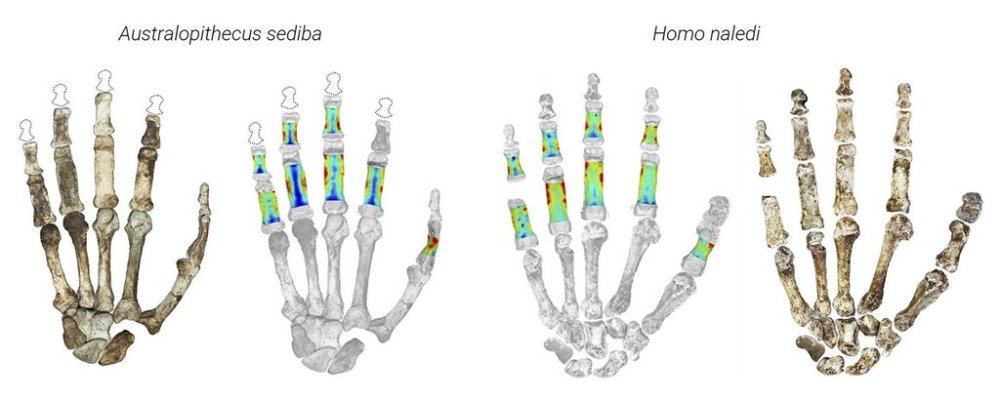
This artist rendering shows hands of early human ancestors, called Australopithecus sediba and Homo naledi, found in South Africa. The left images show photos of the bones, and the right images show how the fingers absorbed stress during daily activities. Red areas absorbed more stress than blue ones, which scientists can tell based on bone thickness. (Tracy Kivell via AP)

They focused on the fossil hands of two early human ancestor species recovered from excavations in southern Africa, called Australopithecus sediba and Homo naledi. The individuals lived around 2 million years ago and around 300,000 years ago, respectively.

Both ancient human species showed signs of simultaneously using their hands to move around – such as by climbing trees – as well as to grasp and manipulate objects, a requirement to being able to make tools.

“They were likely walking on two feet and using their hands to manipulate objects or tools, but also spent time climbing and hanging,” perhaps on trees or cliffs, said study co-author and paleoanthropologist Samar Syeda of the American Museum of Natural History.

The research was published Wednesday in Science Advances.

The findings show there wasn’t a simple “evolution in hand function where you start off with more ‘ape-like’ and end up more ‘human-like,’” said Smithsonian paleoanthropologist Rick Potts, who was not involved in the study.

Complete fossil hands are relatively rare, but the specimens used in the study gave an opportunity to understand the relative forces on each finger, said Chatham University paleontologist Erin Marie Williams-Hatala, who was not involved in the study.

“Hands are one of the primary ways we engage with world around us,” she said.

___

The Associated Press Health and Science Department receives support from the Howard Hughes Medical Institute’s Science and Educational Media Group and the Robert Wood Johnson Foundation. The AP is solely responsible for all content.

Report Error Submit a Tip

More Stories

Ready to crack over late-night ‘snacks’

Maureen Scurfield 4 minute read Yesterday at 2:00 AM CDT

DEAR MISS LONELYHEARTS: My new love has a seriously annoying habit that could break us up now that we’re actually living together.

I’m not getting much sleep, and it has nothing to do with having too much sex! Every night at about 2 a.m., my man gets up and goes to the fridge, makes a giant sandwich and pours a huge glass of apple juice, then sits there scarfing it down, with music on for a bit of entertainment. This often wakes me up, and when I complain he just invites me to join him “for a bite.”

Really? The last thing I need is to eat a fourth meal of the day in the middle of the night. He says it’s an old habit from his football days, when he was so hungry all the time and he still enjoys it. He says he isn’t about to change that for me, so, tough luck.

It’s a big problem as I can’t just fall back to sleep after he rattles around the kitchen and then comes back and jumps back into bed with me.

Fatal stabbing of Ukrainian newcomer left family shattered

Erik Pindera 5 minute read Preview

Fatal stabbing of Ukrainian newcomer left family shattered

Erik Pindera 5 minute read Thursday, Aug. 20, 2026

A man who fatally stabbed a Ukrainian newcomer in “a random, unprovoked, and senseless act of violence” on the street has been sentenced to 10 years behind bars.

Ethan Gladu, 22, was found guilty of manslaughter in February in the December 20, 2023 killing of Ivan Rubanik, a 46-year-old father of two who had fled to Canada for a better life with his family several months before.

Gladu, then 19, randomly stabbed Rubanik shortly before 8 a.m., near Talbot Avenue and Watt Street, as the victim was walking to work that morning. He died of blood loss soon after.

“The people of Winnipeg, or any community, should feel confident that they can go about their business, walk to work, support their family, and carry on with their lives without being attacked,” said Court of King’s Bench Justice Kenneth Champagne on Thursday afternoon as he sentenced the killer.

Read
Thursday, Aug. 20, 2026

Frustration mounts as drug raids sweep problems out of downtown, into West End

Scott Billeck 7 minute read Preview

Frustration mounts as drug raids sweep problems out of downtown, into West End

Scott Billeck 7 minute read Updated: Yesterday at 6:24 PM CDT

West End business owners say their neighbourhood has been under siege for months, and some believe downtown police drug sweeps have made things worse by pushing more street disorder in their direction — and pushing customers away.

Read
Updated: Yesterday at 6:24 PM CDT

Transit union pleads for full shields after near ‘hijacking situation’

Nicole Buffie 5 minute read Preview

Transit union pleads for full shields after near ‘hijacking situation’

Nicole Buffie 5 minute read Thursday, Aug. 20, 2026

The union representing Winnipeg Transit drivers says the need for full safety shields is critical after an operator was threatened with a hatchet early Thursday.

Read
Thursday, Aug. 20, 2026

Letters, Aug. 22

7 minute read 2:01 AM CDT

Foster system must be better

Re: Paralyzed foster girl has system under a microscope (Aug. 18)

Families Minister Nahanni Fontaine’s assertion that “you can’t train people not to be violent” should concern everyone who cares about the safety of children in Manitoba’s child welfare system.

Of course, no training program can guarantee that an individual will never harm a child. But framing these tragedies as the actions of a few “abominable” people risks absolving the system of its responsibility to prevent harm.

Sunshine Fund guarantees a little magic in the summer

Grace Penner 4 minute read Preview

Sunshine Fund guarantees a little magic in the summer

Grace Penner 4 minute read 2:01 AM CDT

To this day, I still remember the morning polar plunges into Moose Lake — a cold shock to the system meant to wake campers up before the sun hit its peak.

Throughout my youth, my siblings and I attended Camps with Meaning, an organization that at the time offered three Mennonite bible camps at Camp Moose Lake, Camp Koinonia, and Camp Assiniboina. I spent many summers at Camp Moose Lake as well as an annual weekend trip with my high school, Westgate Mennonite Collegiate.

I have fond memories of swimming in the lake, picking up a bow and arrow for archery practice, sitting in the cafeteria with all of my friends waiting to devour home-cooked meals, as well as camp-wide games of Manhunt where bouts of giggling echoed around the property.

My parents were able to send all three of us to camp, including my brothers Jonah and Samuel, due to the camp being subsidized by the Mennonite Church. Without the financial assistance, it would have been a strain on my family to support three children going to summer camp on a yearly basis.

Read
2:01 AM CDT