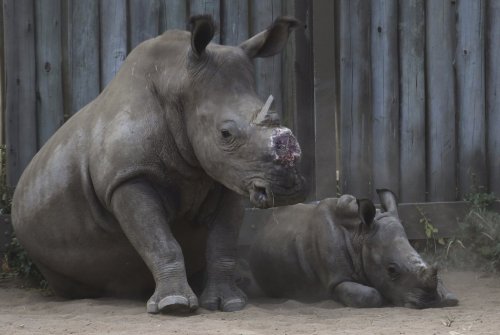
Cutting off rhinos’ horns is a contentious last resort to stop poaching. A new study found it works

Advertisement

Advertise with us

CAPE TOWN, South Africa (AP) — Cutting off the horns of sedated rhinos with a chainsaw has been viewed by wildlife conservationists in Africa for more than 30 years as a necessary evil to save the iconic endangered species from poaching.

Read this article for free:


or

Already have an account? Log in here »

To continue reading, please subscribe:

Subscribe and receive a limited-edition Free Press branded hat or tote.

Digital Subscription

One year of digital access for only $205*

  • Enjoy unlimited reading on winnipegfreepress.com
  • Read the E-Edition, our digital replica newspaper
  • Access News Break, our award-winning app
  • Play interactive puzzles

*First annual payment billed as $205.00 + GST for one year. This annual subscription will automatically renew at $233.00 + GST every 52 weeks (10% off the regular annual price of $259.35). Offer available to new and qualified returning subscribers only. Cancel any time.

To continue reading, please subscribe:

Add Free Press access to your Brandon Sun subscription for only an additional

$1 for the first 4 weeks*

  • Enjoy unlimited reading on winnipegfreepress.com
  • Read the E-Edition, our digital replica newspaper
  • Access News Break, our award-winning app
  • Play interactive puzzles
Start now

*Your next Brandon Sun subscription payment will increase by $1.00 and you will be charged $17.95 plus GST for four weeks. After four weeks, your payment will increase to $24.95 plus GST every four weeks.

Hey there, time traveller!
This article was published 05/06/2025 (458 days ago), so information in it may no longer be current.

CAPE TOWN, South Africa (AP) — Cutting off the horns of sedated rhinos with a chainsaw has been viewed by wildlife conservationists in Africa for more than 30 years as a necessary evil to save the iconic endangered species from poaching.

They hoped the drastic action was working, but evidence was scarce.

Now, a study published Thursday in the academic journal Science has found that dehorning rhinos has led to a large reduction in poaching in game reserves in and around the Kruger National Park in northern South Africa — an area that’s home to 25% of the world’s rhinos and is especially vulnerable to poaching.
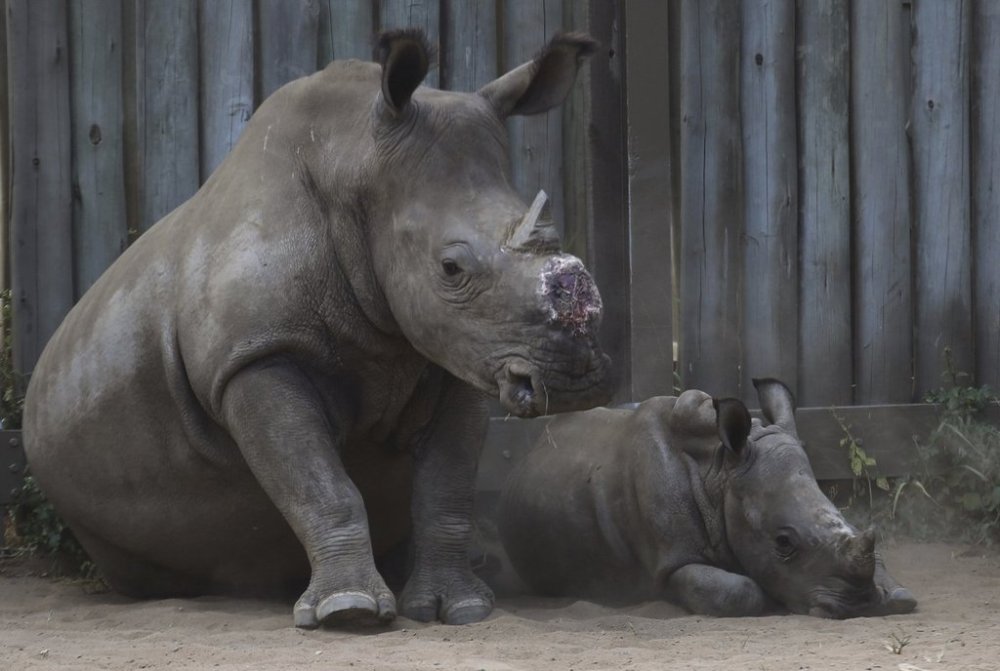
FILE -- In this file photo taken Feb. 15, 2016, a de-horned rhino and her calf rest in their corral at a rhino orphanage in the Hluhluwe-iMfolozi Game Reserve in the KwaZulu Natal province South Africa. (AP Photo/Denis Farrell-File)

The results of the seven-year study that ended in 2023 are seen as long-awaited evidence that removing rhinos’ horns — which needs to be done every one to two years because they grow back — helps them survive, even if the animals lose part of their makeup.

Consistently reduced poaching

The conclusions seem obvious. Lucrative illegal markets in parts of southeast Asia and China crave rhino horns for use in traditional medicines, and removing the rhinos’ horns take away what poachers are after.

But Tim Kuiper, a biodiversity scientist at South Africa’s Nelson Mandela University and the lead author of the study, said it was new to have long-term data from multiple sites on dehorning rhinos. He said the study, conducted between January 2017 and December 2023, focused on 11 reserves in the Kruger area and compared data from eight that dehorned their rhinos against the three that didn’t.

It also analyzed data from the reserves before and after they dehorned their rhinos.

The study showed that dehorning consistently reduced poaching, Kuiper said. It found that the dehorning of more than 2,000 rhinos resulted in a 78% reduction in poaching in those eight reserves, providing some confirmation that such an invasive intervention was worth it.

“It is a big part of what a rhino is, having a horn,” Kuiper said. “So having to remove it is kind of a necessary evil, if I can put it that way. But it’s very effective. There’s no doubt it saved hundreds of rhinos’ lives.”

South Africa has the largest numbers of black and white rhinos. Namibia, Zimbabwe and Kenya also have significant populations. There are around 17,500 white rhinos and 6,500 black rhinos left in the world, with black rhino numbers reduced from 70,000 in 1970 to less than 2,500 by the time poaching reached a crisis point in the mid-1990s, according to the Save the Rhino organization.

Dehorning was not always accepted

Dehorning rhinos started in southern Africa as early as 1989. It has not been accepted without question.

There has been opposition from animal rights activists but also questions from conservationists over what impact it has on a rhino’s wellbeing, and what a future might look like with more hornless rhinos.

Vanessa Duthe, a rhino researcher in South Africa not involved in the study, said rhinos use their horns to defend themselves against predators, to compete for territory and, in the case of black rhinos, to look for food. There is also evidence that dehorned rhinos adjust their movements to live in smaller ranges, she said.

She said conservationists don’t know the full impacts of dehorning, but research had found it had no adverse effect on rhinos’ breeding rates or mortality rates.

“What we do know is that the benefits of dehorning by far outweigh any ecological cost that we’re aware of today,” Duthe said. She said dehorning a rhino now takes around 10 minutes and the process causes minimum distress. Blindfolds and earmuffs are put on sedated rhinos during dehorning, which also provides an opportunity to microchip rhinos and collect samples that aid research.

Only one part of the battle

Conservationists agree that dehorning alone will not end rhino poaching and Kuiper said he saw it as a short-to-mid-term solution. Other efforts like more effective law enforcement and better support for game rangers on the frontline are key.

While South Africa has helped pull rhinos back from the threat of extinction, more than 400 rhinos a year are still killed by poachers in the country.

The dehorning study was a collaboration between scientists from three South African universities, Oxford University in England and game reserve managers and rangers. It also involved the South African National Parks department, the World Wildlife Fund and the Rhino Recovery Fund.

___

AP Africa news: https://apnews.com/hub/africa

Report Error Submit a Tip

More Stories

(Un)friendly competition

Ken Wiebe 6 minute read Preview

(Un)friendly competition

Ken Wiebe 6 minute read Yesterday at 5:26 PM CDT

REGINA – Jermarcus Hardrick knows exactly what kind of battle he is in for on Sunday in the 61st edition of the Labour Day Classic.

The Saskatchewan Roughriders right tackle has ample experience lining up opposite Winnipeg Blue Bombers defensive end Willie Jefferson, both as teammates and opponents during the past decade and change.

In this pivotal matchup between Prairie rivals jockeying for position in the CFL West Division, this head-to-head battle in the trenches figures to be must-see TV.

“Willie is one of my best friends, one of the best players in the league. It’s amazing to see what he’s doing on film, what he’s always done on film,” said Hardrick, who spent eight seasons with the Blue Bombers before joining the Roughriders in 2024 as a free agent. “With the way that you know he plays and what he can do to a team with his energy and knowing that’s on the other side from you all game, that’s a big challenge that you look forward to.

Read
Yesterday at 5:26 PM CDT

Back to school means increased costs for parents, post-secondary students

Joel Schlesinger 6 minute read Preview

Back to school means increased costs for parents, post-secondary students

Joel Schlesinger 6 minute read Yesterday at 2:01 AM CDT

In the words of advice for students from Thornton Melon: “It’s rough out there. Move back in with your parents.”

As comedian Rodney Dangerfield’s character alluded to in the 1986 comedy Back to School, it is indeed a tough financial environment as students head back to the classroom in 2026.

A Capital One Canada survey found families are struggling with costs, with nearly six in 10 parents surveyed stating back-to-school expenses are higher than expected.

It’s not just tuition, new clothes and supplies. Extracurricular activities — like hockey, figure skating, ringette, soccer, dance, etc. — also ramp up, involving tuition-sized payments.

Read
Yesterday at 2:01 AM CDT

Controlling pace of response path to success

Tim Kist 5 minute read Yesterday at 2:01 AM CDT

WITH the recent collapse of Canada-U.S. trade talks, the economic, political and social changes are coming at business leaders on a daily basis.

While you cannot control the pace of these changes, you can control the pace of response and timing of actions your organization takes. This is a time for thoughtful analysis and careful action, not chasing the latest trends.

Artificial intelligence, for example, can write articles, create images, draft emails and perform seemingly countless other tasks. But is this new tool solving a current business problem?

Successful companies know they must develop a strategy before launching any tactics. Otherwise, the strategy is based on “hope” — and we all know hope is not a strategy.

Smith’s pretzel logic confuses

Editorial 4 minute read Preview

Smith’s pretzel logic confuses

Editorial 4 minute read Yesterday at 2:01 AM CDT

Alberta Premier Danielle Smith had both sides of her mouth working overtime on Aug. 30, when she spoke at an event in Calgary to commemorate Alberta Day, the annual celebration of the province’s entry into Confederation in 1905 (officially Sept. 1, it was celebrated on the weekend).

Smith’s comments — and the things she did not say — revealed a lot about the political tightrope the premier is trying to walk over the challenges currently faced by her province. At the top of that list of challenges is a persistent campaign to separate Alberta from the aforementioned Confederation. A campaign that Smith appears to both support and oppose, depending on which day of the week it is.

Her Alberta Day remarks were an excellent case in point.

Smith has decided that on Oct. 19, Albertans will vote on a series of non-binding propositions in a province referendum. One of those questions will ask Albertans whether they want to hold a referendum on separation, thus making this fall’s vote a “referendum on whether to hold a referendum,” as some observers have dubbed it.

Read
Yesterday at 2:01 AM CDT

Cutting off rhinos’ horns is a contentious last resort to stop poaching. A new study found it works

Gerald Imray, The Associated Press 5 minute read Preview

Cutting off rhinos’ horns is a contentious last resort to stop poaching. A new study found it works

Gerald Imray, The Associated Press 5 minute read Thursday, Jun. 5, 2025

CAPE TOWN, South Africa (AP) — Cutting off the horns of sedated rhinos with a chainsaw has been viewed by wildlife conservationists in Africa for more than 30 years as a necessary evil to save the iconic endangered species from poaching.

They hoped the drastic action was working, but evidence was scarce.

Now, a study published Thursday in the academic journal Science has found that dehorning rhinos has led to a large reduction in poaching in game reserves in and around the Kruger National Park in northern South Africa — an area that's home to 25% of the world's rhinos and is especially vulnerable to poaching.

The results of the seven-year study that ended in 2023 are seen as long-awaited evidence that removing rhinos' horns — which needs to be done every one to two years because they grow back — helps them survive, even if the animals lose part of their makeup.

Read
Thursday, Jun. 5, 2025

‘Quite a journey’: dozens move into transitional housing downtown

Carol Sanders 4 minute read Preview

‘Quite a journey’: dozens move into transitional housing downtown

Carol Sanders 4 minute read Friday, Sep. 4, 2026

Dozens of residents have moved into transitional housing units in a former university building in downtown Winnipeg.

Housing, Addictions and Homelessness Minister Bernadette Smith said 42 residents have moved into suites on the third and fourth floors of a seven-storey building previously owned by Providence University College and Theological Seminary. There will be space for as many as 118 people who were in encampments or otherwise homeless.

The remaining units under renovation are expected to be ready and occupied in the coming weeks, Smith said.

“This has been two years in the making,” the minister said at a media event with residents, staff, neighbours and supporters. The building cost the province $24.4 million to purchase and renovate.

Read
Friday, Sep. 4, 2026