Drone debris found in Ukraine indicates Russia is using new technology from Iran
Advertisement
Read this article for free:
or
Already have an account? Log in here »
To continue reading, please subscribe:

Digital Subscription
One year of digital access for only $205*
- Enjoy unlimited reading on winnipegfreepress.com
- Read the E-Edition, our digital replica newspaper
- Access News Break, our award-winning app
- Play interactive puzzles
*First annual payment billed as $205.00 + GST for one year. This annual subscription will automatically renew at $233.00 + GST every 52 weeks (10% off the regular annual price of $259.35). Offer available to new and qualified returning subscribers only. Cancel any time.
To continue reading, please subscribe:
Add Free Press access to your Brandon Sun subscription for only an additional
$1 for the first 4 weeks*
- Enjoy unlimited reading on winnipegfreepress.com
- Read the E-Edition, our digital replica newspaper
- Access News Break, our award-winning app
- Play interactive puzzles
*Your next Brandon Sun subscription payment will increase by $1.00 and you will be charged $17.95 plus GST for four weeks. After four weeks, your payment will increase to $24.95 plus GST every four weeks.
Read unlimited articles for free today:
or
Already have an account? Log in here »
Hey there, time traveller!
This article was published 25/06/2025 (467 days ago), so information in it may no longer be current.
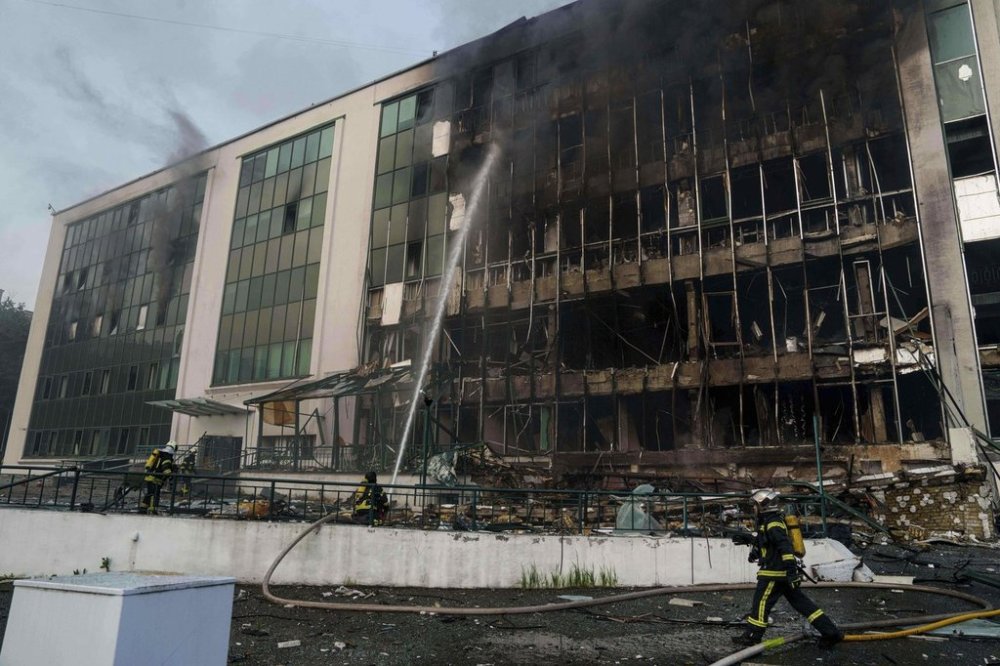
Last week, Ukrainian drone hunters picking up the debris from Russia’s nightly assault on their cities found a weapon that stood out from the rest.
It had an advanced camera, a computing platform powered by artificial intelligence and a radio link, allowing an operator to pilot it remotely from Russia. It also contained new, Iranian-made, anti-jamming technology, according to a Ukrainian drone expert.
Most Russian attack drones are black, said Serhii Beskrestnov, an electronics expert more widely known as Flash. The new one, he told The Associated Press, was white.
Inside, there were no markings or labels consistent with Russian-made drones. Instead, the stickers followed a “standard Iran labeling system,” Beskrestnov said.
Experts who spoke to AP said the labels are not conclusive proof but the English-language words are consistent with how Iran marks its drones. It is quite possible, they said, that it was sold by Iran to Russia to test in combat.
Moscow has pummeled Ukraine almost nightly with Iranian-designed drones throughout the course of the war, now in its fourth year. They swarm above Ukrainian cities, their moped-like sound filling the air, as air defenses and sharpshooters take aim. While some carry warheads, many are decoys.
Russia is improving its drone technology and tactics, striking Ukraine with increasing success. But the U.K’s Defense Ministry said Israel’s strikes on Iran will “likely negatively impact the future provision of Iranian military equipment to Russia,” since Tehran had supplied “significant quantities” of attack drones to Moscow.
Israeli attacks on Iran
Israel’s military would not comment on what it struck. Although it has carried out sweeping attacks across Iranian military facilities and the U.S. bombed nuclear sites, the impact on Iran’s drone industry is not yet clear.
The anti-jammer in the latest drone discovered in Ukraine contained new Iranian technology, suggested Beskrestnov. Other components in Russia’s drones often come from Russia, China and the West.
Although Russia’s drones are based on an Iranian design, the majority are now made in Russia.
And because much of the technology to make them, including the Iranian software and technical expertise, has already been transferred to Russia, the immediate impact on Moscow’s drone program could be limited, experts said.
However, if Israel struck facilities producing drones and components — such as engines and anti-jamming units — which are shipped to Russia, then Moscow could face supply shortages, experts suggested.
A secretive Russian factory
Moscow makes its Shahed — meaning “witness” in Farsi — drones based on an Iranian model in a highly secure factory in central Russia.
The Alabuga plant in the Tatarstan region took delivery of its first Iranian drones in 2022 after Russia and Iran signed a $1.7 billion deal. It later established its own production lines, churning out thousands of them.
The upgrades identified from debris in Ukraine are the latest in a series of innovations that began with Russia buying drones directly from Iran in the fall of 2022, according to leaked documents from Alabuga previously reported on by AP.
In early 2023, Iran shipped about 600 disassembled drones to be reassembled in Russia before production was localized. In 2024, the design was adapted.
Specialists added cameras to some drones and implemented a plan, revealed in an AP investigation, dubbed Operation False Target — creating decoys to overwhelm Ukrainian air defenses.
Alabuga also modified the Shahed to make it more lethal, creating a thermobaric drone which sucks out all the oxygen in its path — potentially collapsing lungs, crushing eyeballs and causing brain damage. The size of the warhead was also upgraded.
Jet-propelled drones and AI
In at least one case, Iran shipped a jet-powered Shahed that Russia “experimented” with in Ukraine, said Fabian Hinz, an expert on Russian and Iranian drones at the International Institute for Strategic Studies in London.
Ukraine’s air force found two more examples of jet-powered Shaheds in May but it appears they have not been widely adopted.
That’s possibly because the Iranian design uses a very sophisticated jet engine that also powers Iran’s cruise missiles, Hinz said. That likely makes it too expensive to use nightly in Ukraine, he said, even if the engine is swapped to a cheaper Chinese model.
The electronics in the drone most recently found in Ukraine are also very expensive, Beskrestnov said, pointing to its AI computing platform, camera and radio link. It’s unclear why it was deployed but Beskrestnov suggested it could be used to target “critical infrastructure,” including electrical transmission towers.
Previous versions of the Shahed drone could not hit a moving object or change their flight path once launched. They sometimes ended up “traveling in circles all through Ukraine before they finally hit a target,” which made them easier to shoot down, said David Albright of the Washington-based Institute for Science and International Security.
The radio link means an operator can communicate with the drone from Russia, introduce a new target and potentially control many drones at the same time, the experts said.
The remotely operable Shahed has similarities to drones Russia is already using on the front lines and is particularly resistant to jamming, Beskrestnov said.
There are eight, rather than four, antennas on the drone which means it is harder for Ukraine to overwhelm it with electronic warfare, he said.
The new drone has markings that suggest the anti-jamming unit was made in Iran within the past year and similarities to Iranian components found in older models of the Shahed, said Beskrestnov.
Such advanced antennas, said Hinz, have not previously been seen on drones used in Ukraine but have been found on Iranian missiles destined for Iran-backed Houthi rebels in Yemen.
In a statement, Ukraine’s Ministry of Defense told AP in the past four months it had found drones with eight and 12 antennas made in China and Russia.
Despite sanctions, both Russia and Iran have continued to find ways to procure Western technology.
The drone’s AI computing platform can help it autonomously navigate if communications are jammed. Similar technology was used by Ukraine to attack aircraft deep inside Russia during Operation Spiderweb, when it used drones to target Russian air bases hosting nuclear-capable strategic bombers.
Changing tactics
Russia is improving its technology at the same time as it is also changing its tactics.
Moscow is flying the Shahed drones at high altitudes where they are out of reach of Ukrainian shooters, as well as lower down to avoid radio detection.
It is also carrying out massive group attacks on cities including where drones sometimes dive-bomb a target, Ukraine’s Ministry of Defense said.
The drones can be used to clear a path for cruise missiles or to exhaust Ukrainian air defenses by sending a wave of decoys followed by one or two with a warhead.
The tactics appear to be working.
AP collected almost a year’s worth of Russian drone strike data on Ukraine posted online by the Ukrainian air force.
An analysis shows that Russia significantly ramped up its attacks after U.S. President Donald Trump was inaugurated in January. And Russian hits have increased markedly since March — shortly before reports emerged that Russia was using Shahed drones with advanced jammers.
In November 2024, only around 6% of drones hit a discernible target but, by June, that reached about 16%. On some nights, almost 50% of drones got through Ukraine’s air defenses.
Ukraine’s Ministry of Defense said the Shaheds’ effectiveness is likely because Russia is firing more drones, including decoys, as well as the change in technology and tactics.
But although Russia appears to have had increasing success striking Ukraine, it is not clear if that will continue.
Israel’s strikes on Iran will “certainly” hurt Russia long-term, Albright said.

Moscow, he said, is “not going to be able to get as much assistance from Iran as it has been.”
——
This story has been corrected to show only around 6% of drones hit a discernible target in November 2024, not November 2022.
——
Associated Press journalists Lydia Doye in London, Volodymyr Yurchuk and Illia Novikov in Kyiv, Ukraine, and Sam Mednick in Tel Aviv, Israel, contributed to this report.