Yukon disaster one of two ‘most catastrophic’ in heap-leach mining history: expert

Advertisement

Advertise with us

The spill of about two million tonnes of cyanide-soaked ore at a Yukon gold mine was one of the two "most catastrophic failures" in the 45-year history of the heap-leaching mining process, an engineer tasked with reviewing it said.

Read this article for free:


or

Already have an account? Log in here »

To continue reading, please subscribe:

Subscribe and receive a limited-edition Free Press branded hat or tote.

Digital Subscription

One year of digital access for only $205*

  • Enjoy unlimited reading on winnipegfreepress.com
  • Read the E-Edition, our digital replica newspaper
  • Access News Break, our award-winning app
  • Play interactive puzzles

*First annual payment billed as $205.00 + GST for one year. This annual subscription will automatically renew at $233.00 + GST every 52 weeks (10% off the regular annual price of $259.35). Offer available to new and qualified returning subscribers only. Cancel any time.

To continue reading, please subscribe:

Add Free Press access to your Brandon Sun subscription for only an additional

$1 for the first 4 weeks*

  • Enjoy unlimited reading on winnipegfreepress.com
  • Read the E-Edition, our digital replica newspaper
  • Access News Break, our award-winning app
  • Play interactive puzzles
Start now

*Your next Brandon Sun subscription payment will increase by $1.00 and you will be charged $17.95 plus GST for four weeks. After four weeks, your payment will increase to $24.95 plus GST every four weeks.

Hey there, time traveller!
This article was published 08/07/2025 (438 days ago), so information in it may no longer be current.

The spill of about two million tonnes of cyanide-soaked ore at a Yukon gold mine was one of the two “most catastrophic failures” in the 45-year history of the heap-leaching mining process, an engineer tasked with reviewing it said.

Mark Smith said the disasters last year, the other occurring in Turkey, would “define the next 10 or 20 years for heap-leach practices,” in which minerals are extracted from piles of ore by running liquid chemicals through them.

Smith is a member of the independent review board that examined the disaster at the Eagle Gold Mine in June 2024, when an ore slope failed, leading to the contamination of local groundwater in central Yukon.
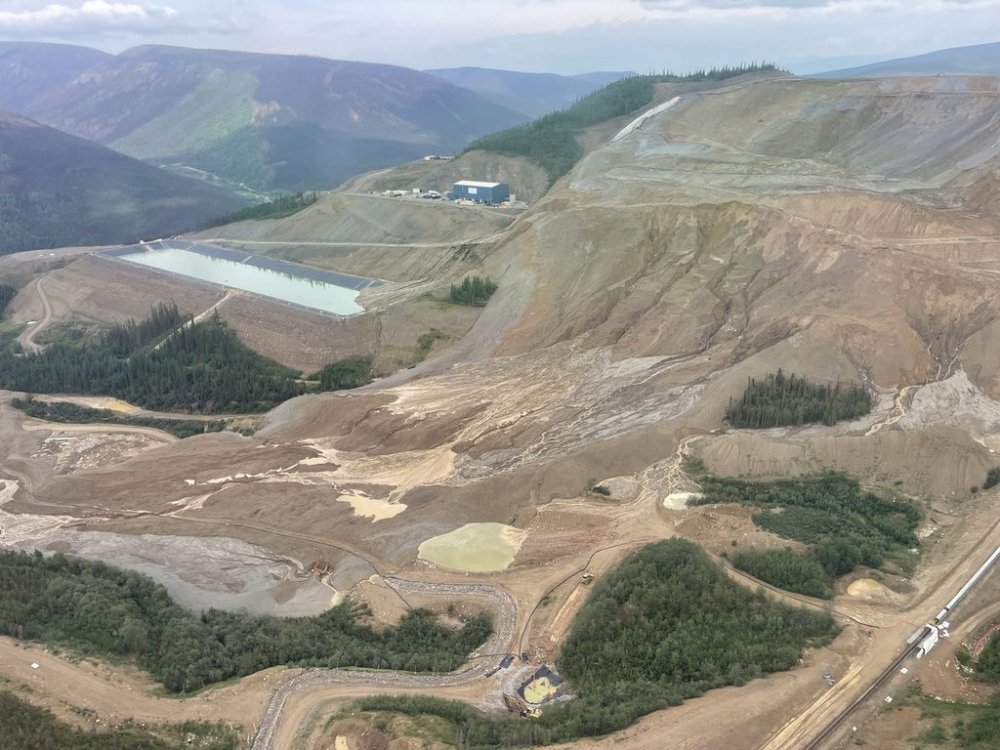
Victoria Gold's Eagle gold mine site north of Mayo, Y.T., is shown in this handout aerial photo taken Wednesday, July 3, 2024. THE CANADIAN PRESS/Handout — Yukon Government (Mandatory Credit)

He told a briefing hosted by the Yukon government on Tuesday that the board found several underlying causes along with a trigger for the disaster.

Those factors included the poor quality of ore, an “over-steepened” slope and a rising water table at the facility, as well as the “impairment” of a gravel layer that was meant to collect and move liquid, Smith explained.

Together they led to the large-scale liquefaction of saturated ore that triggered the massive failure in a matter of 10 seconds, he said. 

“All five of those things had to happen at the same time for this catastrophe to happen. If we only had the first four, and no liquefiable ore, it would have been a failure, but it wouldn’t have been a catastrophe,” he said.

The mine located about 85 kilometres north of Mayo has not operated since the collapse and Victoria Gold was placed in receivership in August 2024.

Smith said the board found irrigation of part of the heap that started in April 2024 was raising the water table and would have caused material to start moving in the weeks prior to the massive slide on June 24.

“Probably around June 1st, there would have been some evidence of distress on that slope. But there are no operators down there,” he said.

“This is not an area where people were going routinely … and there was no instrumentation on the slope. So, they didn’t know this was happening.”

If the irrigation sprinklers had been turned off, “it may have stopped the failure completely,” Smith said.

He said the site that had been operated by Victoria Gold Corp. had “almost no surveillance,” something that is “far too common” in the industry.

“We need better surveillance of these facilities across the board.”

Smith told the briefing he hopes the board’s findings and recommendations will extend beyond the territory, steering the heap-leach industry toward better practices that lower the risks of failures.

Asked if other mining companies had reached out to him after the disaster at the Eagle Gold Mine, Smith said he was receiving calls “as often as daily” in the months that followed. He also hears from regulators, insurance companies and investors asking about the future of heap leaching, he added.

Smith said he is the lead editor on the first-ever guidelines on heap and dump leaching, which are funded by industry and set for publication in 2027.

While there may always be a risk of failure, he said heap-leach facilities should aim to reduce not only the risk but also the consequences of failure.

“Things can go wrong, but they don’t go badly wrong. They don’t become catastrophic failures,” he said.

The heap-leach disaster in Turkey last year resulted in deaths, he noted.

The review board for the Eagle Gold Mine failure makes 50 recommendations in its report released this month, and Smith said none of them would be “particularly expensive” to implement.

“I’m pretty sure that the cost burden that’s now been put on the Yukon taxpayers for the Eagle Gold failure would fund all of our recommendations on every mining project that will ever be proposed in the Yukon,” he said.

“I think cost-wise, it’s nothing in comparison.”

If he had to pick, Smith said his top recommendation would be requiring independent technical review boards for all significant heap-leach projects.

Yukon officials have said the territory is reviewing the board’s report.

This report by The Canadian Press was first published July 8, 2025.

Report Error Submit a Tip

More Stories

Desperate Poilievre wants Canadians to believe the sky is falling when it’s just cloudy outside

Tom Brodbeck 5 minute read Preview

Desperate Poilievre wants Canadians to believe the sky is falling when it’s just cloudy outside

Tom Brodbeck 5 minute read Yesterday at 12:47 PM CDT

Pierre Poilievre has a problem.

Canadians just don’t seem to be paying much attention to him anymore.

So, naturally, the Conservative Opposition leader has decided to turn up the volume.

At a recent party caucus retreat in Penticton, B.C., Poilievre delivered the familiar message: Canada is in trouble, Canadians are hurting and the Liberal government is making everything worse.

Read
Yesterday at 12:47 PM CDT

Near-future U.S. the setting for surreal dual-world storyline

Reviewed by Morley Walker 4 minute read Preview

Near-future U.S. the setting for surreal dual-world storyline

Reviewed by Morley Walker 4 minute read 2:01 AM CDT

It’s not every day you encounter a seriously intended literary novel that attempts to dramatize a mind-bending physics theory like quantum entanglement.

But then the B.C.-born-and-raised Emily St. John Mandel is not your everyday Canadian literary writer.

In her late 40s, she has lived in the U.S. for her entire writing career. She is best known for her 2014 dystopian novel Station Eleven, about a Shakespearean acting troupe navigating a pandemic-ravaged America.

Her new outing, her seventh, Exit Party, shares DNA with detective and sci-fi genres more than with conventional literary fiction.

Read
2:01 AM CDT

Manitoba abandoning spring, fall clock changes

Carol Sanders 8 minute read Preview

Manitoba abandoning spring, fall clock changes

Carol Sanders 8 minute read Updated: Yesterday at 8:48 AM CDT

Time’s up for the time change in Manitoba.

Manitobans won’t be setting their clocks back an hour in November. The province has decided to permanently stay on daylight time after surveying residents on the twice annual clock adjustment.

“We heard from Manitobans loud and clear — no more changing the clocks in Manitoba,” Premier Wab Kinew said in a news release Thursday.

Most of the 72,000 votes submitted in an online EngageMB survey — 92 per cent — said they would like to see the practice end. The survey asked if they preferred earlier sunrises in winter with standard time or the later sunsets in summer with daylight time. More than half of survey participants (58 per cent) indicated a preference to stay on permanent daylight time; 34 per cent voted to eliminate the time change but stay on standard time.

Read
Updated: Yesterday at 8:48 AM CDT

Grieving child builds backyard rocket ship

Harriet Zaidman 4 minute read 2:01 AM CDT

I Built a Rocket Ship (Kids Can Press, 32 pages, hardcover, $22) by Winnipegger Anna Lazowski is a tender story for children ages 4-8 about a little girl trying to make sense of her mother’s death. The child engages in conversation with her late mom, agreeing and disagreeing about things said as she carries objects (and of course, the cat) to the backyard. There, she is building a rocket ship she will pilot into the skies to find her mom again.

Jennica Lounsbury’s varied perspectives show the range of emotions the little girl experiences.

● ● ●

Northwoods Lullaby by Mary Casanova (University of Minnesota Press, 32 pages, hardover, $25) is a bedtime book for readers up to age eight, perfect to bring a busy, happy day to a close. Just like children who are listening to adults reading the book, all the animal babies are being tucked into their nests and burrows by loving parents: “Thump and scamper,/nimble clover./ Soon it’s time to rest. Baby loon/ nestles in/as Papa floats along.”

Not good bet to shoulder gambling issue alone

Maureen Scurfield 5 minute read 2:01 AM CDT

DEAR MISS LONELYHEARTS: We’re living a lie over at our house, but it’s holding the family together.

I know my husband is deeply into gambling. If it weren’t for my steady job I don’t know where the family would be! I insist on paying all of our bills. I also funnel some major cash off to my sister, in case my husband tries to tap into my accounts somehow when I’m out of the house.

He doesn’t know my passwords, since I keep changing them, but he sometimes shows up behind me when I’m online, like he’s dying to ask something.

I say, “What are you looking at? Stop looking over my shoulder!” Then he makes a lame joke and goes away.

Hellebuyck standoff caused by… Nathan MacKinnon?

Mike McIntyre 6 minute read Preview

Hellebuyck standoff caused by… Nathan MacKinnon?

Mike McIntyre 6 minute read Yesterday at 6:34 PM CDT

Looking for someone to blame in the Connor Hellebuyck fiasco and cast as public enemy No. 1? How about long-time Winnipeg Jets nemesis Nathan MacKinnon?

Allow us to explain as we fire up the time machine and head back to February in Italy.

Oh, what could have been if MacKinnon had been able to score on what appeared to be an open net late in the third period of the men’s gold medal game with Hellebuyck down and seemingly out of position.

Instead, the star forward fired wide, keeping the score deadlocked at 1-1 as the clock ticked down on regulation.

Read
Yesterday at 6:34 PM CDT