Yukon disaster one of two ‘most catastrophic’ in heap-leach mining history: expert

Advertisement

Advertise with us

The spill of about two million tonnes of cyanide-soaked ore at a Yukon gold mine was one of the two "most catastrophic failures" in the 45-year history of the heap-leaching mining process, an engineer tasked with reviewing it said.

Read this article for free:


or

Already have an account? Log in here »

To continue reading, please subscribe:

Subscribe and receive a limited-edition Free Press branded hat or tote.

Digital Subscription

One year of digital access for only $205*

  • Enjoy unlimited reading on winnipegfreepress.com
  • Read the E-Edition, our digital replica newspaper
  • Access News Break, our award-winning app
  • Play interactive puzzles

*First annual payment billed as $205.00 + GST for one year. This annual subscription will automatically renew at $233.00 + GST every 52 weeks (10% off the regular annual price of $259.35). Offer available to new and qualified returning subscribers only. Cancel any time.

To continue reading, please subscribe:

Add Free Press access to your Brandon Sun subscription for only an additional

$1 for the first 4 weeks*

  • Enjoy unlimited reading on winnipegfreepress.com
  • Read the E-Edition, our digital replica newspaper
  • Access News Break, our award-winning app
  • Play interactive puzzles
Start now

*Your next Brandon Sun subscription payment will increase by $1.00 and you will be charged $17.95 plus GST for four weeks. After four weeks, your payment will increase to $24.95 plus GST every four weeks.

Hey there, time traveller!
This article was published 08/07/2025 (464 days ago), so information in it may no longer be current.

The spill of about two million tonnes of cyanide-soaked ore at a Yukon gold mine was one of the two “most catastrophic failures” in the 45-year history of the heap-leaching mining process, an engineer tasked with reviewing it said.

Mark Smith said the disasters last year, the other occurring in Turkey, would “define the next 10 or 20 years for heap-leach practices,” in which minerals are extracted from piles of ore by running liquid chemicals through them.

Smith is a member of the independent review board that examined the disaster at the Eagle Gold Mine in June 2024, when an ore slope failed, leading to the contamination of local groundwater in central Yukon.
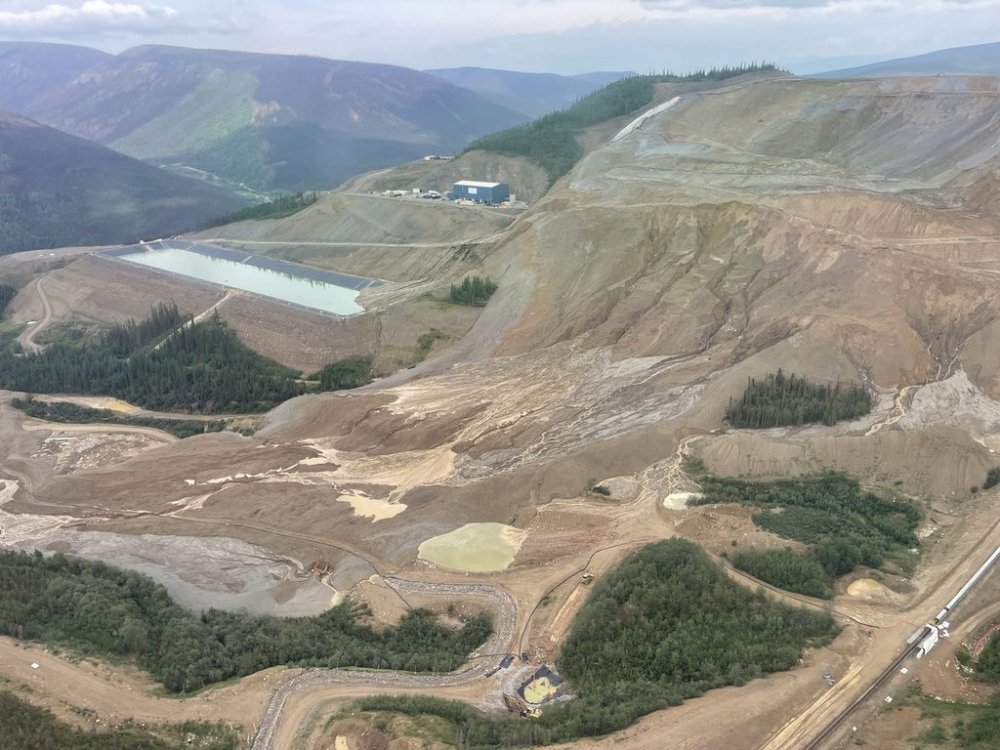
Victoria Gold's Eagle gold mine site north of Mayo, Y.T., is shown in this handout aerial photo taken Wednesday, July 3, 2024. THE CANADIAN PRESS/Handout — Yukon Government (Mandatory Credit)

He told a briefing hosted by the Yukon government on Tuesday that the board found several underlying causes along with a trigger for the disaster.

Those factors included the poor quality of ore, an “over-steepened” slope and a rising water table at the facility, as well as the “impairment” of a gravel layer that was meant to collect and move liquid, Smith explained.

Together they led to the large-scale liquefaction of saturated ore that triggered the massive failure in a matter of 10 seconds, he said. 

“All five of those things had to happen at the same time for this catastrophe to happen. If we only had the first four, and no liquefiable ore, it would have been a failure, but it wouldn’t have been a catastrophe,” he said.

The mine located about 85 kilometres north of Mayo has not operated since the collapse and Victoria Gold was placed in receivership in August 2024.

Smith said the board found irrigation of part of the heap that started in April 2024 was raising the water table and would have caused material to start moving in the weeks prior to the massive slide on June 24.

“Probably around June 1st, there would have been some evidence of distress on that slope. But there are no operators down there,” he said.

“This is not an area where people were going routinely … and there was no instrumentation on the slope. So, they didn’t know this was happening.”

If the irrigation sprinklers had been turned off, “it may have stopped the failure completely,” Smith said.

He said the site that had been operated by Victoria Gold Corp. had “almost no surveillance,” something that is “far too common” in the industry.

“We need better surveillance of these facilities across the board.”

Smith told the briefing he hopes the board’s findings and recommendations will extend beyond the territory, steering the heap-leach industry toward better practices that lower the risks of failures.

Asked if other mining companies had reached out to him after the disaster at the Eagle Gold Mine, Smith said he was receiving calls “as often as daily” in the months that followed. He also hears from regulators, insurance companies and investors asking about the future of heap leaching, he added.

Smith said he is the lead editor on the first-ever guidelines on heap and dump leaching, which are funded by industry and set for publication in 2027.

While there may always be a risk of failure, he said heap-leach facilities should aim to reduce not only the risk but also the consequences of failure.

“Things can go wrong, but they don’t go badly wrong. They don’t become catastrophic failures,” he said.

The heap-leach disaster in Turkey last year resulted in deaths, he noted.

The review board for the Eagle Gold Mine failure makes 50 recommendations in its report released this month, and Smith said none of them would be “particularly expensive” to implement.

“I’m pretty sure that the cost burden that’s now been put on the Yukon taxpayers for the Eagle Gold failure would fund all of our recommendations on every mining project that will ever be proposed in the Yukon,” he said.

“I think cost-wise, it’s nothing in comparison.”

If he had to pick, Smith said his top recommendation would be requiring independent technical review boards for all significant heap-leach projects.

Yukon officials have said the territory is reviewing the board’s report.

This report by The Canadian Press was first published July 8, 2025.
Report Error Submit a Tip

More Stories

High-risk sex offender charged with Osborne Village apartment break-ins

Erik Pindera 3 minute read Preview

High-risk sex offender charged with Osborne Village apartment break-ins

Erik Pindera 3 minute read Yesterday at 2:08 PM CDT

A convicted, high-risk sex offender has been arrested for allegedly breaking into several Osborne Village apartments last month, court records show.

Winnipeg Police Service property crime investigators were alerted to the series of break-ins in September.

Investigators learned that three break-and-enters occurred Sept. 13-14 at apartments on the 200 block of Stradbrook Avenue; a suspect got inside via a window.

In two of the break-ins, police said, the suspect fled after encountering the residents inside their homes. Nothing was stolen and no one was hurt in any of the incidents.

Read
Yesterday at 2:08 PM CDT

Jets top line powers win over Wild

Ken Wiebe 7 minute read Preview

Jets top line powers win over Wild

Ken Wiebe 7 minute read Tuesday, Oct. 13, 2026

Cole Perfetti has made it clear he doesn’t want to get ahead of himself.

The Winnipeg Jets winger has first-hand knowledge on how humbling the NHL can be, coming off a quiet campaign as he worked his way back from a high ankle sprain.

But with the benefit of a full summer of training and a return to health, Perfetti has taken advantage of his promotion to the top line and quickly shown he belongs.

The latest proof came Tuesday, with Perfetti scoring a pair of goals — including the game-winner — in a 5-2 victory over the Minnesota Wild at Canada Life Centre.

Read
Tuesday, Oct. 13, 2026

Police, street groups looking to extend co-ordinated outreach-first approach to drug-use, trafficking crackdown

Chris Kitching 6 minute read Preview

Police, street groups looking to extend co-ordinated outreach-first approach to drug-use, trafficking crackdown

Chris Kitching 6 minute read Tuesday, Oct. 13, 2026

Winnipeg police and street outreach groups are discussing how to extend an initiative that tries to link people with addictions and homelessness services, while targeting open drug use and dealing.

Read
Tuesday, Oct. 13, 2026

Law will curb e-scooter enthusiasts

Editorial 4 minute read Preview

Law will curb e-scooter enthusiasts

Editorial 4 minute read 2:00 AM CDT

For people concerned about safety on Manitoba’s sidewalks and roadways, the province’s announcement that new rules will be introduced next year regarding the use of e-scooters and other personal electric vehicles (PEVs) was no doubt met with an enthusiastic “It’s about time.”

Read
2:00 AM CDT

Yukon disaster one of two ‘most catastrophic’ in heap-leach mining history: expert

Brenna Owen, The Canadian Press 4 minute read Preview

Yukon disaster one of two ‘most catastrophic’ in heap-leach mining history: expert

Brenna Owen, The Canadian Press 4 minute read Tuesday, Jul. 8, 2025

The spill of about two million tonnes of cyanide-soaked ore at a Yukon gold mine was one of the two "most catastrophic failures" in the 45-year history of the heap-leaching mining process, an engineer tasked with reviewing it said.

Mark Smith said the disasters last year, the other occurring in Turkey, would "define the next 10 or 20 years for heap-leach practices," in which minerals are extracted from piles of ore by running liquid chemicals through them.

Smith is a member of the independent review board that examined the disaster at the Eagle Gold Mine in June 2024, when an ore slope failed, leading to the contamination of local groundwater in central Yukon.

He told a briefing hosted by the Yukon government on Tuesday that the board found several underlying causes along with a trigger for the disaster.

Read
Tuesday, Jul. 8, 2025

Convicted harasser accused of targeting old, new victims, including judge

Dean Pritchard 6 minute read Preview

Convicted harasser accused of targeting old, new victims, including judge

Dean Pritchard 6 minute read Yesterday at 5:53 PM CDT

Agnieszka Ciochon-Newton, who was sentenced to six years in prison for mercilessly harassing two people she believed had wronged her, as well as other crimes, wasted no time when her sentence ended to launch fresh attacks on victims new and old, including the judge who convicted her, court documents allege.

The 58-year-old former nurse was arrested last month after Winnipeg police “became aware that (Ciochon-Newton) was engaging in aggressive and harassing behaviours again, starting almost immediately upon the expiry of her parole conditions” on May 13, Det. Sgt Kylie Case wrote in search warrant documents obtained by the Free Press.

Ciochon-Newton is charged with seven counts of criminal harassment, two counts of uttering threats and one count each of fraud, breaking and entering, attempting to obstruct justice, intimidation of a justice official, mischief and defamatory libel. She remains in custody.

Search warrant documents say provincial court Judge Keith Eyrikson learned in late August that Ciochon-Newton had emailed CBC Manitoba days earlier and threatened him.

Read
Yesterday at 5:53 PM CDT