From tech podcasts to policy: Trump’s new AI plan leans heavily on Silicon Valley industry ideas
Advertisement
Read this article for free:
or
Already have an account? Log in here »
To continue reading, please subscribe:

Digital Subscription
One year of digital access for only $205*
- Enjoy unlimited reading on winnipegfreepress.com
- Read the E-Edition, our digital replica newspaper
- Access News Break, our award-winning app
- Play interactive puzzles
*First annual payment billed as $205.00 + GST for one year. This annual subscription will automatically renew at $233.00 + GST every 52 weeks (10% off the regular annual price of $259.35). Offer available to new and qualified returning subscribers only. Cancel any time.
To continue reading, please subscribe:
Add Free Press access to your Brandon Sun subscription for only an additional
$1 for the first 4 weeks*
- Enjoy unlimited reading on winnipegfreepress.com
- Read the E-Edition, our digital replica newspaper
- Access News Break, our award-winning app
- Play interactive puzzles
*Your next Brandon Sun subscription payment will increase by $1.00 and you will be charged $17.95 plus GST for four weeks. After four weeks, your payment will increase to $24.95 plus GST every four weeks.
Read unlimited articles for free today:
or
Already have an account? Log in here »
Hey there, time traveller!
This article was published 22/07/2025 (435 days ago), so information in it may no longer be current.
WASHINGTON (AP) — President Donald Trump on Wednesday unveiled a sweeping new plan for America’s “global dominance” in artificial intelligence, proposing to cut back environmental regulations to speed up the construction of AI supercomputers while promoting the sale of U.S.-made AI technologies at home and abroad.
The “AI Action Plan” embraces many of the ideas voiced by tech industry lobbyists and the Silicon Valley investors who backed Trump’s election campaign last year.
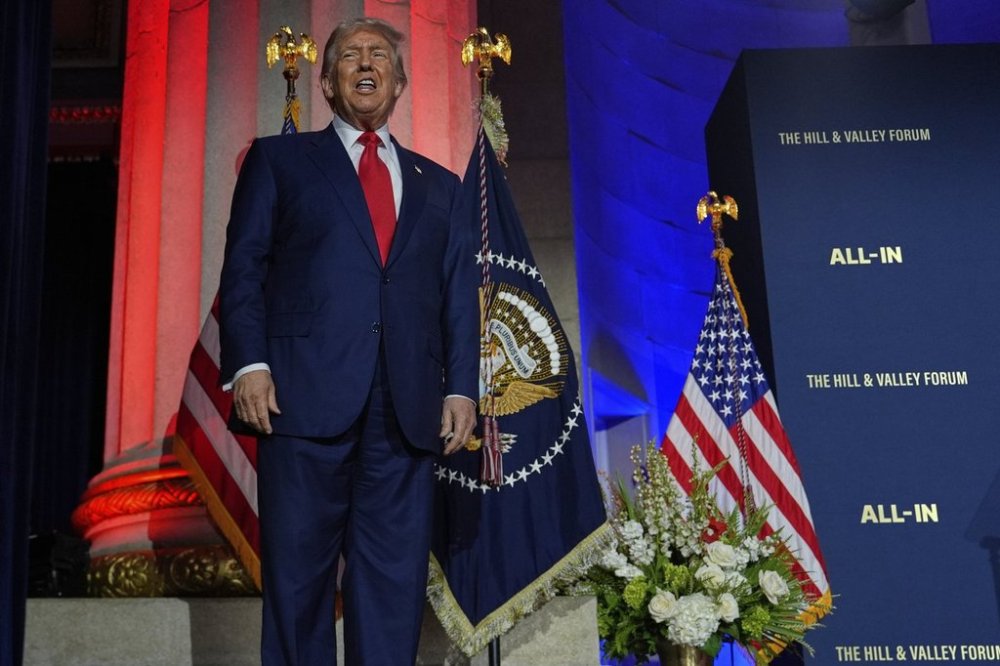
“America must once again be a country where innovators are rewarded with a green light, not strangled with red tape,” Trump said at an unveiling event that was co-hosted by the bipartisan Hill and Valley Forum and the “All-In” podcast, a business and technology show hosted by four tech investors and entrepreneurs, which includes Trump’s AI czar, David Sacks.
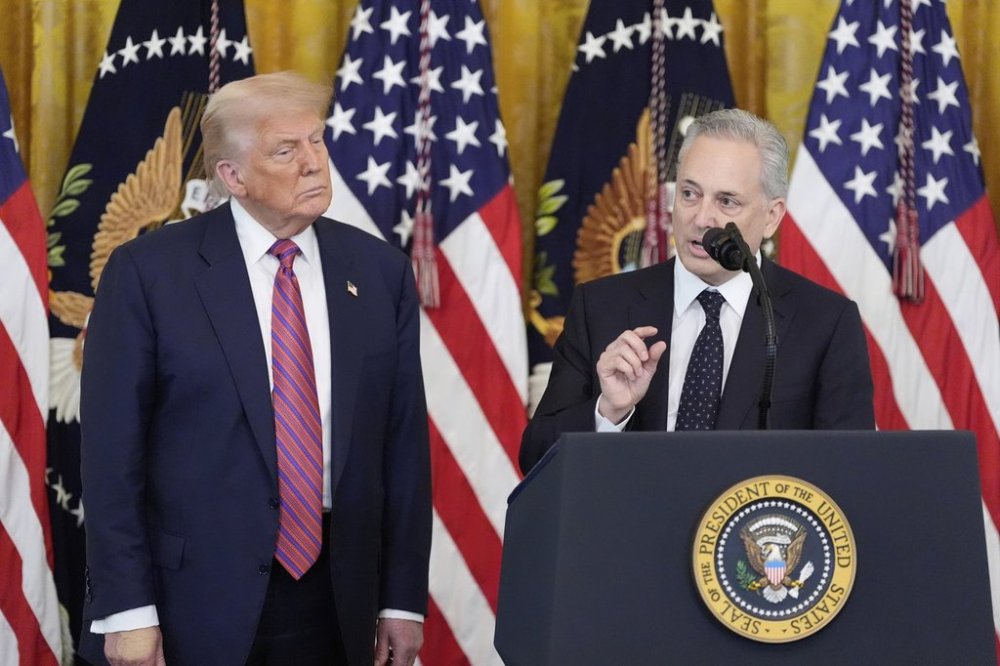
The plan includes some familiar tech lobby pitches. That includes accelerating the sale of AI technology abroad and making it easier to construct the energy-hungry data center buildings that are needed to form and run AI products. It also includes some AI culture war preoccupations of the circle of venture capitalists who endorsed Trump last year.
Trump signed three executive orders Wednesday to deliver on the plan. They seek to fast-track permitting of AI construction projects, expand U.S. tech exports and get rid of “woke” in AI.
Trump had given his tech advisers six months to come up with new AI policies after revoking President Joe Biden’s signature AI guardrails on his first day in office.
Trump’s AI plan: global dominance, cutting regulations
The plan prioritizes AI innovation and adoption, urging the removal of any barriers that could slow down adoption across industries and government. The nation’s policy, Trump said, will be to do “whatever it takes to lead the world in artificial intelligence.”
Yet it also seeks to guide the industry’s growth to address a longtime rallying point for the tech industry’s loudest Trump backers: countering the liberal bias they see in AI chatbots such as ChatGPT or Google’s Gemini.
Trump’s plan aims to block the government from contracting with tech companies unless they “ensure that their systems are objective and free from top-down ideological bias.” The plan says the nation’s leading AI models should protect free speech and be “founded on American values,” though it doesn’t define which values those should include.
Sacks, a former PayPal executive and now Trump’s top AI adviser, has been criticizing “woke AI” for more than a year, fueled by Google’s February 2024 rollout of an AI image generator. When asked to show an American Founding Father, it created pictures of Black, Asian, and Native American men.
Google quickly fixed its tool, but the “Black George Washington” moment remained a parable for the problem of AI’s perceived political bias, taken up by X owner Elon Musk, venture capitalist Marc Andreessen, Vice President JD Vance and Republican lawmakers.
Streamlining AI data center permits to speed up supercomputer construction
Chief among the plan’s goals is to speed up permitting and loosen environmental regulation to accelerate construction on new data centers and factories. It condemns “radical climate dogma” and recommends lifting environmental restrictions, including clean air and water laws.
Trump has previously paired AI’s need for huge amounts of electricity with his own push to tap into U.S. energy sources, including gas, coal and nuclear.
“We will be adding at least as much electric capacity as China,” Trump said at the Wednesday event. “Every company will be given the right to build their own power plant.”
Many tech giants are already well on their way toward building new data centers in the U.S. and around the world. OpenAI announced this week that it has switched on the first phase of a massive data center complex in Abilene, Texas, part of an Oracle-backed project known as Stargate that Trump promoted earlier this year. Amazon, Microsoft, Meta and xAI also have major projects underway.
The tech industry has pushed for easier permitting rules to get its computing facilities connected to power, but the AI building boom has also contributed to spiking demand for fossil fuel production, which contributes to global warming.
United Nations Secretary-General Antonio Guterres on Tuesday called on the world’s major tech firms to power data centers completely with renewables by 2030.
The plan includes a strategy to disincentivize states from aggressively regulating AI technology, calling on federal agencies not to provide funding to states with burdensome regulations.
“We need one common sense federal standard that supersedes all states, supersedes everybody,” Trump said, “so you don’t end up in litigation with 43 states at one time.”
Who benefits from Trump’s AI action plan?
There are sharp debates on how to regulate AI, even among the influential venture capitalists who have been debating it on their favorite medium: the podcast.
While some Trump backers, particularly Andreessen, have advocated an “accelerationist” approach that aims to speed up AI advancement with minimal regulation, Sacks has described himself as taking a middle road of techno-realism.

“Technology is going to happen. Trying to stop it is like ordering the tides to stop. If we don’t do it, somebody else will,” Sacks said on the “All-In” podcast.
On Tuesday, more than 100 groups, including labor unions, parent groups, environmental justice organizations and privacy advocates, signed a resolution opposing Trump’s embrace of industry-driven AI policy and calling for a “People’s AI Action Plan” that would “deliver first and foremost for the American people.”
J.B. Branch, Big Tech accountability advocate at the watchdog group Public Citizen, which signed the resolution, called the plan a “sellout.”
“Under this plan, tech giants get sweetheart deals while everyday Americans will see their electricity bills rise to subsidize discounted power for massive AI data centers,” Branch said in a statement Wednesday. “Americans deserve an AI future rooted in safety, fairness, and accountability — not a handout to billionaires.”
___