Russian lawmakers pass a bill punishing online searches for information deemed to be ‘extremist’

Advertisement

Advertise with us

MOSCOW (AP) — Russian lawmakers on Tuesday approved a bill that punishes online searches for information that is deemed “extremist,” the latest move by government authorities in their relentless crackdown on dissent.

Read this article for free:


or

Already have an account? Log in here »

To continue reading, please subscribe:

Subscribe and receive a limited-edition Free Press branded hat or tote.

Digital Subscription

One year of digital access for only $205*

  • Enjoy unlimited reading on winnipegfreepress.com
  • Read the E-Edition, our digital replica newspaper
  • Access News Break, our award-winning app
  • Play interactive puzzles

*First annual payment billed as $205.00 + GST for one year. This annual subscription will automatically renew at $233.00 + GST every 52 weeks (10% off the regular annual price of $259.35). Offer available to new and qualified returning subscribers only. Cancel any time.

To continue reading, please subscribe:

Add Free Press access to your Brandon Sun subscription for only an additional

$1 for the first 4 weeks*

  • Enjoy unlimited reading on winnipegfreepress.com
  • Read the E-Edition, our digital replica newspaper
  • Access News Break, our award-winning app
  • Play interactive puzzles
Start now

*Your next Brandon Sun subscription payment will increase by $1.00 and you will be charged $17.95 plus GST for four weeks. After four weeks, your payment will increase to $24.95 plus GST every four weeks.

Hey there, time traveller!
This article was published 22/07/2025 (438 days ago), so information in it may no longer be current.

MOSCOW (AP) — Russian lawmakers on Tuesday approved a bill that punishes online searches for information that is deemed “extremist,” the latest move by government authorities in their relentless crackdown on dissent.

The bill passed by the lower house, the State Duma, moves to its all-but-certain endorsement in the upper house and then goes to President Vladimir Putin to be signed into law.

The legislation punishes what it describes as “deliberately searching for and accessing extremist materials” online. First-time offenders face a fine of up to the equivalent of $64.
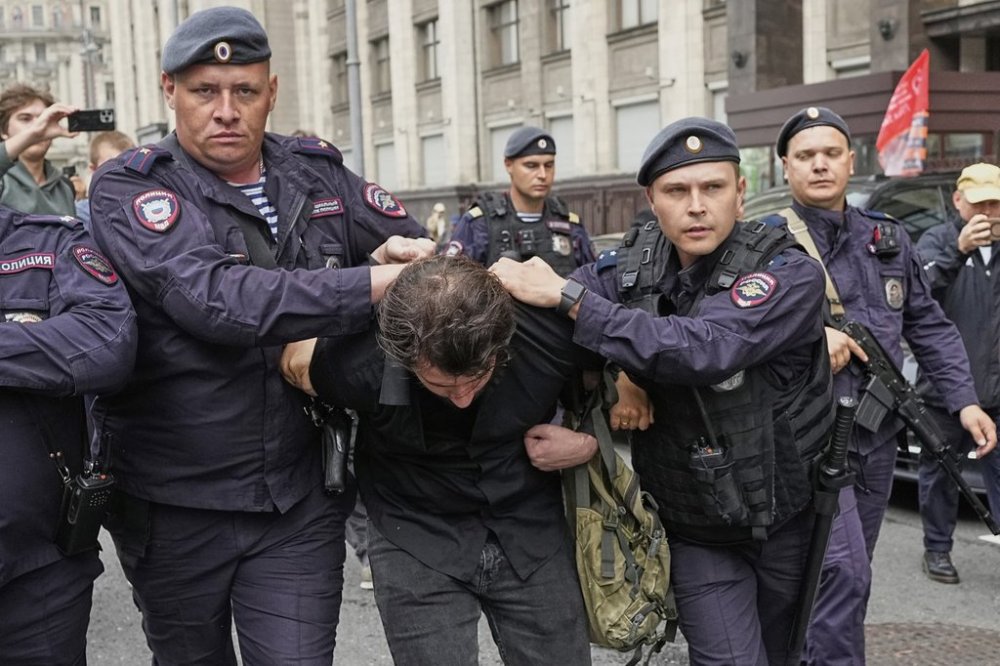
Police detain an activist during a picket against internet limitations in front of The State Duma, the lower house of the Russian Parliament, prior to consider the third and final reading of a bill, criminalising the search of
Police detain an activist during a picket against internet limitations in front of The State Duma, the lower house of the Russian Parliament, prior to consider the third and final reading of a bill, criminalising the search of "extremist materials" in Moscow, Russia, Tuesday, July 22, 2025. (AP Photo)

The official definition of extremist activity is extremely broad and includes opposition groups like the Anti-Corruption Foundation, created by the late opposition leader Alexei Navalny, and the “international LGBT movement.”

It’s not clear how authorities will track down violators. Officials and lawmakers said ordinary internet users won’t be affected and only those who methodically seek outlawed content will be targeted. They didn’t explain how the authorities would differentiate between them.

Some observers have suggested the information would likely come from internet providers or social media platforms, and police also could randomly check the search history of cellphones or computers.

The new legislation also contained a ban on advertising of virtual private network services and fines for VPN resources that fail to comply with government regulations, but stopped short of banning their use. It did list the use of a VPN as an “aggravating circumstance” in case of other violations of the law.

Russians widely use VPN services for access to banned content, but authorities have sought to tighten restrictions, trying to close the loopholes. The state communications watchdog has increasingly used technology to analyze traffic and block specific VPN protocols.

The Russian authorities have ramped their multipronged crackdown on dissent after sending troops into Ukraine in February 2022.

Since then, online censorship and prosecutions for social media posts and comments have soared. Multiple independent news outlets and rights groups have been shut down, labeled as “foreign agents” or outlawed as “undesirable.” Hundreds of activists and critics of the Kremlin have faced criminal charges.

The new legislation has sparked broad public criticism. The Duma, which unanimously supports most government initiatives, was markedly divided in Tuesday’s vote, with 306 backing the measure, 67 voting against it and 22 abstaining. Among those who opposed the bill were some members of the Communist Party, Just Russia and the liberal New People party who usually follow the Kremlin’s wishes.

Liberal politician Boris Nadezhdin, who sought to challenge Putin in last year’s presidential election but was denied a spot on the ballot, told reporters outside the State Duma that he opposed the new legislation. “It creates real problems for tens of millions of people,” he said.

Nadezhdin’s aide, Dmitry Kisiev, who picketed the parliament building with a poster likening the legislation to the world of George Orwell’s dystopian “1984,” was quickly rounded up by police, who also detained several reporters covering the protest.

Even some pro-Kremlin figures have criticized the bill, arguing it would make it impossible for them to track down and deflect comments by Kremlin critics.

Margarita Simonyan, head of the state-funded RT channel, has spoken against the legislation, questioning how her media group could “investigate and bring to shame” anti-Kremlin outlets “if we are forbidden to even read them.”

And Yekaterina Mizulina, whose group Safe Internet League has frequently reported dissenters to authorities, also strongly condemned the new bill, arguing it would make it impossible for her group to monitor “extremist communities” on the web.
Report Error Submit a Tip

More Stories

J’accuse!: Kinew uses French to fry interim Tory leader over alleged caucus subterfuge

Chris Kitching and Maggie Macintosh 4 minute read Preview

J’accuse!: Kinew uses French to fry interim Tory leader over alleged caucus subterfuge

Chris Kitching and Maggie Macintosh 4 minute read Yesterday at 5:55 PM CDT

NDP Premier Wab Kinew took a dig at the Progressive Conservatives’ leadership change while facing off with Obby Khan’s short-term replacement for the first time in question period Thursday.

Read
Yesterday at 5:55 PM CDT

U of W Collegiate students thank residential school survivors with the lessons they’ve learned

Maggie Macintosh 6 minute read Preview

U of W Collegiate students thank residential school survivors with the lessons they’ve learned

Maggie Macintosh 6 minute read 6:49 PM CDT

It’s become a back-to-school tradition for teachers to invite Indigenous elders to their classrooms to share first-hand accounts about the ongoing impacts of Canada’s residential school system.

This fall, the University of Winnipeg Collegiate was among the schools that sent an invitation — but its purpose wasn’t to educate students about the system’s horrors.

“Truth and Reconciliation week is so emotional and draining for residential school survivors,” said Christine M’Lot, a longtime instructor of the school’s Grade 9 truth and reconciliation course.

“I wanted to do something a little bit different and offer a thank you.”

Read
6:49 PM CDT

From the starting gate to the home stretch: Here’s to you, Bud

GEORGE WILLIAMS 5 minute read Preview

From the starting gate to the home stretch: Here’s to you, Bud

GEORGE WILLIAMS 5 minute read 10:00 PM CDT

No more horsey dreams. My Dad died last Sunday. He was 89.

He was sitting on the steps at the front door tying his shoes, waiting for the neighbour to pick him up for church, when he just slumped over. The neighbour tried CPR. The paramedics arrived and did what they could.

But he was gone.

He wasn’t in the best of health, but he was still sharp mentally and he could get around the house with a walker. And lately our conversations had become much more animated, especially when it came to his new horse. After decades of not owning a racehorse, he had a new two-year-old at Woodbine.

Read
10:00 PM CDT

Influx of young talent gives Jets a noticeable boost

Ken Wiebe and Mike McIntyre 8 minute read Preview

Influx of young talent gives Jets a noticeable boost

Ken Wiebe and Mike McIntyre 8 minute read 5:55 PM CDT

A weekly lap around the NHL by Free Press hockey writers Ken Wiebe and Mike McIntyre

The paths couldn’t have been more different, even if the destination ended up being the same.

Viggo Bjorck is the can’t-miss prospect — a Top-10 pick with a clear path to The Show. Though it’s evident he hasn’t taken a single step in this process for granted.

Tyrel Bauer is the rough-and-tumble long shot, a sixth-round pick whose uphill battle to graduate to the highest level has featured a ton of scar tissue, both literally and metaphorically.

Read
5:55 PM CDT

Health minister warns $1.2 billion in annual federal funding set to expire in March

Scott Billeck 4 minute read Preview

Health minister warns $1.2 billion in annual federal funding set to expire in March

Scott Billeck 4 minute read Yesterday at 6:58 PM CDT

Manitoba’s health minister is warning of possible cuts to health care with $1.2 billion in annual funding from Ottawa set to expire next year.

“We’re very concerned that what would be the largest cut to health care in a generation is right in front of us,” Health Minister Uzoma Asagwara said Thursday at the Manitoba legislature. “It means that services that Manitobans depend on will be in jeopardy and be at risk.

“Any reductions, any cuts from Canada, will have direct impacts on the health outcomes of Manitobans.”

Asagwara, who serves as the provincial and territorial health minister lead, chaired a virtual meeting Tuesday with provincial and territorial health ministers to discuss federal funding for health care, mental health care and substance use services, which is scheduled to expire March 31, 2027.

Read
Yesterday at 6:58 PM CDT

Retired guidance counsellor defends explicit 2025 sex-ed presentation to high school football team in disciplinary hearing

Maggie Macintosh 7 minute read Preview

Retired guidance counsellor defends explicit 2025 sex-ed presentation to high school football team in disciplinary hearing

Maggie Macintosh 7 minute read Updated: 12:26 PM CDT

Gus Watanabe, a former employee of Oak Park High School in Winnipeg, was the subject of a public disciplinary hearing on Thursday.

Read
Updated: 12:26 PM CDT