Hubble Space Telescope takes best picture yet of the comet visiting from another solar system
Advertisement
Read this article for free:
or
Already have an account? Log in here »
To continue reading, please subscribe:

Digital Subscription
One year of digital access for only $205*
- Enjoy unlimited reading on winnipegfreepress.com
- Read the E-Edition, our digital replica newspaper
- Access News Break, our award-winning app
- Play interactive puzzles
*First annual payment billed as $205.00 + GST for one year. This annual subscription will automatically renew at $233.00 + GST every 52 weeks (10% off the regular annual price of $259.35). Offer available to new and qualified returning subscribers only. Cancel any time.
To continue reading, please subscribe:
Add Free Press access to your Brandon Sun subscription for only an additional
$1 for the first 4 weeks*
- Enjoy unlimited reading on winnipegfreepress.com
- Read the E-Edition, our digital replica newspaper
- Access News Break, our award-winning app
- Play interactive puzzles
*Your next Brandon Sun subscription payment will increase by $1.00 and you will be charged $17.95 plus GST for four weeks. After four weeks, your payment will increase to $24.95 plus GST every four weeks.
Read unlimited articles for free today:
or
Already have an account? Log in here »
Hey there, time traveller!
This article was published 07/08/2025 (406 days ago), so information in it may no longer be current.
CAPE CANAVERAL, Fla. (AP) — The Hubble Space Telescope has captured the best picture yet of a high-speed comet visiting our solar system from another star.
NASA and the European Space Agency released the latest photos Thursday.
Discovered last month by a telescope in Chile, the comet known as 3I-Atlas is only the third known interstellar object to pass our way and poses no threat to Earth.
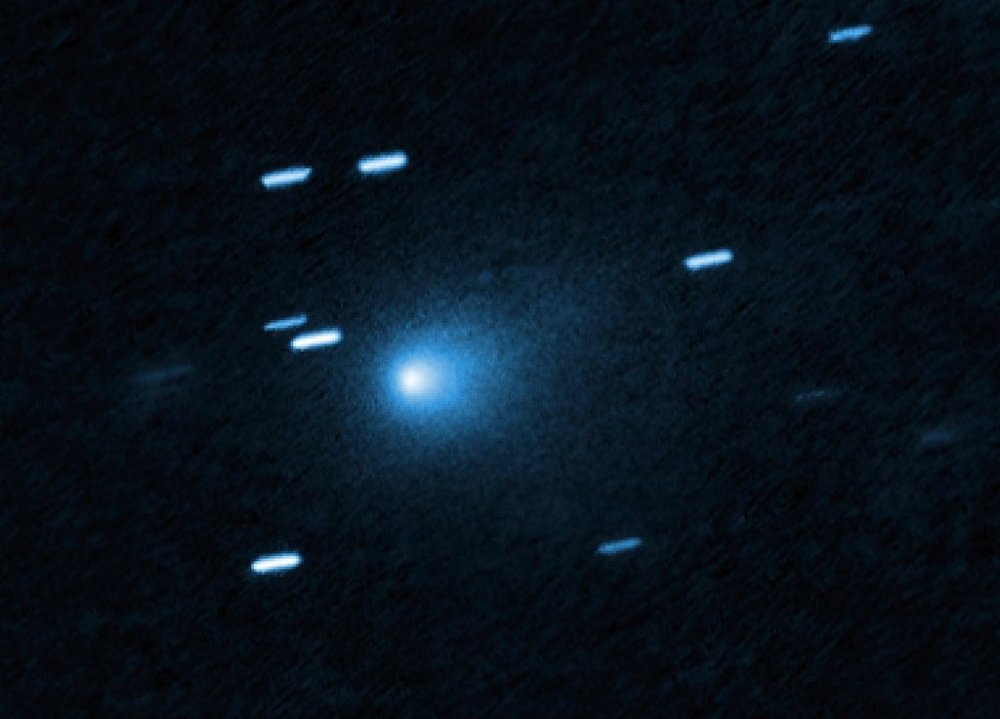
Astronomers originally estimated the size of its icy core at several miles (tens of kilometers) across, but Hubble’s observations have narrowed it down to no more than 3.5 miles (5.6 kilometers). It could even be as small as 1,000 feet (320 meters), according to scientists.
The comet is hurtling our way at 130,000 mph (209,000 kph), but will veer closer to Mars than Earth, keeping a safe distance from both. It was 277 million miles (446 million kilometers) away when photographed by Hubble a couple weeks ago. The orbiting telescope revealed a teardrop-shaped plume of dust around the nucleus as well as traces of a dusty tail.
___
The Associated Press Health and Science Department receives support from the Howard Hughes Medical Institute’s Department of Science Education and the Robert Wood Johnson Foundation. The AP is solely responsible for all content.