Scientists get a rare peek inside of an exploding star

Advertisement

Advertise with us

NEW YORK (AP) — Scientists for the first time have spotted the insides of a dying star as it exploded, offering a rare peek into stellar evolution.

Read this article for free:


or

Already have an account? Log in here »

To continue reading, please subscribe:

Subscribe and receive a limited-edition Free Press branded hat or tote.

Digital Subscription

One year of digital access for only $205*

  • Enjoy unlimited reading on winnipegfreepress.com
  • Read the E-Edition, our digital replica newspaper
  • Access News Break, our award-winning app
  • Play interactive puzzles

*First annual payment billed as $205.00 + GST for one year. This annual subscription will automatically renew at $233.00 + GST every 52 weeks (10% off the regular annual price of $259.35). Offer available to new and qualified returning subscribers only. Cancel any time.

To continue reading, please subscribe:

Add Free Press access to your Brandon Sun subscription for only an additional

$1 for the first 4 weeks*

  • Enjoy unlimited reading on winnipegfreepress.com
  • Read the E-Edition, our digital replica newspaper
  • Access News Break, our award-winning app
  • Play interactive puzzles
Start now

*Your next Brandon Sun subscription payment will increase by $1.00 and you will be charged $17.95 plus GST for four weeks. After four weeks, your payment will increase to $24.95 plus GST every four weeks.

Hey there, time traveller!
This article was published 20/08/2025 (359 days ago), so information in it may no longer be current.

NEW YORK (AP) — Scientists for the first time have spotted the insides of a dying star as it exploded, offering a rare peek into stellar evolution.

Stars can live for millions to trillions of years until they run out of fuel. The most massive ones go out with a bang in an explosion called a supernova.

Using telescopes that peer deep into space, researchers have observed many such explosions. The cosmic outbursts tend to jumble up a dying star’s layers, making it hard for scientists to observe the inner structure.

This illustration provided by W.M. Keck Observatory depicts the insides of an exploding star. (Adam Makarenko/W. M. Keck Observatory via AP)

But that wasn’t the case for the new discovery, a supernova called 2021yfj located more than 2 billion light years from Earth.

The collapsing star’s outermost layers of hydrogen and helium had peeled away long ago, which wasn’t surprising. But the star’s dense, innermost layers of silicon and sulfur had also shed during the explosion.

“We have never observed a star that was stripped to this amount,” said Northwestern University’s Steve Schulze, who was part of the discovery team that published the research Wednesday in the journal Nature.

The finding lends evidence to ideas scientists have about how large stars look near the end of their lives, organized into layers with lighter elements on the outside and heavier ones close to the core.

“Because so many of the layers had been stripped off this star, this basically confirmed what those layers were,” said Anya Nugent, who studies supernovas at the Harvard-Smithsonian Center for Astrophysics. She was not involved with the new research.

It’s not yet clear how this star got so whittled down — whether its layers were flung off violently in the final stages of its life or yanked away by a twin star. Future research may yield clues, though scientists acknowledged such an event may be tough to capture again.

___

The Associated Press Health and Science Department receives support from the Howard Hughes Medical Institute’s Department of Science Education and the Robert Wood Johnson Foundation. The AP is solely responsible for all content.

___

This story was first published on Aug. 20, 2025. It was updated on Aug. 26, 2025, to correct that the supernova is not in the Milky Way.
Report Error Submit a Tip

More Stories

Inman launching new album at WECC

Ben Waldman 5 minute read Preview

Inman launching new album at WECC

Ben Waldman 5 minute read 2:01 AM CDT

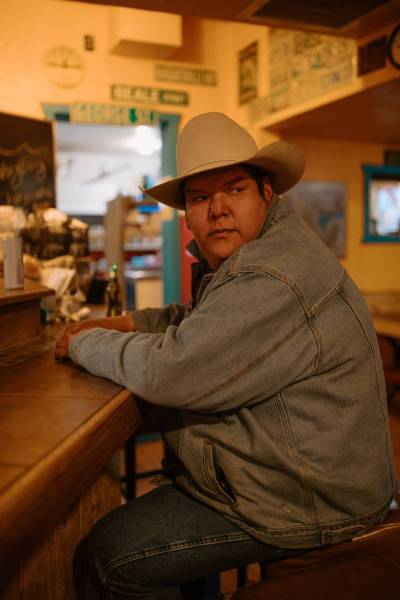
Give Richard Inman a moment and a surface, and he’ll cover it with a story.

“I’ve scribbled down lyrics on paper plates, McDonald’s bags — whatever you got,” says Inman, who grew up in southern Manitoba but now lives in a three-bedroom ranch house near Twin Butte, Alta., so close to the American border that he says he can spit into Montana from his backyard.

“The other day I had a line in my head for seven hours before I wrote it down,” says the songwriter, who managed to remember the phrasing after driving home from a music festival in Idaho. “That certainly was lucky.”

Though Inman, 35, first starting sharing his Americana concoctions with crowds at Winnipeg’s Times Change(d) High & Lonesome Club in the late 2000s, learning how to play his compositions with his band, the Mad Trappers, he has spent the bulk of the past decade out west, splitting time between the stage and the sale barn.

Read
2:01 AM CDT

It’s one thing to climb aboard rail-relocation train, quite another to pay for the ride

Dan Lett 5 minute read Preview

It’s one thing to climb aboard rail-relocation train, quite another to pay for the ride

Dan Lett 5 minute read Wednesday, Aug. 12, 2026

Anyone who wants a brighter, safer, healthier future for the city of Winnipeg should really want the renewed hopes of rail relocation to finally become reality. And the sooner, the better.

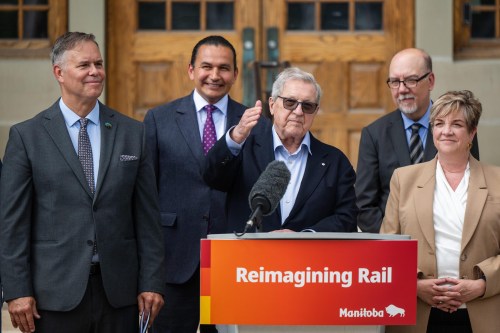
Premier Wab Kinew announced Wednesday the province was going to forge a plan to relocate the Canadian Pacific Kansas City central yards and many of other the lines that run through Winnipeg to a bypass that runs around the city.

This “plan to design a plan” strategy was devised by a task force headed up by former federal MP and cabinet minister Lloyd Axworthy, who in 2024 was given a two-year mandate to find the best way to rid the city of some or all of its rail infrastructure.

For the record, Kinew and Axworthy said a relocation would likely take 20 years to complete, which makes this week’s announcement an important statement of intent, but little more. The sobering reality is that this promising idea has been proposed by political leaders, and then abandoned, for decades.

Read
Wednesday, Aug. 12, 2026

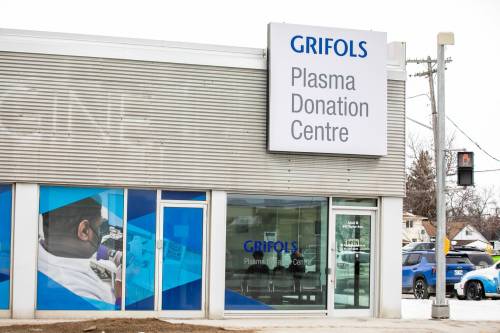
Plasma clinic pauses operations in Canada amid ‘unfounded attention’

Morgan Modjeski 4 minute read Preview

Plasma clinic pauses operations in Canada amid ‘unfounded attention’

Morgan Modjeski 4 minute read Updated: Yesterday at 7:24 PM CDT

A plasma collection company is pausing operations in Canada due to “unfounded attention” after two people died following donations at Winnipeg clinics.

Read
Updated: Yesterday at 7:24 PM CDT

Europe anxious as ever about immigration

Kyle Volpi Hiebert 5 minute read 2:00 AM CDT

It was only a matter of time before immigration would again panic Europe. The issue has roiled the continent’s politics ever since its 2015 migrant crisis, when 1.3 million unauthorized migrants crossed its borders that summer. They exposed a broken immigration system in the process, triggering a populist backlash that hasn’t dimmed.

All those same tensions were reignited in late July, when 72,000 migrants converged on the Spanish exclave of Ceuta in just 24 hours. The city — a holdover from Spain’s colonial era — is Europe’s only land border with Africa, nestled next to Morocco. It was almost instantly overrun.

Dozens of people died in the chaos, while the reasons for the sudden influx remain unknown. However, virtually all the arrivals were sent back to Morocco almost immediately; some spent a few days in makeshift holding centres. None were recorded as finding their way to mainland Europe.

Still, the episode inflamed divisions in a region caught in existential limbo. Ultranationalist political parties are ascendant — yet low birth rates and stagnant productivity mean Europe’s future largely hinges on accepting more newcomers.

A message to Mark: Don’t. Back. Down.

Judy Waytiuk 5 minute read Preview

A message to Mark: Don’t. Back. Down.

Judy Waytiuk 5 minute read 2:00 AM CDT

When is a leak really a trial balloon? While Mark Carney currently enjoys huge favourability in Canada, there are nine federal byelections pending. If he stumbles on his pledge of “Elbows up’ against the U.S., votes could go against the Liberals; millions of Canadians have utterly lost patience with Trump’s madness — and with Carney appearing to pander to it.

Now we lift the booze bans? Meddle with our supply management dairy system? So say “sources” in the Carney camp. But journalists can be manipulated — a galling truth. Set up a leak from a couple of sources. Two is standard; what’s often forgotten is that those sources, especially if the story’s a hot one, should be verifiably unconnected.

If a story is really hot, more sources must be scraped up, but the temptation to run with it regardless of that is enormous. Many a drool-worthy story I ran across in my early days at the Free Press and later at CBC TV news was spiked because those standards could not be met. These days, it’s almost impossible to meet that bar. Everybody’s connected.

Well, appeasement doesn’t work; we all know it. We dropped the digital services tax. That achieved nothing. American trade envoy Jameson Greer noted we don’t get credit for lifting something Trump resented from the get-go. The digital giants who imposed news-sharing bans on Canada in retaliation for the tax did not lift those bans. We still can’t share news links on Meta platforms in Canada, and we have not a penny in digital tax to show for it.

Read
2:00 AM CDT

Moving rail lines outside city would make Winnipeg ‘major transportation hub’

Carol Sanders 6 minute read Preview

Moving rail lines outside city would make Winnipeg ‘major transportation hub’

Carol Sanders 6 minute read Wednesday, Aug. 12, 2026

After decades of calls to move rail traffic to the outskirts of Winnipeg, a plan that would benefit residents, railways and taxpayers is now on track, says the former Winnipegger leading the way.

A rail line bypass south of the city, using Crown-owned land and the Manitoba Hydro corridor, would take 20 years to complete, remove 120 railway crossings that are a safety risk and free up about 250 acres of Winnipeg land over time for development, Lloyd Axworthy said Wednesday.

“The visions that we have have to be implemented,” Axworthy said at a news conference announcing the launch of a 90-day feasibility study to move freight rail traffic out of Winnipeg’s urban core along Manitoba Hydro’s southern transmission corridor, connecting east to west along the Perimeter Highway.

The former federal transport minister and Manitoba MP was tasked by Premier Wab Kinew in October 2024 to lead a two-year rail relocation feasibility study.

Read
Wednesday, Aug. 12, 2026