Students face new cellphone restrictions in 17 states as school year begins
Advertisement
Read this article for free:
or
Already have an account? Log in here »
To continue reading, please subscribe:

Digital Subscription
One year of digital access for only $205*
- Enjoy unlimited reading on winnipegfreepress.com
- Read the E-Edition, our digital replica newspaper
- Access News Break, our award-winning app
- Play interactive puzzles
*First annual payment billed as $205.00 + GST for one year. This annual subscription will automatically renew at $233.00 + GST every 52 weeks (10% off the regular annual price of $259.35). Offer available to new and qualified returning subscribers only. Cancel any time.
To continue reading, please subscribe:
Add Free Press access to your Brandon Sun subscription for only an additional
$1 for the first 4 weeks*
- Enjoy unlimited reading on winnipegfreepress.com
- Read the E-Edition, our digital replica newspaper
- Access News Break, our award-winning app
- Play interactive puzzles
*Your next Brandon Sun subscription payment will increase by $1.00 and you will be charged $17.95 plus GST for four weeks. After four weeks, your payment will increase to $24.95 plus GST every four weeks.
Read unlimited articles for free today:
or
Already have an account? Log in here »
Hey there, time traveller!
This article was published 20/08/2025 (406 days ago), so information in it may no longer be current.
Jamel Bishop is seeing a big change in his classrooms as he begins his senior year at Doss High School in Louisville, Kentucky, where cellphones are now banned during instructional time.
In previous years, students often weren’t paying attention and wasted class time by repeating questions, the teenager said. Now, teachers can provide “more one-on-one time for the students who actually need it.”
Kentucky is one of 17 states and the District of Columbia starting this school year with new restrictions, bringing the total to 35 states with laws or rules limiting phones and other electronic devices in school. This change has come remarkably quickly: Florida became the first state to pass such a law in 2023.
Both Democrats and Republicans have taken up the cause, reflecting a growing consensus that phones are bad for kids’ mental health and take their focus away from learning, even as some researchers say the issue is less clear-cut.
“Anytime you have a bill that’s passed in California and Florida, you know you’re probably onto something that’s pretty popular,” Georgia state Rep. Scott Hilton, a Republican, told a forum on cellphone use last week in Atlanta.
Phones are banned throughout the school day in 18 of the states and the District of Columbia, although Georgia and Florida impose such “bell-to-bell” bans only from kindergarten through eighth grade. Another seven states ban them during class time, but not between classes or during lunch. Still others, particularly those with traditions of local school control, mandate only a cellphone policy, believing districts will take the hint and sharply restrict phone access.
Students see pros and cons
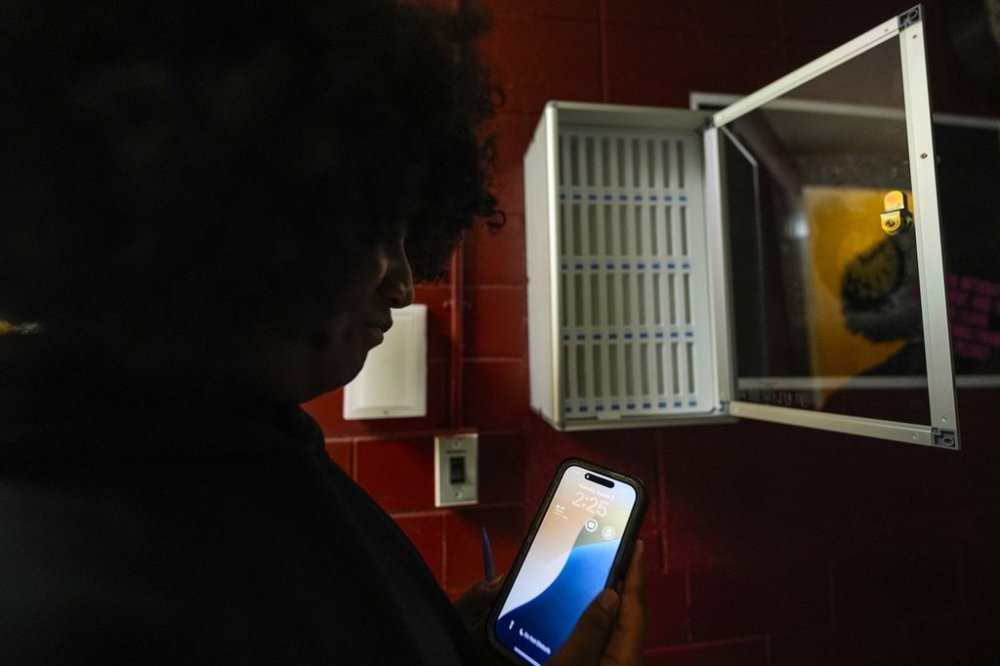
For students, the rules add new school-day rituals, like putting phones in magnetic pouches or special lockers.
Students have been locking up their phones during class at McNair High School in suburban Atlanta since last year. Audreanna Johnson, a junior, said “most of them did not want to turn in their phones” at first, because students would use them to gossip, texting “their other friends in other classes to see what’s the tea and what’s going on around the building.”
That resentment is “starting to ease down” now, she said. “More students are willing to give up their phones and not get distracted.”
But there are drawbacks — like not being able to listen to music when working independently in class. “I’m kind of 50-50 on the situation because me, I use headphones to do my schoolwork. I listen to music to help focus,” she said.
Some parents want constant contact
In a survey of 125 Georgia school districts by Emory University researchers, parental resistance was cited as the top obstacle to regulating student use of social and digital media.
Johnson’s mother, Audrena Johnson, said she worries most about knowing her children are safe from violence at school. School messages about threats can be delayed and incomplete, she said, like when someone who wasn’t a McNair student got into a fight on school property, which she learned about when her daughter texted her during the school day.
“My child having her phone is very important to me, because if something were to happen, I know instantly,” Johnson said.
Many parents echo this — generally supporting restrictions but wanting a say in the policymaking and better communication, particularly about safety — and they have a real need to coordinate schedules with their children and to know about any problems their children may encounter, said Jason Allen, the national director of partnerships for the National Parents Union.
“We just changed the cellphone policy, but aren’t meeting the parents’ needs in regards to safety and really training teachers to work with students on social emotional development,” Allen said.
Research remains in an early stage
Some researchers say it’s not yet clear what types of social media may cause harm, and whether restrictions have benefits, but teachers “love the policy,” according to Julie Gazmararian, a professor of public health at Emory University who does surveys and focus groups to research the effects of a phone ban in middle school grades in the Marietta school district near Atlanta.
“They could focus more on teaching,” Gazmararian said. “There were just not the disruptions.”
Another benefit: More positive interactions among students. “They were saying that kids are talking to each other in the hallways and in the cafeteria,” she said. “And in the classroom, there is a noticeably lower amount of discipline referrals.”
Gazmararian is still compiling numbers on grades and discipline, and cautioned that her work may not be able to answer whether bullying has been reduced or mental health improved.
Social media use clearly correlates with poor mental health, but research can’t yet prove it causes it, according to Munmun De Choudhury, a Georgia Tech professor who studies this issue.
“We need to be able to quantify what types of social media use are causing harm, what types of social media use can be beneficial,” De Choudhury said.
A few states reject rules
Some state legislatures are bucking the momentum.
Wyoming’s Senate in January rejected requiring districts to create some kind of a cellphone policy after opponents argued that teachers and parents need to be responsible.
And in the Michigan House in July, a Republican-sponsored bill directing schools to ban phones bell-to-bell in grades K-8 and during high school instruction time was defeated in July after Democrats insisted on upholding local control. Democratic Gov. Gretchen Whitmer, among multiple governors who made restricting phones in schools a priority this year, is still calling for a bill to come to her desk.
___
Associated Press writers Isabella Volmert in Lansing, Michigan, and Dylan Lovan in Louisville, Kentucky, contributed.