Scientists are baffled by a powerful and long-lasting gamma ray explosion outside our galaxy
Advertisement
Read this article for free:
or
Already have an account? Log in here »
To continue reading, please subscribe:

Digital Subscription
One year of digital access for only $205*
- Enjoy unlimited reading on winnipegfreepress.com
- Read the E-Edition, our digital replica newspaper
- Access News Break, our award-winning app
- Play interactive puzzles
*First annual payment billed as $205.00 + GST for one year. This annual subscription will automatically renew at $233.00 + GST every 52 weeks (10% off the regular annual price of $259.35). Offer available to new and qualified returning subscribers only. Cancel any time.
To continue reading, please subscribe:
Add Free Press access to your Brandon Sun subscription for only an additional
$1 for the first 4 weeks*
- Enjoy unlimited reading on winnipegfreepress.com
- Read the E-Edition, our digital replica newspaper
- Access News Break, our award-winning app
- Play interactive puzzles
*Your next Brandon Sun subscription payment will increase by $1.00 and you will be charged $17.95 plus GST for four weeks. After four weeks, your payment will increase to $24.95 plus GST every four weeks.
Read unlimited articles for free today:
or
Already have an account? Log in here »
Hey there, time traveller!
This article was published 09/09/2025 (389 days ago), so information in it may no longer be current.
CAPE CANAVERAL, Fla. (AP) — Scientists have discovered a gamma ray explosion outside our galaxy that’s not only exceptionally powerful, but also long-lasting.
Telescopes on Earth and in space — including Hubble — have teamed up to study the unique explosion of high-energy radiation first observed in July. Astronomers reported Tuesday it’s unlike anything they’ve witnessed before.
The repeated bursts of gamma rays were detected over the course of a day, according to scientists. That’s highly unusual since these kinds of bursts normally last just minutes or even milliseconds — rarely no more than a few hours — as dying stars collapse or are torn apart by black holes.
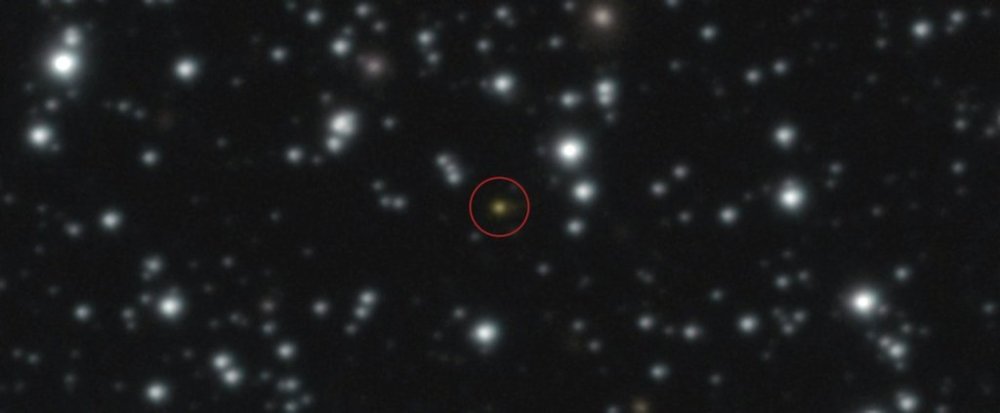
Scientists said such a long and recurrent gamma ray explosion is puzzling — a cosmic whodunit, at least for now. More observations are needed to confirm its precise whereabouts.
The European-led team announced its findings in the Astrophysical Journal Letters in August.
___
The Associated Press Health and Science Department receives support from the Howard Hughes Medical Institute’s Department of Science Education and the Robert Wood Johnson Foundation. The AP is solely responsible for all content.