Montreal police resolve cold case from 2008 using genetic genealogy to ID killer

Advertisement

Advertise with us

MONTREAL - A long-standing cold case was cracked using genetic genealogy to identify the man who killed a Montreal woman in her apartment in 2008, police said Wednesday.

Read this article for free:


or

Already have an account? Log in here »

To continue reading, please subscribe:

Subscribe and receive a limited-edition Free Press branded hat or tote.

Digital Subscription

One year of digital access for only $205*

  • Enjoy unlimited reading on winnipegfreepress.com
  • Read the E-Edition, our digital replica newspaper
  • Access News Break, our award-winning app
  • Play interactive puzzles

*First annual payment billed as $205.00 + GST for one year. This annual subscription will automatically renew at $233.00 + GST every 52 weeks (10% off the regular annual price of $259.35). Offer available to new and qualified returning subscribers only. Cancel any time.

To continue reading, please subscribe:

Add Free Press access to your Brandon Sun subscription for only an additional

$1 for the first 4 weeks*

  • Enjoy unlimited reading on winnipegfreepress.com
  • Read the E-Edition, our digital replica newspaper
  • Access News Break, our award-winning app
  • Play interactive puzzles
Start now

*Your next Brandon Sun subscription payment will increase by $1.00 and you will be charged $17.95 plus GST for four weeks. After four weeks, your payment will increase to $24.95 plus GST every four weeks.

Hey there, time traveller!
This article was published 17/09/2025 (358 days ago), so information in it may no longer be current.

MONTREAL – A long-standing cold case was cracked using genetic genealogy to identify the man who killed a Montreal woman in her apartment in 2008, police said Wednesday.

Catherine Daviau, 26, was killed in her Rosemont-La Petite-Patrie apartment in December 2008. Investigators had not identified a suspect in her brazen murder under recently, naming Jacques Bolduc as the man who killed Daviau.

Bolduc died of natural causes in 2021 at the Archambault Institution, where he was serving time for two robberies and two attempted murders. But it was diligent scientific work that ultimately linked him to the homicide.
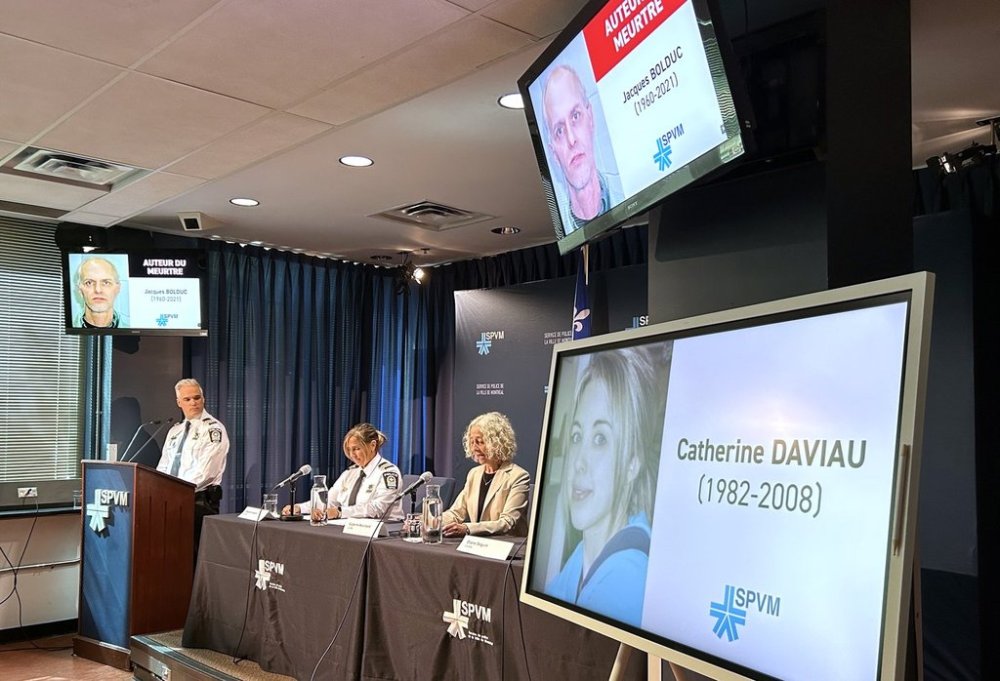
Montreal police Cmdr. Francois Sauve, left to right, Montreal police Cmdr. Melanie Dupont and Suzanne Marchand, senior executive director of the provincial crime lab, announce the resolution in the 2008 murder of Catherine Daviau during a news conference in Montreal, on Wednesday, Sept. 17, 2025. THE CANADIAN PRESS/Sidhartha Banerjee

“The resolution is entirely thanks to genetic genealogy, which pointed us to that name, and it never came up in the investigation at any time,” Cmdr. Mélanie Dupont, head of the Montreal police major crimes unit, told a news conference.

Bolduc was serving an indeterminate sentence at the time of his death handed down in 2020, earning dangerous offender status. His criminal past dated back to 1979 mainly for similar offences.

Bolduc did not know Daviau and there was no connection between the two. Bolduc had only contacted her a few days before the killing by phone, after she’d posted a vehicle for sale on an online classified site.

“There was a possible appointment, but he never showed up. Was he observing at that time? We can hypothesize that he was observing because the planned meeting was on Dec. 10 and he didn’t show up for the appointment,” Dupont said. 

“We know for sure that on Dec. 11, he was there.”

Police say Bolduc attempted to set fire to the unit to cover up evidence. Investigators still found traces of DNA at the scene, but without a match in the system.

Bolduc was on parole at the time and living at a halfway house that he did not return to on Dec. 11, 2008. He was later caught in Sherbrooke, Que., east of Montreal, trying to steal a car. 

Diane Seguin of the Laboratoire de sciences judiciaires et de médecine légale, the provincial criminal crime lab, said genetic genealogy for the Daviau killing began in 2021, creating a profile checking weekly for any matches. It’s not about a perfect match between the profile and what’s available in the databases, but pointing them in the right direction using very distant genetic links between individuals.

From there, they can start to build a family tree, which provides a list of potential persons of interest that can then be investigated through traditional policing methods.

“The interesting match that we got for this case was in fall 2024,” Seguin said. “We did the genealogy, our genealogist did the research, and then we were able to provide the investigators with a name.”

Dupont noted that Bolduc died on Sept. 8, 2021, but an order for a DNA swab following his conviction in June 2020 never made it into the national DNA bank, in part because of the COVID-19 pandemic.

Police, who never had Bolduc on their radar during their probe, began to investigate the individual. 

“In this case, Jacques Bolduc was dead and incinerated, so we could not do DNA match with the body,” Dupont said. So they went to family to confirm DNA from the scene was compatible with that of Bolduc.

There are more than 800 unsolved cases in Montreal, most predating 2010 and the vast majority dating back to before 2000. There are currently 16 investigators working full time, with the unit expanded last April, Dupont said.

Investigators met with Daviau’s relatives earlier Wednesday to discuss the resolution. Dupont said she hoped it helped bring some peace of mind in their grieving process.

“Of course, our goal is to bring people to justice,” Dupont said. “However, providing answers to the family is just as important.”

This report by The Canadian Press was first published Sept. 17, 2025.
Report Error Submit a Tip

More Stories

Governments chip in for housing at Portage Place, Market Lands, other city locations

Joyanne Pursaga 4 minute read Preview

Governments chip in for housing at Portage Place, Market Lands, other city locations

Joyanne Pursaga 4 minute read Updated: Yesterday at 8:24 PM CDT

A new government partnership will aim to speed up home construction, largely in downtown Winnipeg, with a goal to produce at least 740 affordable housing units.

The Build Canada Homes partnership, funded by the governments of Canada, Manitoba and Winnipeg, will support at least 821 housing units. The vast majority (811) will be in Winnipeg, while the rest will be added in Swan River.

Federal Housing Minister Gregor Robertson said the partnership will tackle substantial housing needs in Manitoba, at a time home prices are out of reach for many Canadians.

“Far too many people (are) sleeping outside, sleeping rough, unsheltered. Far too many people … can’t find a home they can afford,” said Robertson.

Read
Updated: Yesterday at 8:24 PM CDT

‘Dynacare sucks’: premier muses about bringing lab services back into public system

Carol Sanders 6 minute read Preview

‘Dynacare sucks’: premier muses about bringing lab services back into public system

Carol Sanders 6 minute read Updated: 6:48 PM CDT

Premier Wab Kinew says Manitoba may bring Dynacare’s diagnostic lab services back into the public system rather than continue to sign contracts with the for-profit company.

“Dynacare sucks. They’ve made an absolute mess of this situation,” the premier said Wednesday, the day the company’s 350 employees reported back to work after the labour board halted their strike after just one day.

Kinew first made the remark about Dynacare in a CBC radio interview Wednesday morning and added he is “not happy with them.”

Dynacare performs the majority of non-emergency blood and urine tests in the province.

Read
Updated: 6:48 PM CDT

Weekender festivities to take over downtown

Sheldon Birnie 3 minute read Preview

Weekender festivities to take over downtown

Sheldon Birnie 3 minute read 6:00 AM CDT

Come one, come all, to Graham Avenue this weekend.

Organizers of the Weekender hope to welcome thousands of Winnipeggers to the streets and parking lots in and around the Graham Avenue pedestrian mall in what they are billing as “Downtown’s Biggest Street Party.”

Starting Friday evening and running through Sunday, the free festival boasts a plethora of ways by which visitors can enjoy themselves. From food trucks to markets, games to live music, classic cars and free bike repairs, the festival aims to provide a little something for everyone.

“The Weekender is truly about bringing people together, to have fun, to experience all that downtown has to offer,” says Olivia Billson, director of communications and public relations for Downtown Winnipeg BIZ, which is putting on the festival in conjunction with Smith Events and Arch Events.

Read
6:00 AM CDT

All quiet on the Hellebuyck front

Mike McIntyre 8 minute read Preview

All quiet on the Hellebuyck front

Mike McIntyre 8 minute read Yesterday at 4:58 PM CDT

Pull up a chair, folks, as we address the elephant in the room. Or, to be more precise, the decorated goaltender who is not in the room. Or on the ice. Or even in the city.

Not surprisingly, the Connor Hellebuyck situation took centre stage Tuesday as members of the Winnipeg Jets held their first media session following an informal, pre-training camp skate.

“We’re definitely going to get asked about it. That’s no chirp to anybody. I think that’s just the reality of the situation,” admitted veteran defenceman Dylan DeMelo, who took part in an hour-long practice at Hockey For All Centre that involved nearly every member of the organization.

With one very notable exception, of course.

Read
Yesterday at 4:58 PM CDT

Manitoba artists in TIFF spotlight as fest begins

Randall King 6 minute read Preview

Manitoba artists in TIFF spotlight as fest begins

Randall King 6 minute read 6:15 PM CDT

Expect Winnipeg film production — and Manitoba talent — to grab its share of the klieg lights at the 2026 edition of the Toronto International Film Festival, which starts today and runs to Sept. 20.

On the TIFF menu: the feature film debut of a local filmmaker who began taking short films to the festival 10 years ago.

In 2016, Ian Bawa arrived at the festival with three collaborators — Markus Henkel, Milos Mitrovic and Fabian Velasco — debuting their outrageous satire Imitations to the Short Cuts program, devoted to short films.

Bawa kept coming, scoring a short film hit in the COVID-truncated 2020 edition of TIFF with a personal project titled Strong Son, which featured his own father, Jagdeep Singh Bawa, in the role of a bodybuilder’s stern father.

Read
6:15 PM CDT

Battling agencies would have far greater impact on homeless crisis by working together

Dan Lett 5 minute read Preview

Battling agencies would have far greater impact on homeless crisis by working together

Dan Lett 5 minute read Updated: 5:28 PM CDT

In the midst of one of the most concerted efforts to reduce, if not eliminate, homelessness, why are two of Winnipeg’s more prominent social service agencies fighting each other?

Read
Updated: 5:28 PM CDT