Discovery of insects trapped in amber sheds light on ancient Amazon rainforest

Advertisement

Advertise with us

WASHINGTON (AP) — Scientists have discovered prehistoric insects preserved in amber for the first time in South America, providing a fresh glimpse into life on Earth at a time when flowering plants were just beginning to diversify and spread around the world.

Read this article for free:


or

Already have an account? Log in here »

To continue reading, please subscribe:

Subscribe and receive a limited-edition Free Press branded hat or tote.

Digital Subscription

One year of digital access for only $205*

  • Enjoy unlimited reading on winnipegfreepress.com
  • Read the E-Edition, our digital replica newspaper
  • Access News Break, our award-winning app
  • Play interactive puzzles

*First annual payment billed as $205.00 + GST for one year. This annual subscription will automatically renew at $233.00 + GST every 52 weeks (10% off the regular annual price of $259.35). Offer available to new and qualified returning subscribers only. Cancel any time.

To continue reading, please subscribe:

Add Free Press access to your Brandon Sun subscription for only an additional

$1 for the first 4 weeks*

  • Enjoy unlimited reading on winnipegfreepress.com
  • Read the E-Edition, our digital replica newspaper
  • Access News Break, our award-winning app
  • Play interactive puzzles
Start now

*Your next Brandon Sun subscription payment will increase by $1.00 and you will be charged $17.95 plus GST for four weeks. After four weeks, your payment will increase to $24.95 plus GST every four weeks.

Hey there, time traveller!
This article was published 18/09/2025 (363 days ago), so information in it may no longer be current.

WASHINGTON (AP) — Scientists have discovered prehistoric insects preserved in amber for the first time in South America, providing a fresh glimpse into life on Earth at a time when flowering plants were just beginning to diversify and spread around the world.

Many of the specimens found at a sandstone quarry in Ecuador date to 112 million years ago, said Fabiany Herrera, curator of fossil plants at the Field Museum in Chicago and co-author of the study published Thursday in the journal Communications Earth and Environment.

Almost all known amber deposits from the past 130 million years have been in the Northern Hemisphere, and it’s long been “an enigma” that scientists have found few in southern regions that once comprised the supercontinent Gondwana, said David Grimaldi, an entomologist at the American Museum of Natural History who was not involved in the discovery.
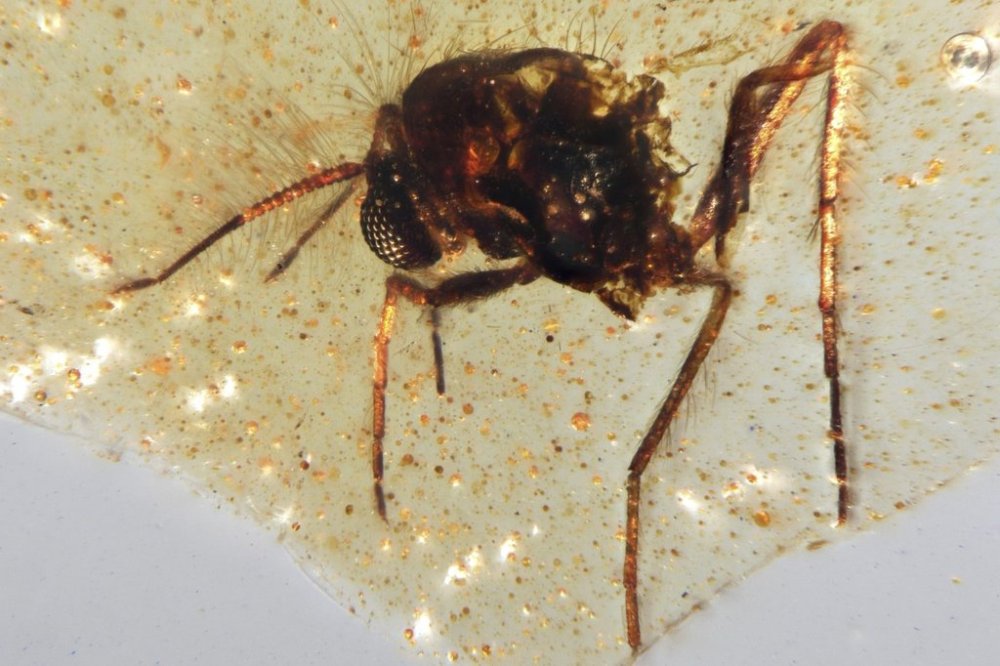
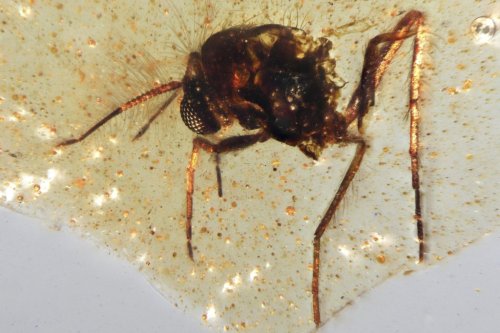
This photo provided by researchers in September 2025 shows a Diptera Nematocera fly of the family Chironomidae (non-biting midges) trapped in a Cretaceous-era amber sample discovered in Ecuador. (Mónica Solórzano-Kraemer via AP)

This marks the first time researchers have identified ancient beetles, flies, ants and wasps in fossilized tree resin in South America, said Ricardo Pérez-de la Fuente, a paleoentomologist at the Oxford University Museum of Natural History, who also was not involved in the new study.

“Amber pieces are little windows into the past,” Pérez-de la Fuente said, adding that the discovery will help researchers understand the evolving interactions between flowering plants and insects that lived during the era of the dinosaurs.

The researchers uncovered hundreds of fragments of amber, some containing ancient insects, pollen and tree leaves, at a sandstone quarry in Ecuador that’s on the edge of what is today the Amazon basin.

But today’s rainforest is much different from what dinosaurs roamed through, Herrera said. Based on an analysis of fossils in the amber, the ancient rainforest contained species of ferns and conifers, including the unusual Monkey Puzzle Tree, that no longer grow in Amazonia.

“It was a different kind of forest,” said Herrera.

The amber deposits were previously known to geologists and miners who worked at the Genoveva quarry. Study co-author Carlos Jaramillo at the Smithsonian Tropical Research Institute first heard of them about a decade ago and set out to find the exact location, aided by geology field notes.

“I went there and realized this place is amazing,” Jaramillo said. “There’s so much amber in the mines,” and it’s more visible in the open quarry than it would be if hidden under dense layers of vegetation.

Researchers will continue to analyze the amber trove to learn more about Cretaceous-era biodiversity — including the insects that contributed to evolution by feeding on flowering plants. “Amber tends to preserve things that are tiny,” said Grimaldi.

“It’s the time when the relationship between flowering plants and insects got started,” said Pérez-de la Fuente. “And that turned out to be one of the most successful partnerships in nature.”

___

The Associated Press Health and Science Department receives support from the Howard Hughes Medical Institute’s Department of Science Education and the Robert Wood Johnson Foundation. The AP is solely responsible for all content.

Report Error Submit a Tip

More Stories

Rogers, Telus deny blame for June twister alert barrage

Malak Abas 3 minute read Preview

Rogers, Telus deny blame for June twister alert barrage

Malak Abas 3 minute read Updated: Yesterday at 7:21 AM CDT

Telecom companies say they aren’t to blame for the barrage of tornado alerts Manitobans received during severe thunderstorms in early June.

The Canadian Radio-television and Telecommunications Commission announced in August it would investigate the unusually high number of alerts, and called on the Pelmorex Corp., which operates the national Alert Ready system, along with telecom companies Bell, Rogers and Telus to respond to a number of questions.

They were given until last Friday to describe their possible roles in the creation, receipt, processing or distribution of alerts issued from Environment and Climate Change Canada in the midst of the June 9 storm.

Telus said in its response that it received 133 alert requests targeted to Manitoba created by Environment Canada and forwarded by Pelmorex between 2:35 p.m. June 9 and 3:29 a.m. the following day. While the majority of those messages contained identical information and were automatically suppressed, 17 were ultimately sent out as alerts in Winnipeg.

Read
Updated: Yesterday at 7:21 AM CDT

A clear example of doing things right

Editorial 4 minute read Preview

A clear example of doing things right

Editorial 4 minute read Updated: Yesterday at 7:05 AM CDT

This week’s re-opening of a temporary emergency department in the flood-damaged Dauphin Regional Health Centre was described by government officials as a “monumental team effort.” It was certainly that, but the story about how the ER was restored so quickly is so much more.

Read
Updated: Yesterday at 7:05 AM CDT

A development infused with personal memory

Brent Bellamy 6 minute read Preview

A development infused with personal memory

Brent Bellamy 6 minute read Yesterday at 2:00 AM CDT

I haven’t written here in a while. Early this summer, my mom was unfairly taken from us — from me. Healing, as much as it’s possible, takes time.

Read
Yesterday at 2:00 AM CDT

Discovery of insects trapped in amber sheds light on ancient Amazon rainforest

Christina Larson, The Associated Press 3 minute read Preview

Discovery of insects trapped in amber sheds light on ancient Amazon rainforest

Christina Larson, The Associated Press 3 minute read Thursday, Sep. 18, 2025

WASHINGTON (AP) — Scientists have discovered prehistoric insects preserved in amber for the first time in South America, providing a fresh glimpse into life on Earth at a time when flowering plants were just beginning to diversify and spread around the world.

Many of the specimens found at a sandstone quarry in Ecuador date to 112 million years ago, said Fabiany Herrera, curator of fossil plants at the Field Museum in Chicago and co-author of the study published Thursday in the journal Communications Earth and Environment.

Almost all known amber deposits from the past 130 million years have been in the Northern Hemisphere, and it’s long been “an enigma” that scientists have found few in southern regions that once comprised the supercontinent Gondwana, said David Grimaldi, an entomologist at the American Museum of Natural History who was not involved in the discovery.

This marks the first time researchers have identified ancient beetles, flies, ants and wasps in fossilized tree resin in South America, said Ricardo Pérez-de la Fuente, a paleoentomologist at the Oxford University Museum of Natural History, who also was not involved in the new study.

Read
Thursday, Sep. 18, 2025

Putting together annual fashion show takes many hard-working hands

AV Kitching 8 minute read Preview

Putting together annual fashion show takes many hard-working hands

AV Kitching 8 minute read 2:00 AM CDT

A frenzy of activity is taking place behind the closed doors of WAG-Qaumajuq on Monday. It’s the day before Crafted on the Catwalk, the gallery’s annual fashion and design show, and the clock is ticking.

There’s less than 30 hours before the big event and it’s all hands on deck.

A steady stream of people walk in and out of the Memorial Boulevard entrance towards the main hall, which glows in soft hues as technicians test out lighting equipment.

The ground floor is teeming with people lugging chairs and pushing trolleys. A stream of white material unravelling from its roll prompts a shouted “OK to step on this?” and receives an equally loud ‘No!” in reply, voices raised above the metallic buzz of a drill as staff from a local production company put together seats.

Read
2:00 AM CDT

Puzzles Palace

1 minute read Monday, Jul. 27, 2026

To solve our puzzles, please subscribe with this special offer: |