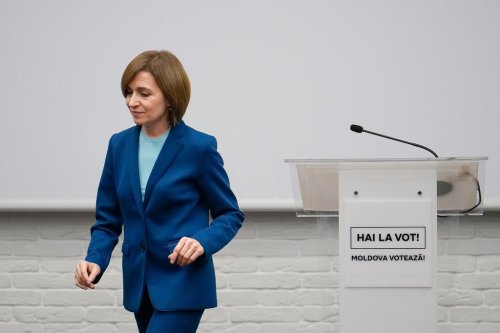
Moldova’s election faces AI-driven disinformation from Russia
Advertisement
Read this article for free:
or
Already have an account? Log in here »
To continue reading, please subscribe:

Digital Subscription
One year of digital access for only $205*
- Enjoy unlimited reading on winnipegfreepress.com
- Read the E-Edition, our digital replica newspaper
- Access News Break, our award-winning app
- Play interactive puzzles
*First annual payment billed as $205.00 + GST for one year. This annual subscription will automatically renew at $233.00 + GST every 52 weeks (10% off the regular annual price of $259.35). Offer available to new and qualified returning subscribers only. Cancel any time.
To continue reading, please subscribe:
Add Free Press access to your Brandon Sun subscription for only an additional
$1 for the first 4 weeks*
- Enjoy unlimited reading on winnipegfreepress.com
- Read the E-Edition, our digital replica newspaper
- Access News Break, our award-winning app
- Play interactive puzzles
*Your next Brandon Sun subscription payment will increase by $1.00 and you will be charged $17.95 plus GST for four weeks. After four weeks, your payment will increase to $24.95 plus GST every four weeks.
Read unlimited articles for free today:
or
Already have an account? Log in here »
Hey there, time traveller!
This article was published 22/09/2025 (334 days ago), so information in it may no longer be current.
CHISINAU, Moldova (AP) — Moldovans are facing a flood of disinformation driven by artificial intelligence ahead of a critical parliamentary election, which will determine whether the small country can stay on its path toward the European Union or is pulled back into Moscow’s orbit.
Ahead of Sunday’s vote to choose a new 101-seat legislature, multiple online monitoring groups have tracked propaganda and disinformation campaigns attributed to Russia. Their aim is to diminish support for the ruling pro-European Party of Action and Solidarity, or PAS, in a vote many view as a geopolitical choice between East and West.
Researchers say the coordinated campaigns mark a new phase in Russian influence operations, built on fresh infrastructure and heavy use of AI. Spoof websites impersonate legitimate Western media and pay “engagement farms” in Africa, while AI bots are deployed to flood comment sections deriding PAS and the EU.
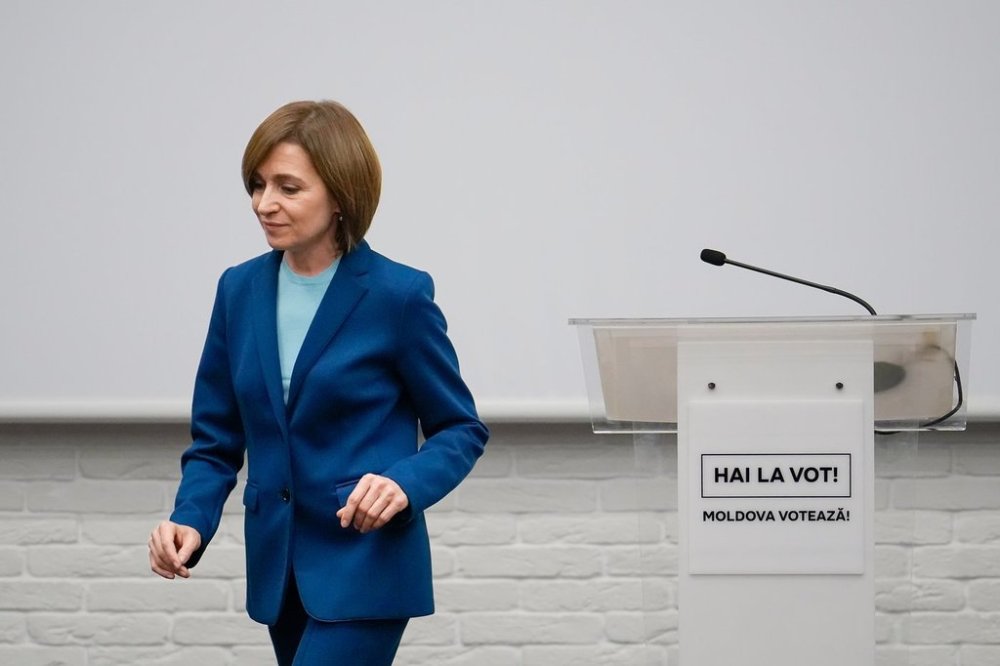
Moldovan President Maia Sandu warned that Sunday’s vote will be the “most consequential” in her country’s history, which will determine whether Moldova becomes a stable democracy or whether Russia pulls the country away from Europe.
She said joining the EU will protect Moldova “from the greatest threat we face: Russia.”
Police on Monday arrested 74 people in 250 raids as part of an investigation into an alleged Russia-backed plan to incite mass riots and destabilize the country.
The pro-European PAS, which Sandu founded in 2016, won a clear majority in the 2021 parliamentary election but risks losing it on Sunday, with no viable pro-European alternatives on the ballot but several Russia-friendly ones.
In the wake of Russia’s full invasion of Ukraine in 2022, Moldova applied to join the EU and was granted candidate status that year, and Brussels agreed to open accession negotiations last year.
Moldovan authorities have long warned that Russia is conducting a hybrid war — meddling in elections, disinformation campaigns, illicitly funding pro-Russian parties — to try to derail the country’s path toward EU membership. Moscow has repeatedly denied meddling in Moldova.
Unmasking AI-generated sites
Reset Tech, a global not-for-profit that monitors digital threats to democracy and Russian online influence operations since 2022, investigated an English-language AI-generated platform Restmedia, which proclaims to be “committed to exposing and addressing the critical issues shaping Europe’s future.”
While Restmedia mimics investigative journalism with serious-looking articles and well-designed graphics, all of its content is generated using AI tools, according to a report by Reset Tech shared with The Associated Press. About a quarter of its content focuses on Moldova, but is “translated and amplified” by websites in other EU languages. It publishes “Kremlin-aligned propaganda” attacking Sandu, PAS and the EU.
Disinformation refers to misinformation created and spread intentionally, mainly to confuse or mislead.
“We have learned to detect the fingerprints of these Russian secret services in lots of different countries … and seen them really active in Moldova,” Ben Scott, the director of Reset Tech, told the AP. “And not surprising, because Moldova has some very critical elections.”
African “engagement farms”
The 36-page report reveals that Restmedia pays “engagement farms” in Africa to promote its narratives across verified accounts on X in a “amplification-for-hire” schemes. Although Restmedia tried to “mask its infrastructure,” researchers found “clear technical links to Russia” via IP addresses and website metadata.
“I’m not at all shocked by the sophistication because it isn’t sophisticated. What’s remarkable about it is how large it is,” Scott said. “If a couple of researchers at an NGO like ours can find a big Russian information operation targeting Moldova, why is it that big companies … can’t do it?”
Google said in a statement that it proactively tracks and tackles coordinated election-influence operations. “On YouTube, as part of our proactive coverage for the 2025 Moldova elections, we have terminated more than 1,000 channels since June 2024 for being part of coordinated influence operations targeting Moldova.”
Between Aug. 5 and Sept. 4, Expert Forum, a Romanian think tank monitoring the Moldovan election, said it tracked 100 inauthentic TikTok accounts that garnered a total of 13.9 million views in a campaign driven by “fear and resentment,” mostly attacking PAS. The NGO later found a “mirror network” of the 100 TikTok accounts on Facebook.
“What we are seeing today is fundamentally different from classic disinformation campaigns,” it said. “AI can generate complete profiles, realistic photos, credible biographies, and varied content in minutes that would have required weeks of manual work.”
Promo-Lex, a Moldovan nonprofit monitoring the election, also found 500 fake TikTok accounts that posted the same videos, graphics, and anti-EU and anti-Sandu narratives, which racked up 1.3 million views in three days. Driven by 25 “core accounts,” the network used two election-related hashtags to “manipulate TikTok’s algorithm to force posts” into trending.
The Moldovan government has tried to counter the slew. On Sept. 16, Sandu signed a decree approving the establishment of a center to counter disinformation.
Spoof websites mimic Western media
One site that mimics the U.S. lifestyle outlet OK! Magazine ran a fabricated story titled “Moldovan president in celebrity sperm scandal!” and falsely used the name of a real reporter. It alleged that Sandu — who is unmarried and does not have children — was purchasing sperm from gay celebrity donors such as Ricky Martin and Elton John to have a child.
“The article seeks to discredit Sandu by weaponizing gender stereotypes and targeting her personal life, while eroding her political reputation,” the Reset Tech report states.
Another article on a fake news site referenced as its primary source a report by the EU-sanctioned Russian Foundation to Battle Injustice, which accuses Sandu of running a child trafficking campaign via Ukraine to pedophile networks in Europe.
“The Kremlin operatives are using AI, cheap, off-the-shelf software to create quick and dirty images for lookalike websites,” Scott said. “Not only does it bring false information to voters who are trying to consider very consequential issues in their country, but also over time it leads people to believe that nothing can be trusted.”
Reset Tech said the network uses methods and digital assets that link it to a broader Russian information influence network, often referred to as Storm-1516. Its analysis built on research by Recorded Future’s Insikt Group and the Foreign Information Manipulation and Interference Information Sharing and Analysis Center, which is made up of DFRLab, EU Disinfo Lab, Alliance4Europe, and Debunk.
Pro-Russian oligarch accused of meddling
Fugitive pro-Russian Moldovan oligarch Ilan Shor, who was convicted of fraud and reportedly lives in exile in Moscow, has been accused of funding a large Russia-backed network of paid political ads on Facebook and YouTube ahead of the election.
Between April 30 and July 28, a network led by Shor and several other political actors paid for 1,505 advertisements on Meta platforms with a budget estimated at 45,000 euros ($53,000), according to the Chisinau-based think tank WatchDog. Hundreds of adverts were also placed on YouTube.
During the period WatchDog monitored, the main “propaganda narratives” promoted across the two platforms were that PAS will rig the election, persecutes the Orthodox Church of Moldova, and claims that the pro-EU party has impoverished Moldova.
Moldovan authorities conducted a series of raids in the run-up to the election, as part of investigations into voter corruption, illegal party financing and money laundering, allegedly tied to the Shor “criminal organization.”
During a raid on Sept. 18 in which one person was detained, police said they seized cash, laptops, bank documents, and that the suspects were receiving instructions via Telegram from “curators in the Russian Federation” on how to distribute and comment on disinformation videos on Facebook, TikTok and Telegram. Shor has denied wrongdoing.
“We know how to fight Russian propaganda (and) pro-Russian oligarchs,” says Andrei Rusu, a media monitoring expert at WatchDog. “But we need more support from our partners. … Words will not save our country from a pro-Russian regime if this election will be corrupted.”