Ukraine uses remote-controlled vehicles for dangerous missions to protect soldiers
Advertisement
Read this article for free:
or
Already have an account? Log in here »
To continue reading, please subscribe:

Digital Subscription
One year of digital access for only $205*
- Enjoy unlimited reading on winnipegfreepress.com
- Read the E-Edition, our digital replica newspaper
- Access News Break, our award-winning app
- Play interactive puzzles
*First annual payment billed as $205.00 + GST for one year. This annual subscription will automatically renew at $233.00 + GST every 52 weeks (10% off the regular annual price of $259.35). Offer available to new and qualified returning subscribers only. Cancel any time.
To continue reading, please subscribe:
Add Free Press access to your Brandon Sun subscription for only an additional
$1 for the first 4 weeks*
- Enjoy unlimited reading on winnipegfreepress.com
- Read the E-Edition, our digital replica newspaper
- Access News Break, our award-winning app
- Play interactive puzzles
*Your next Brandon Sun subscription payment will increase by $1.00 and you will be charged $17.95 plus GST for four weeks. After four weeks, your payment will increase to $24.95 plus GST every four weeks.
Read unlimited articles for free today:
or
Already have an account? Log in here »
Hey there, time traveller!
This article was published 22/09/2025 (360 days ago), so information in it may no longer be current.
DONETSK REGION, Ukraine (AP) — On a battlefield swarming with deadly Russian drones, Ukrainian soldiers are increasingly turning to nimble, remote-controlled armored vehicles that can perform an array of tasks and spare troops from potentially life-threatening missions.
The Ukrainian army is especially eager to deploy what soldiers refer to as “robots on wheels” as it faces a shortage of soldiers in a war that has dragged on for more than 3 1/2 years. The vehicles look like miniature tanks and can ferry supplies, clear mines and evacuate the wounded or dead.
“It cannot fully replace people,” said the commander of a platoon of the 20th Lyubart Brigade who goes by the call sign Miami and spoke on condition of anonymity in line with military rules. “I would put it this way: A person can go in there, but for a human it’s (sometimes) far too dangerous.”

The robotic vehicles are mostly made by Ukrainian companies and range in cost from about $1,000 to as much as $64,000, depending on their size and capabilities.
While they have become vital to Ukrainian troops along the 1,000 kilometer (620 mile) front line, such vehicles are not new to warfare.
The German army used a remote-controlled miniature tank – tethered by a wire — called the Goliath in World War II. In recent decades, the U.S., Israel, Britain and China have developed modern versions used for combat engineering and other battlefield roles, according to Ben Barry, a fellow at the International Institute for Strategic Studies. But Ukraine’s extensive deployment of these vehicles is noteworthy and could lead to advances, Barry said.
The Russian army also uses remote-controlled vehicles.
From drones to autonomous vehicles
Miami joined the army on the first day of Russia’s full-scale invasion in February 2022. He served as an infantryman and later a drone operator before his latest assignment. His path reflects how the war itself has evolved.
“I couldn’t even imagine that I would become a (drone) pilot,” he said. “But war is progress, and we cannot stand aside.”
The robotic vehicles his team deploys are armored and mounted on either wheels or tracks. Painted in military colors, they crawl slowly over rubble or dirt roads, easily navigating terrain that would be difficult – or too dangerous — for soldiers.
“They arrive in one condition, and we improve them,” Miami said. “We adapt the controls to work better (in the face of Russia’s) electronic warfare so the connection doesn’t cut off.”
Miami’s 10-man team is just starting to incorporate the machines into their missions, mostly using them to deliver food and ammunition to soldiers near the front.
Just like remote-controlled, or first-person view, drones, the use of these vehicles will only grow, said a soldier in Miami’s unit who goes by the call sign Akim and spoke on condition of anonymity.
“When FPV drones first appeared, they weren’t popular, but those who pioneered them, (now) show (the best) results,” said Akim.
An autonomous vehicle ‘doesn’t get tired’
Before sending a remote-controlled vehicle forward, Akim flies a drone along the planned route to check for obstacles or mines.
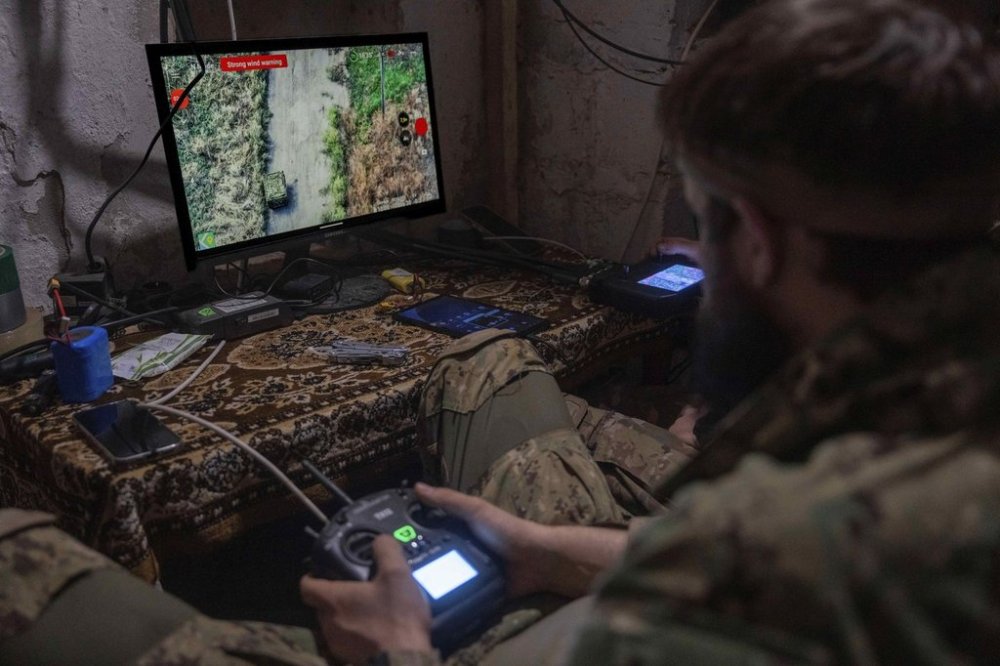
Operating from a cramped basement near Kostiantynivka, less than 10 kilometers from the front, Akim can hear the muffled thuds of aerial bombs, the sharp cracks of artillery and the buzzing of drones.
Kostiantynivka, once home to 67,000 people, is a largely deserted city on a shrinking patch of Ukrainian-held territory just west of Bakhmut. It is nearly encircled on three sides by Russian forces. Apartment blocks are scarred by strikes, smoke still rises from recent bombings, and the roads leading toward nearby Pokrovsk are littered with burned-out cars.
The aerial drone allows Akim to scout the city and routes without risking his life.
“Every time a drone or a robot does something, it means one of our fighters doesn’t have to,” Akim said. On top of that, “the machine doesn’t get tired. It can carry as much as needed.”
Akim works in tandem with another soldier operating the robotic vehicle with a joystick. The vehicle has no camera; instead, Akim’s drone feed provides its “eyes.”
On one recent mission, the team loaded it with 200 kilograms (440 pounds) of supplies — ammunition, fuel, water and food — and sent it several kilometers to drone operators closer to the front. The machine moved forward at about six kilometers per hour, delivered its cargo into a well-hidden position in the forest, and returned to base.
Bumps along the road
Because robotic vehicles move more slowly than cars or trucks, and usually across open ground, they are an easy target — and this is one factor slowing their adoption.

“That’s why we haven’t evacuated many wounded (on these vehicles),” said Miami. “Some refuse to leave because it’s dangerous.”
There are also cost considerations, with the vehicles his platoon uses averaging roughly 400,000 hryvnias ($9,700). “That’s not too expensive, but when three or four get destroyed in a week, the total adds up,” Miami said.
To make them less vulnerable, Miami and his soldiers have tried welding grill-like cages onto the machines or attaching metallic rollers in front to detect mines. The war provides real-time feedback that is incorporated into newer models being built.
___
Vasilisa Stepanenko and Yehor Konovalov contributed to this report.