A trio of space weather satellites blast off together to study the sun’s violent side

Advertisement

Advertise with us

CAPE CANAVERAL, Fla. (AP) — A cluster of space weather satellites blasted off Wednesday morning to cast fresh eyes on solar storms that can produce stunning auroras but also scramble communications and threaten astronauts in flight.

Read this article for free:


or

Already have an account? Log in here »

To continue reading, please subscribe:

Subscribe and receive a limited-edition Free Press branded hat or tote.

Digital Subscription

One year of digital access for only $205*

  • Enjoy unlimited reading on winnipegfreepress.com
  • Read the E-Edition, our digital replica newspaper
  • Access News Break, our award-winning app
  • Play interactive puzzles

*First annual payment billed as $205.00 + GST for one year. This annual subscription will automatically renew at $233.00 + GST every 52 weeks (10% off the regular annual price of $259.35). Offer available to new and qualified returning subscribers only. Cancel any time.

To continue reading, please subscribe:

Add Free Press access to your Brandon Sun subscription for only an additional

$1 for the first 4 weeks*

  • Enjoy unlimited reading on winnipegfreepress.com
  • Read the E-Edition, our digital replica newspaper
  • Access News Break, our award-winning app
  • Play interactive puzzles
Start now

*Your next Brandon Sun subscription payment will increase by $1.00 and you will be charged $17.95 plus GST for four weeks. After four weeks, your payment will increase to $24.95 plus GST every four weeks.

Hey there, time traveller!
This article was published 24/09/2025 (378 days ago), so information in it may no longer be current.

CAPE CANAVERAL, Fla. (AP) — A cluster of space weather satellites blasted off Wednesday morning to cast fresh eyes on solar storms that can produce stunning auroras but also scramble communications and threaten astronauts in flight.

The three satellites soared from Kennedy Space Center shortly after sunrise on the same SpaceX rocket. They aimed for a sun-orbiting lookout 1 million miles (1.6 million kilometers) from Earth, each on its own separate mission.

Altogether, the satellites from NASA and the National Oceanic and Atmospheric Administration, plus related costs, are worth about $1.6 billion. NASA’s Joe Westlake calls it “the ultimate cosmic carpool” by sharing a rocket to save money.
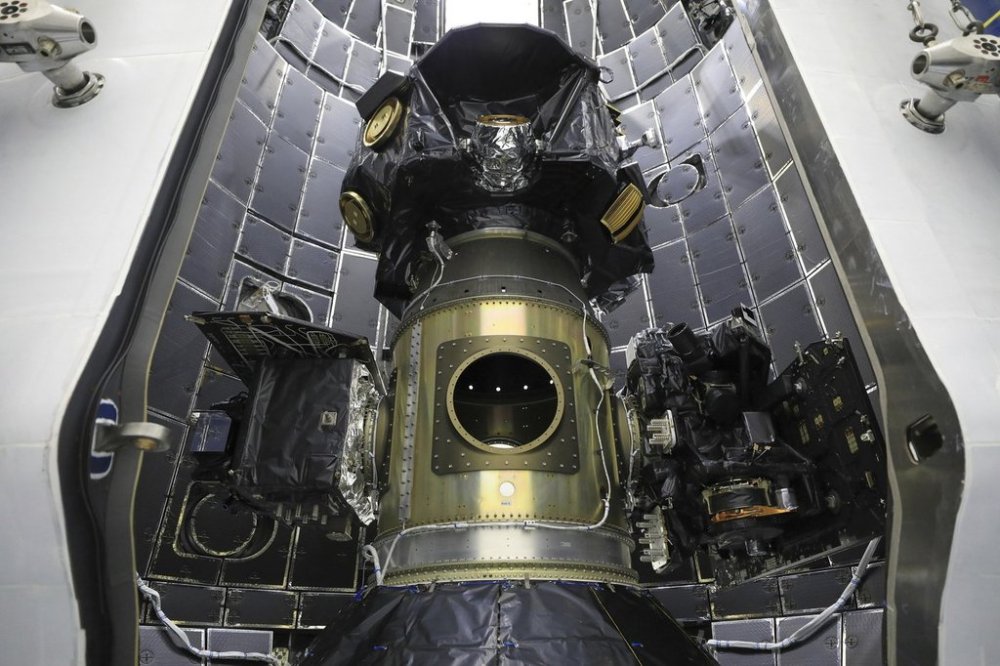
This photo provided by NASA in September 2025 shows NASA’s Carruthers Geocorona Observatory, IMAP (Interstellar Mapping and Acceleration Probe), and the National Oceanic and Atmospheric Administration’s (NOAA) Space Weather Follow On-Lagrange 1 (SWFO-L1) satellite at the Kennedy Space Center in Florida. (NASA via AP)

Heading the lineup is NASA’s Interstellar Mapping and Acceleration Probe, the first to be deployed. It will scrutinize the outer limits of the heliosphere, the protective, solar wind-driven bubble of gas around our solar system.

As a bonus, IMAP will be capable of providing advance notice of solar storms — a valuable 30-minute heads-up — for astronauts exploring the moon under NASA’s Artemis program. Officials expect the observatory to be fully operational by the time four astronauts fly around the moon and back next year.

NASA’s smaller Carruthers Geocorona Observatory also is flying, focusing on Earth’s outermost, glowing atmosphere that extends well beyond the moon. It’s named after the late scientist George Carruthers, who invented the ultraviolet telescope left on the moon by the Apollo 16 astronauts in 1972.

NOAA’s newest space weather observatory will be pushed into full-time, around-the-clock forecasting service. It will keep tab on the sun’s activity and measure the solar wind to help keep Earth safe from threatening flares.

Officials expect NASA’s satellites to be in position and operational by the beginning of next year, and NOAA’s spacecraft by spring.

NASA is kicking in more than $879 million for its two missions, while NOAA’s share is $693 million.

While NASA already has a fleet of sun-observing spacecraft, science mission chief Nicky Fox said these newer missions offer more advanced instruments that will provide more sensitive measurements.

“Just being able to put all those together to give us a much, much better view of the sun,” she said.
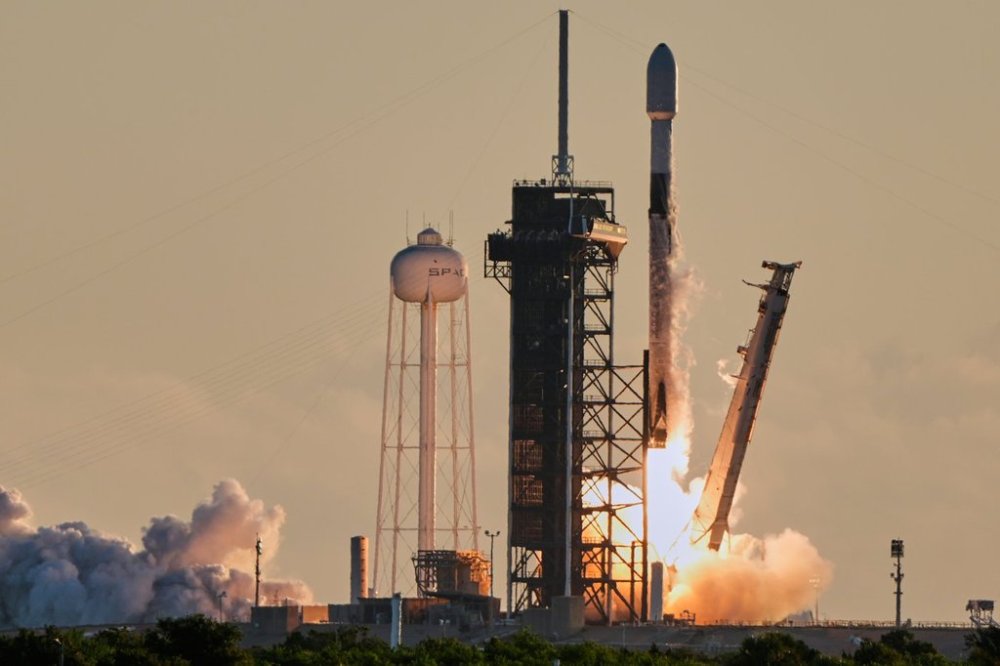
A SpaceX Falcon 9 rocket with a Interstellar Mapping and Acceleration Probe (IMAP) as it's primary payload, lifts off from pad 39A at the Kennedy Space Center in Cape Canaveral, Fla., Wednesday, Sept. 24, 2025. (AP Photo/John Raoux)

The goal is to better understand the sun in order to better protect Earth, according to officials. As spectacular as they are, the northern and southern lights will not be the missions’ focus.

During a preview of NASA’s upcoming Artemis mission around the moon, science officials said Tuesday that these new space weather missions will enhance forecasting and provide vital alerts if major solar activity strikes. If that happens, the four astronauts will take temporary shelter in a storage area under the capsule’s floor to avoid the heightened radiation levels.

___

The Associated Press Health and Science Department receives support from the Howard Hughes Medical Institute’s Department of Science Education and the Robert Wood Johnson Foundation. The AP is solely responsible for all content.


Report Error Submit a Tip

More Stories

AI governance: Canada’s next structural test

Anne Thompson 4 minute read 2:00 AM CDT

Artificial intelligence is accelerating faster than the governance structures meant to contain it. Canada now faces a structural test — whether our institutions can protect autonomy, dignity, and continuity in an era when decision-making is increasingly mediated by systems we did not design, cannot fully audit, and do not yet constitutionally constrain.

This is not a technological problem. It is a governance problem.

AI systems influence how information flows, how institutions behave, and how decisions are made. They shape the conditions under which harm becomes predictable. They amplify both the strengths and weaknesses of the systems into which they are deployed. And they do all of this at a scale and speed that outpaces traditional regulatory tools.

Canada’s current approach to AI governance relies heavily on policy, guidelines, and sector-specific regulation. These are important, but they are not sufficient. What is missing is structural clarity — a constitutional-grade framework that defines authority, responsibility, accountability, and the minimum conditions under which AI systems may operate without undermining human dignity or institutional credibility.

Waiver wire pickup leads Jets to victory in Pittsburgh

Ken Wiebe 6 minute read Preview

Waiver wire pickup leads Jets to victory in Pittsburgh

Ken Wiebe 6 minute read Monday, Oct. 5, 2026

PITTSBURGH – Now that’s a positive first impression.

The Winnipeg Jets swept a two-game road trip, thanks in part to Clay (Mud) Stevenson making 30 saves in his debut with the team that claimed him off waivers one week earlier.

Stevenson was excellent in a 3-2 victory for the Jets over the Pittsburgh Penguins on Monday night at PPG Paints Arena.

“He obviously made some big big stops, right up to the end of the game there,” said Jets head coach Scott Arniel. “He was real solid and confident and looked comfortable. It was great to see a kid come in here like that, a new organization late in training camp. He came as advertised.”

Read
Monday, Oct. 5, 2026

Today’s horoscope

Georgia Nicols 4 minute read Preview

Today’s horoscope

Georgia Nicols 4 minute read 2:00 AM CDT

MOON ALERT: Avoid shopping (except food and gas) and important decisions after 1:30 p.m. The moon is in Virgo.

ARIES (March 21-April 19)

Even though your work routine might be interrupted, this is a productive day. Parents should be extra vigilant because this could be an accident-prone day for kids. Social plans might suddenly change. Athletes should be careful to avoid injuries.

TAURUS (April 20-May 20)

Read
2:00 AM CDT

Alzheimer’s has sent my mother back in time

Pam Frampton 5 minute read Preview

Alzheimer’s has sent my mother back in time

Pam Frampton 5 minute read 2:01 AM CDT

My mother does a lot of time-travelling — time-shifting, the Alzheimer’s Society calls it.

I wonder how it feels to be in the present at one moment and then suddenly catapulted deep into the past. Is it a jolting experience or a smooth transition to go back and forth in time?

Mom will never be able to tell me. There is so much she can never tell me now.

She can still recite her children’s names when prompted, but she doesn’t ask us about our lives. Instead, she talks about her younger siblings, their grandfather who was hard of hearing, the isolated place where they used to live whose inhabitants were resettled nearly 60 years ago.

Read
2:01 AM CDT

Man who exploited teen sentenced to 11 years in prison

Erik Pindera 4 minute read Preview

Man who exploited teen sentenced to 11 years in prison

Erik Pindera 4 minute read Yesterday at 2:00 AM CDT

A man who picked up a vulnerable 17-year-old child-welfare ward on the streets of Winnipeg and coerced her into providing sexual services for several months has been sent to prison for more than a decade.

After a trial, Hassan Kargbo, who’s in his early 30s, was found guilty of sexual exploitation, making child sexual abuse and exploitation material, receiving a material benefit from sexual services provided by a person under 18, procuring a person under 18 and advertising sexual services.

Provincial court Judge Julie Frederickson sentenced him to 11 years behind bars late last month.

“Mr. Kargbo picked up a young Indigenous girl walking over the Osborne Street bridge and quickly got her involved in drug use and escorting,” Frederickson said in a written decision.

Read
Yesterday at 2:00 AM CDT

Corporate declaration of action takes flight

Gabrielle Piché 4 minute read Preview

Corporate declaration of action takes flight

Gabrielle Piché 4 minute read 2:01 AM CDT

Businesses pledging to support reconciliation will meet in Assiniboine Park today as a national project launches.

Victoria Grant plans to attend. She’s been working on this nationwide corporate declaration of action for years — skipping Wednesday morning’s event in Winnipeg means missing launch time.

The private-sector-led declaration will gain its first signees during a ceremony, running from 10 a.m. to noon in the Pavilion.

Signatories agree to learn about the past, build cultural awareness, support Indigenous entrepreneurs and incorporate reconciliation into their corporate policies, among other things.

Read
2:01 AM CDT