Experts say Ottawa’s new AI task force is skewed towards industry
Advertisement
Read this article for free:
or
Already have an account? Log in here »
To continue reading, please subscribe:

Digital Subscription
One year of digital access for only $205*
- Enjoy unlimited reading on winnipegfreepress.com
- Read the E-Edition, our digital replica newspaper
- Access News Break, our award-winning app
- Play interactive puzzles
*First annual payment billed as $205.00 + GST for one year. This annual subscription will automatically renew at $233.00 + GST every 52 weeks (10% off the regular annual price of $259.35). Offer available to new and qualified returning subscribers only. Cancel any time.
To continue reading, please subscribe:
Add Free Press access to your Brandon Sun subscription for only an additional
$1 for the first 4 weeks*
- Enjoy unlimited reading on winnipegfreepress.com
- Read the E-Edition, our digital replica newspaper
- Access News Break, our award-winning app
- Play interactive puzzles
*Your next Brandon Sun subscription payment will increase by $1.00 and you will be charged $17.95 plus GST for four weeks. After four weeks, your payment will increase to $24.95 plus GST every four weeks.
Read unlimited articles for free today:
or
Already have an account? Log in here »
Hey there, time traveller!
This article was published 08/10/2025 (329 days ago), so information in it may no longer be current.
OTTAWA – The Liberal government has given its new AI “task force” until the end of the month to fast-track changes to the national artificial intelligence strategy — a plan that critics say leans too much on the perspective of industry and the tech sector.
Teresa Scassa, a law professor at the University of Ottawa and Canada research chair in information law and policy, said the makeup of the 27-member task force is “skewed towards industry voices and the adoption of AI technologies.”
The risks posed by artificial intelligence to Canada’s culture, environment and workforce “deserve more attention in a national strategy,” Scassa said in an email.
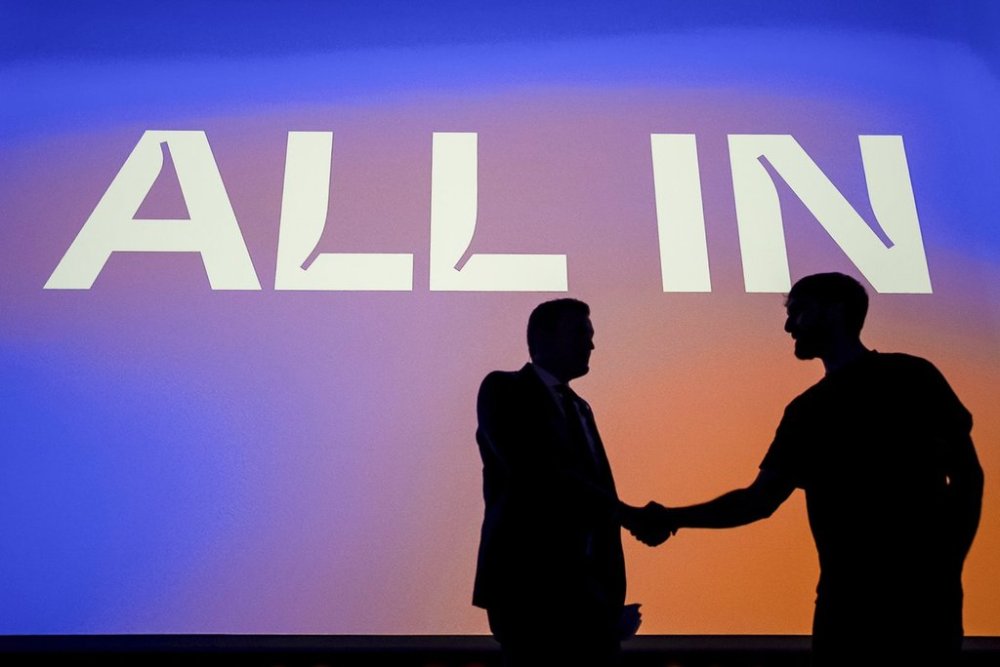
Artificial Intelligence Minister Evan Solomon announced the task force last month and tasked it with a 30-day “national sprint” to draft recommendations for a “refreshed” AI strategy. Solomon said that new strategy will land later this year, nearly two years earlier than planned.
The group has been asked to look at various aspects of AI, including research, adoption, commercialization, investment, infrastructure, skills, and safety and security. The government is also holding a public consultation on its AI strategy.
Canada became the first country to launch a national AI strategy in 2017; it updated the strategy in 2022. Last year’s federal budget included an additional $2.4-billion investment in AI, the bulk of which goes to building up computing capabilities and technological infrastructure. Ottawa also launched an AI strategy for the federal public service earlier this year.
Joel Blit, an associate professor of economics at the University of Waterloo, said he has been encouraged by the government’s approach.
“I really like the urgency of it,” he said, adding that while a 30-day timeline for updating a national AI strategy is “almost unheard of,” the technology is moving fast and Canada isn’t keeping up.
Canada has “always struggled to adopt new technologies as quickly as some other countries,” Blit said.
A recent paper from the C.D. Howe Institute noted that while Canada ranks second globally in top-tier AI researchers and is “first in the G7 for per capita academic AI papers,” it ranked 20th among OECD countries on AI adoption in 2023.
Blit said the government hasn’t invested enough in AI literacy and education and called for AI literacy campaigns “in the same way that maybe 100 years ago we had… literacy campaigns for reading and writing.”
Luc Vinet is a physics professor at the Université de Montréal and CEO of IVADO, a research consortium focused on AI adoption. He said his reaction to the task force and Ottawa’s approach to AI was “quite positive overall.”
He suggested the government could focus on building up “national human infrastructure” in AI by linking up professionals in academia and industry.
“We have remarkable experts in AI, but they might not accompany a medical doctor who wants to adopt AI,” he said. “We have people in universities graduating with PhD, say in chemistry, biology, in economics, (who) still today do not really have much knowledge about AI.”
While Blit said he didn’t want to criticize the task force, he noted that its membership seems to be weighted toward industry representatives.
“Who is going to be advocating to make sure that every Canadian benefits from this, that we invest in education and in literacy and all the other things that we’re going to need?” he asked.
The next “big Canadian economic champion” might not be a big AI company, he suggested.
“It might be a nurse that encounters AI and finds a way to re-imagine health care around AI,” he added.
Scassa said in a recent online post that few of the task force members specialize in social science or studying the ethical dimensions of AI.
“There are no experts in labour and employment issues (which are top of mind for many Canadians these days), nor is there representation from those with expertise in the environmental issues we already know are raised by AI innovation,” she wrote.
Companies with representatives on the task force include generative AI developer Cohere, IT and business consulting company CGI, the Royal Bank of Canada, venture capital firm Inovia Capital, AI search company Coveo, cloud computing company Aptum, data storage company Vdura and crisis alert company Samdesk.
Among the academics on the task force are three professors of computer science, a dean of engineering, a professor of strategic management, a professor of medicine, and the founding director of a research centre for media, technology and democracy.
The group does have representatives from a public sector union, a tech sector group, a think tank, a new safe AI organization launched by AI pioneer Yoshua Bengio, and the First Nations Technology Council.
Only three of the more than two dozen task force members have been asked to work on safe AI systems and public trust, Scassa said.
She said she also has concerns about the government instructing task force members to consult their networks to develop recommendations. Scassa wrote that “sounds a lot like insider networking, which should frankly raise concerns. This does not lend itself to ensuring fair and appropriate representation of diverse voices.”
On Monday, a coalition representing the cultural sector told MPs on the Heritage committee it was disappointed it wasn’t represented on the task force, despite the threat AI poses to the sector.
Jennifer Pybus, associate professor and Canada research chair in data, democracy and AI at York University, said she would have liked to see more civic partners or humanities-based scholars on the task force.
A spokesperson for Solomon said the task force “has a diverse group of folks from across Canada as well as across sectors.”
Pybus said she was still cautiously optimistic about the strategy, partly due to the government’s approach to digital infrastructure. She said the government is recognizing “they have to own the tools and set the rules for the digital age.”
In his speech announcing the task force, Solomon emphasized the principle of digital sovereignty, calling it “the most pressing policy and democratic issue of our time.”
Pybus pointed out that the “vast majority of Canadian AI compute and data storage capacity sits entirely with platforms that are owned by” U.S.-based companies like Amazon, Google and Microsoft.
The Canadian Press reported in September that since 2021, the federal government has spent almost $1.3 billion on cloud services provided by Amazon, Microsoft and Google. Some of those services were used for what the Department of National Defence described as “mission-critical applications that directly support operational readiness and national security.”
Even when AI companies have Canadian subsidiaries, Pybus said, “their governance is still in the U.S., which ultimately means that” legislation on managing that Canadian data “is being shaped by American companies and by the American government.”

Ottawa’s embrace of AI comes as many warn of a potential bubble in AI investment. Blit compared the situation to the dotcom bubble and crash of the early 2000s.
“That doesn’t mean that that technology wasn’t real. It doesn’t mean that that technology didn’t then transform a big part of the economy (or) society,” he said.
Blit said there is a certain amount of AI “hype” about, “but give it a decade and it’s not hype.”
This report by The Canadian Press was first published Oct. 7, 2025.
Note to readers:A previous version of this story referred to Jennifer Pybus as an assistant professor. She is an associate professor.
Related Articles
Canada must turn its AI advantages into economic opportunities: OpenAI exec

Advertisement Advertise With Us
Advertisement Advertise With Us