GM to take a $1.6 billion hit as tax incentives for EVs are slashed and emission rules ease

Advertisement

Advertise with us

General Motors will record a negative impact of $1.6 billion in its next quarter after tax incentives for electric vehicles were slashed by the U.S. and rules governing emissions are relaxed.

Read this article for free:


or

Already have an account? Log in here »

To continue reading, please subscribe:

Subscribe and receive a limited-edition Free Press branded hat or tote.

Digital Subscription

One year of digital access for only $205*

  • Enjoy unlimited reading on winnipegfreepress.com
  • Read the E-Edition, our digital replica newspaper
  • Access News Break, our award-winning app
  • Play interactive puzzles

*First annual payment billed as $205.00 + GST for one year. This annual subscription will automatically renew at $233.00 + GST every 52 weeks (10% off the regular annual price of $259.35). Offer available to new and qualified returning subscribers only. Cancel any time.

To continue reading, please subscribe:

Add Free Press access to your Brandon Sun subscription for only an additional

$1 for the first 4 weeks*

  • Enjoy unlimited reading on winnipegfreepress.com
  • Read the E-Edition, our digital replica newspaper
  • Access News Break, our award-winning app
  • Play interactive puzzles
Start now

*Your next Brandon Sun subscription payment will increase by $1.00 and you will be charged $17.95 plus GST for four weeks. After four weeks, your payment will increase to $24.95 plus GST every four weeks.

Hey there, time traveller!
This article was published 14/10/2025 (361 days ago), so information in it may no longer be current.

General Motors will record a negative impact of $1.6 billion in its next quarter after tax incentives for electric vehicles were slashed by the U.S. and rules governing emissions are relaxed.

Shares fell less than 2% before the opening bell Tuesday. 

The EV tax credit ended last month. The clean vehicle tax credit was worth $7,500 for new EVs and up to $4,000 for used ones. 
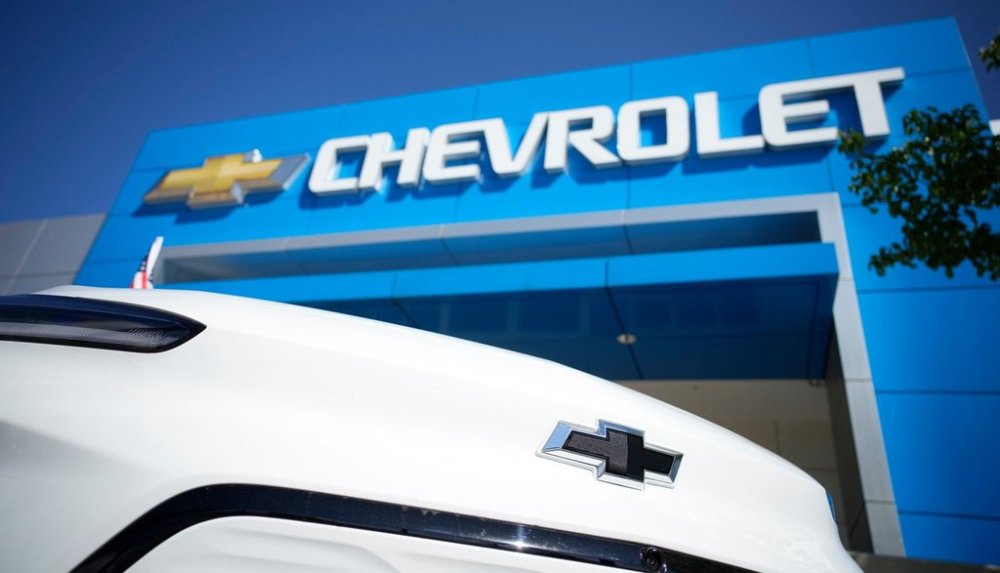
FILE - The company logo shines off the nose of an unsold 2022 Bolt electric vehicle on display in front of a Chevrolet dealership Sunday, Sept. 12, 2021, in Englewood, Colo. (AP Photo/David Zalubowski, File)

Meanwhile, the Environmental Protection Agency has been working on easing rules aimed at cleaning up auto tailpipe emissions as the Trump administration move to undo incentives for automakers to go electric. President Donald Trump has also challenged federal EV charging infrastructure money and blocked California’s ban of new gas-powered vehicle sales. It adds up to less pressure on automakers to continue evolving their production away from gas-burning vehicles.

General Motors, which had led the way among U.S. automakers with plans to convert production to an electric fleet of vehicles, said in a regulatory filing on Tuesday that it will have to book charges that include non-cash impairment and other charges of $1.2 billion due to EV capacity adjustments. There’s also $400 million in charges mostly related to contract cancellation fees and commercial settlements associated with EV-related investments.

GM warned that it may take additional hits as it adjusts production, with non-cash charges potentially impacting operations and cash flow in the future.

The company said that its EV capacity realignment doesn’t impact its retail portfolio of Chevrolet, GMC and Cadillac EVs currently in production, and that it expects those models to remain available to consumers.

EVs were considered to be the future of the US automotive industry. GM had announced in 2020 that it was going to invest $27 billion in electric and autonomous vehicles in the next five years, a 35% increase over plans made before the pandemic.

In 2021 GM said that it planned to have more than half of its North American and China factories be capable of making electric vehicles by 2030. It also pledged at the time to increase its investment in EV charging networks by nearly $750 million through 2025. 

A year later, GM CEO Mary Barra said that the automaker would sell more electric vehicles in the U.S. than Tesla by the middle of the decade. GM also had a goal of making the vast majority of the vehicles it produces electric by 2035, and the entire company carbon neutral, including operations, five years after that. 

Yet U.S. automakers are being hampered in some of their long-term planning, with drastic changes in economic and environmental policy from one administration to the next. The automakers are also facing increased competition from automakers such as China’s BYD, which announced in July that its sales grew 31% in the first six months of the year to 2.1 million cars.

BYD’s sales have skyrocketed on the back of a government-driven EV boom in China. The rise of BYD and other Chinese electric vehicle makers is a challenge for Tesla and the world’s other major automakers as Chinese competitors push into Europe, Southeast Asia and other overseas markets with a relatively affordable option for drivers who want to go green.
Report Error Submit a Tip

More Stories

Kinew, Canadian ambassador to U.S. discuss trade

Free Press staff 2 minute read 2:01 AM CDT

Canada’s ambassador to the United States met Manitoba Premier Wab Kinew and local business leaders during a visit to Winnipeg this week.

Mark Wiseman and Kinew spoke about trade uncertainty with the United States and opportunities for Manitoba businesses, a government news release says.

The provincial U.S. Trade Council, the Business Council of Manitoba and part of the Premier’s Business and Jobs Council spoke to Wiseman about the impacts of trade uncertainty.

Province down 4,400 jobs

Is this the season of secession?

David McLaughlin 5 minute read Preview

Is this the season of secession?

David McLaughlin 5 minute read 2:01 AM CDT

Canada has entered its season of secession. Like El Nino, the currents of grievance can blow hot and cold. Today, they are hot. But how hot for how long? The odds of Alberta and now Quebec separating from Canada are not high, but they are never zero.

After a year of waving the flag in a surge of national patriotism to confront Donald Trump’s attacks on Canada — economic and verbal — it is both jarring and frustrating for most Canadians to be reminded of the pervasive and persistent tensions that come with governing our federation.

When we need new national purpose to confront big economic sovereignty and security challenges from outside, that purpose is undermined and diminished by having to confront homegrown grievances.

We’ve seen and seen off two separation referendums in Quebec. Now we have a newly elected separatist party coming to power. In Alberta, voters will soon decide whether the independence road is one they want to travel.

Read
2:01 AM CDT

Alberta’s gopher museum closed until further notice as owners find new facility

Daniela Germano, The Canadian Press 3 minute read Preview

Alberta’s gopher museum closed until further notice as owners find new facility

Daniela Germano, The Canadian Press 3 minute read Updated: Yesterday at 12:54 PM CDT

A quirky Alberta roadside attraction that has delighted travellers for decades with its stuffed rodents in tiny costumes is closed until further notice.

The World Famous Gopher Hole Museum, located in Torrington, a hamlet about 120 kilometres north of Calgary, made the announcement online earlier this week.

Laural Kurta, museum director, said she was forced to close the doors because the two historical buildings that house the exhibits need to be replaced.

"We have done every patch repair, staple, spackle, everything we could possibly do, and it is just at its end," Kurta said in an interview Tuesday.

Read
Updated: Yesterday at 12:54 PM CDT

Dozens of Uber, Lyft drivers switched to cheaper insurance coverage: MPI probe

Erik Pindera 5 minute read Preview

Dozens of Uber, Lyft drivers switched to cheaper insurance coverage: MPI probe

Erik Pindera 5 minute read Thursday, Oct. 8, 2026

Ride-service drivers have been defrauding Manitoba Public Insurance by improperly insuring their vehicles as for personal use.

The public insurer and the City of Winnipeg, which regulates ride-hailing services like Uber and Lyft, discovered the widespread fraud after MPI conducted a review in December last year.

“When a driver changes their coverage from ride-share insurance to a personal vehicle coverage and continues to operate as a ride-share driver, that is fraud, plain and simple,” said MPI chief executive officer Satvir Jatana at a news conference Thursday.

MPI’s review looked at a random sample of 408 ride-hailing vehicles and found 108 were operating without the proper vehicle-for-hire insurance coverage. In order to register with the city as a ride-service driver, a vehicle must have such insurance and proof must be provided to the ride-booking company.

Read
Thursday, Oct. 8, 2026

Police on scene at Fairmont hotel construction site

1 minute read Updated: Yesterday at 12:19 AM CDT

At least three police cars were present at the under-construction Fairmont Winnipeg Thursday evening.

The nature of the response was unclear, but officers were guiding traffic outside of the construction zone at 2 Lombard Place while the response was underway. At 6:50 p.m., traffic was flowing normally.

Security on site provided no information on the response, but an individual working behind site fencing told the Free Press there’d be no comment from anyone on site as to why police were on scene at this time.

An SUV with a Government of Manitoba logo on its side was also present alongside personnel from Manitoba Workplace Safety and Health. However, it’s unknown if it’s connected to the police response.

Musk’s meddlesome trolling

Editorial 4 minute read Preview

Musk’s meddlesome trolling

Editorial 4 minute read 2:01 AM CDT

It seems obvious the world’s first trillionaire thought he was helping separatists within the Canadian federation when he encouraged three provinces — Alberta, Saskatchewan and Quebec — to leave Canada.

Unfortunately for Elon Musk, a man suffering from a profound deficit of self-awareness, his comments may only help those who want to keep the country together.

Musk entered the national unity debate on Wednesday, two days after the pro-independence Parti Quebecois was returned to power in Quebec with a minority mandate. The PQ has promised to hold a third referendum on separation at some point in its current term.

Musk — who has a Canadian mother and attended university in Ontario — took to X, the social media platform formerly known as Twitter (which he owns) and encouraged Quebec to forge ahead with plans to separate. He said Alberta — which will hold a vote this fall on whether to hold a binding referendum on separation — and Saskatchewan should follow suit.

Read
2:01 AM CDT