The International Space Station marks 25 years of nonstop human presence in orbit
Advertisement
Read this article for free:
or
Already have an account? Log in here »
To continue reading, please subscribe:

Digital Subscription
One year of digital access for only $205*
- Enjoy unlimited reading on winnipegfreepress.com
- Read the E-Edition, our digital replica newspaper
- Access News Break, our award-winning app
- Play interactive puzzles
*First annual payment billed as $205.00 + GST for one year. This annual subscription will automatically renew at $233.00 + GST every 52 weeks (10% off the regular annual price of $259.35). Offer available to new and qualified returning subscribers only. Cancel any time.
To continue reading, please subscribe:
Add Free Press access to your Brandon Sun subscription for only an additional
$1 for the first 4 weeks*
- Enjoy unlimited reading on winnipegfreepress.com
- Read the E-Edition, our digital replica newspaper
- Access News Break, our award-winning app
- Play interactive puzzles
*Your next Brandon Sun subscription payment will increase by $1.00 and you will be charged $17.95 plus GST for four weeks. After four weeks, your payment will increase to $24.95 plus GST every four weeks.
Read unlimited articles for free today:
or
Already have an account? Log in here »
Hey there, time traveller!
This article was published 30/10/2025 (339 days ago), so information in it may no longer be current.
CAPE CANAVERAL, Fla. (AP) — It’s an unprecedented space streak: 25 years of people living off-planet without even a moment’s pause.
The International Space Station marks a quarter-century of continuous occupancy this weekend, boasting a guest list of nearly 300 — mostly professional astronauts but also the occasional space tourist and movie director. The first full-time residents opened the hatch on Nov. 2, 2000.
With only five years left at the scientific outpost, NASA is counting on private companies to launch their own orbiting stations with an even bigger and wider clientele.
Here’s a look at what has been and what is ahead:
The space station’s first astronauts
NASA’s Bill Shepherd and Russia’s Sergei Krikalev and Yuri Gidzenko took off in a Russian Soyuz rocket from Kazakhstan on Oct. 31, 2000. They reached the dark, humid, three-room station two days later and spent almost five months on board, making the place not only functional but hospitable.
Shepherd, a former Navy SEAL who retired in 2002, serves on a space station advisory committee with Krikalev, now a high-ranking Russian space official.
While relations between the U.S. and Russia are “quite bad” on the national level, “person to person and even space agency to space agency, they’re actually quite good,” Shepherd told The Associated Press.
290 visitors and counting
By NASA’s count, 290 people from 26 countries have visited the space station. Seven are up there right now, representing the U.S., Russia and Japan.
Most of the visitors have flown courtesy of their homelands.
The first to pay his own way — California businessman Dennis Tito — launched with the Russians in 2001 over NASA’s objections. Hungry for cash, Russia continued flying private clients, including a Russian movie crew in 2021.
NASA now embraces space tourism, inviting private crews for two-week stays. Dropping by the station a few months ago were the first astronauts in decades from India, Poland and Hungary, accompanied by the station’s first female commander, Peggy Whitson. “Space brings people together,” she noted.
Close calls aboard the space station
Operations may look easy and ho-hum as astronauts come and go, but “there’s nothing routine about it,” former NASA Administrator Jim Bridenstine said at a recent presentation.
Among the more serious stumbles: a spacewalker’s near-drowning, a docking that sent the station into a wild spin, persistent cracks and air leaks, and the ever-growing threat of space junk.
Shepherd is surprised it’s still going strong. “The fact that it’s more than twice its design life on a lot of things is pretty remarkable,” he said.
Touches of home
Space station life has improved drastically since Shepherd and his crew toughed it out.
“It’s a four-star hotel now,” he said. “You couldn’t ask for better accommodations, at least in space.”
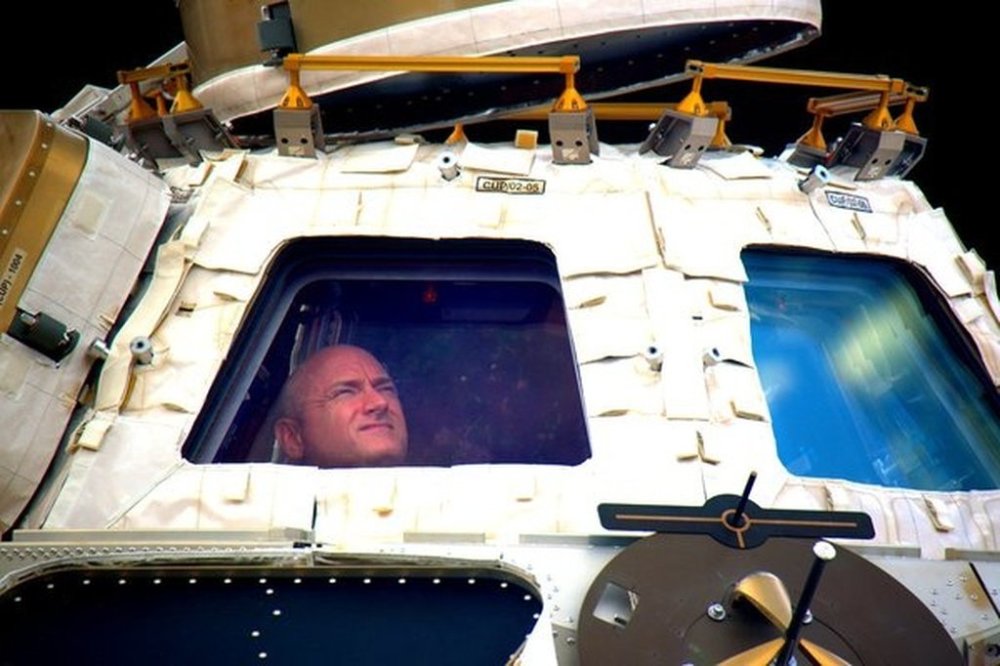
Now the size of a football field with multiple labs, the station has an internet phone for astronauts’ personal use and a glassed-in cupola, or dome, for prime Earth views and performances.
Canada’s guitar-playing astronaut Chris Hadfield famously performed David Bowie’s “Space Oddity” and other tunes from that perch more than a decade ago.
Experimental hothouses also have added color and zip, yielding chile peppers and zinnias. An espresso machine even got a brief tryout, as did a cookie-baking oven. But there’s still no shower or laundry — sponge baths only, with dirty clothes tossed instead of washed.
Highs and lows of station life
Astronauts have gotten married and welcomed newborn children while serving on the space station. One of the new space dads — Mike Fincke — is up there again, more than 20 years after he dialed in from orbit to his wife’s delivery room.
Station residents have also dealt with heartbreak. An astronaut’s mother was killed in a car accident in 2007. And in 2011, Scott Kelly was midway through a five-month stay when his sister-in-law, U.S. Congresswoman Gabrielle Giffords, was shot in the head and survived.
Others have had to cope with delayed returns, the most recent and extreme case involving stuck astronauts Butch Wilmore and Suni Williams. Their planned weeklong test flight of Boeing’s new Starliner capsule turned into a station stay of more than nine months, with NASA switching to SpaceX for the return trip.
Science in zero gravity
Thousands of experiments have been conducted, many on the astronauts themselves. Medical tests took on increased urgency several years ago when an astronaut discovered a blood clot in one of their jugular veins. Doctors oversaw treatment from afar until the patient was safely back home.
NASA also launched a twins study with the Kelly brothers. Scott Kelly took part in NASA’s first yearlong expedition in 2015 and 2016, comparing his body with identical twin Mark’s on the ground. Mark Kelly also contributed to astronomy, leading a shuttle mission to deliver and install a cosmic particle detector. Upgrades are planned next year.
SpaceX will handle the station’s demise
NASA is paying SpaceX nearly $1 billion to boot the space station from orbit in early 2031. The company will launch a heavy-duty capsule to dock with the station and steer it to a fiery reentry over the Pacific.
Before that happens, Axiom Space will remove the module it plans to send to the station. That free-flying module will form the nucleus of Axiom’s own space station. Other companies are working on their own concepts.
NASA wants to avoid a gap between the International Space Station and its successors, preserving America’s continued human presence in orbit.
___
The Associated Press Health and Science Department receives support from the Howard Hughes Medical Institute’s Department of Science Education and the Robert Wood Johnson Foundation. The AP is solely responsible for all content.
Advertisement Advertise With Us
Advertisement Advertise With Us