Canadian ice master makes Olympic history with the Games’ 1st indoor temporary speedskating rink
Advertisement
Read this article for free:
or
Already have an account? Log in here »
To continue reading, please subscribe:

Digital Subscription
One year of digital access for only $205*
- Enjoy unlimited reading on winnipegfreepress.com
- Read the E-Edition, our digital replica newspaper
- Access News Break, our award-winning app
- Play interactive puzzles
*First annual payment billed as $205.00 + GST for one year. This annual subscription will automatically renew at $233.00 + GST every 52 weeks (10% off the regular annual price of $259.35). Offer available to new and qualified returning subscribers only. Cancel any time.
To continue reading, please subscribe:
Add Free Press access to your Brandon Sun subscription for only an additional
$1 for the first 4 weeks*
- Enjoy unlimited reading on winnipegfreepress.com
- Read the E-Edition, our digital replica newspaper
- Access News Break, our award-winning app
- Play interactive puzzles
*Your next Brandon Sun subscription payment will increase by $1.00 and you will be charged $17.95 plus GST for four weeks. After four weeks, your payment will increase to $24.95 plus GST every four weeks.
Read unlimited articles for free today:
or
Already have an account? Log in here »
Hey there, time traveller!
This article was published 12/01/2026 (271 days ago), so information in it may no longer be current.
RHO, Italy (AP) — No ice is colder and harder than speedskating ice. The precision it takes has meant that Olympic speedskaters have never competed for gold on a temporary indoor rink – until the 2026 Milan Cortina Winter Games.
In the pursuit of maximum glide and minimum friction, Olympic officials brought on ice master Mark Messer, a veteran of six previous Olympic speedskating tracks and the ice technician in charge of the Olympic Oval in Calgary, Canada — one of the fastest tracks in the world with over 300 records.
Messer has been putting that experience to work one thin layer of ice at a time since the end of October at the new Speed Skating Stadium, built inside adjacent trade fair halls in the city of Rho just north of Milan.
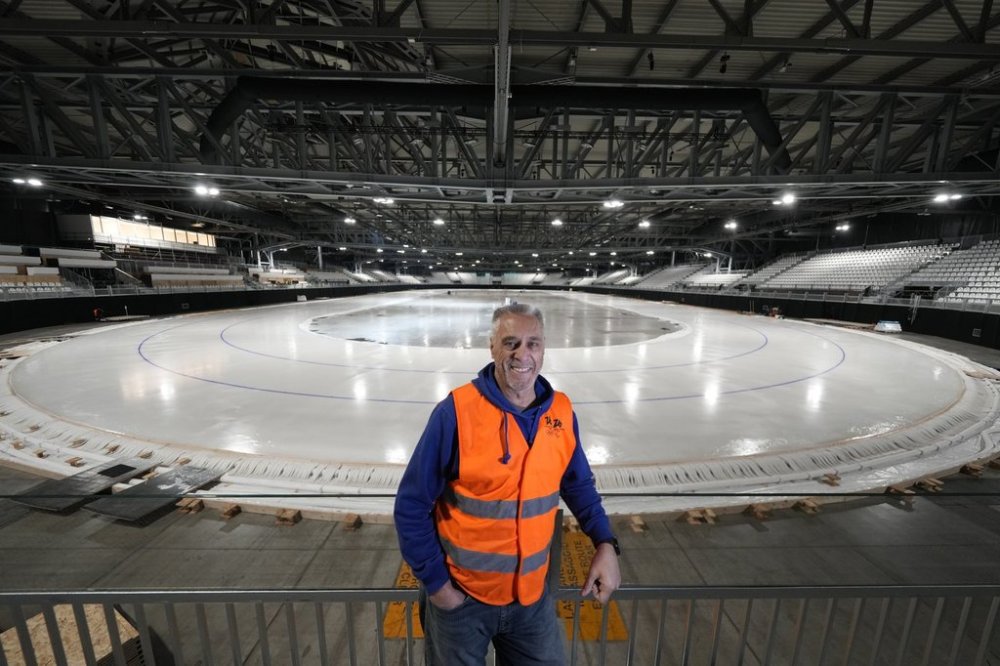
“It’s one of the biggest challenges I’ve had in icemaking,’’ Messer said during an interview less than two weeks into the process.
If Goldilocks were a speedskater, hockey ice would be medium hard, for fast puck movement and sharp turns. Figure skating ice would be softer, allowing push off for jumps and so the ice doesn’t shatter on landing. Curling ice is the softest and warmest of all, for controlled sliding.
For speedskating ice to be just right, it must be hard, cold and clean. And very, very smooth.
“The blades are so sharp, that if there is some dirt, the blade will lose the edge,’’ Messer said, and the skater will lose speed.
Speedskater Enrico Fabris, who won two Olympic golds in Turin in 2006, has traded in his skates to be deputy sports manager at the speedskating venue in Rho. For him, perfect ice means the conditions are the same for all skaters — and then if it’s fast ice, so much the better.
“It’s more of a pleasure to skate on this ice,” he said.
Ice science
Messer’s first Olympics were in Calgary in 1988 — the first time speedskating was held indoors. “That gave us some advantages because we didn’t have to worry about the weather, wind blowing or rain,’’ he said. Now he is upping the challenge by becoming the first ice master to build a temporary rink for the Olympics.
Before Messer arrived in Italy, workers spent weeks setting up insulation to level the floor and then a network of pipes and rubber tubes that carry glycol — an antifreeze — that is brought down to minus 7 or minus 8 degrees Celsius (17.6 to 19.4 degrees Fahrenheit) to make the ice.
Water is run through a purification system — but it can’t be too pure, or the ice that forms will be too brittle. Just the right amount of impurities “holds the ice together,’’ Messer said.
The first layers of water are applied slowly, with a spray nozzle; after the ice reaches a few centimeters it is painted white — a full day’s work — and the stripes are added to make lanes.
“The first one takes about 45 minutes. And then as soon as it freezes, we go back and do it again, and again and again. So we do it hundreds of times,’’ Messer said.
As the ice gets thicker, and is more stable, workers apply subsequent layers of water with hoses. Messer attaches his hose to hockey sticks for easier spreading.
What must absolutely be avoided is dirt, dust or frost — all of which can cause friction for the skaters, slowing them down. The goal is that when the skaters push “they can go as far as possible with the least amount of effort,’’ Messer said.
The Zamboni ice resurfacing machine plays a key role in keeping the track clean, cutting off a layer and spraying water to make a new surface.
One challenge is gauging how quickly the water from the resurfacing machine freezes in the temporary rink.
Another is getting the ice to the right thickness so that the Zamboni, weighing in at six tons, doesn’t shift the insulation, rubber tubing or ice itself.
“When you drive that out, if there’s anything moving it will move. We don’t want that,’’ Messer said.
Final adjustments
The rink got its first big test on Nov. 29-30 during a Junior World Cup event. In a permanent rink, test events are usually held a year before the Olympics, leaving more time for adjustments. “We have a very small window to learn,’’ Messer acknowledged.
Dutch speedskater Kayo Vos, who won the men’s neo-senior 1,000 meters, said the ice was a little soft — but Messer didn’t seem too concerned.

“We went very modest to start, now we can start to change the temperatures and try to make it faster and still maintain it as a safe ice,’’ he said.
Fine-tuning the air temperature and humidity and ice temperature must be done methodically — taking into account that there will be 6,000 spectators in the venue for each event. The next real test will be on Jan. 31, when the Olympians take to the ice for their first training session.
“Eighty percent of the work is done but the hardest part is the last 20 percent, where we have to try to find the values and the way of running the equipment so all the skaters get the same conditions and all the skaters get the best conditions,’’ Messer said.
___
AP Winter Olympics: https://apnews.com/hub/milan-cortina-2026-winter-olympics
Related Articles
USA Luge gets 11 athletes into Milan Cortina Olympics, 1 shy of maximum. Russia will get 2 spots


Advertisement Advertise With Us
Advertisement Advertise With Us