Indonesian handprints are the oldest cave art found yet

Advertisement

Advertise with us

NEW YORK (AP) — Handprints on cave walls in a largely unexplored area of Indonesia may be the oldest rock art studied so far, dating back to at least 67,800 years ago.

Read this article for free:


or

Already have an account? Log in here »

To continue reading, please subscribe:

Subscribe and receive a limited-edition Free Press branded hat or tote.

Digital Subscription

One year of digital access for only $205*

  • Enjoy unlimited reading on winnipegfreepress.com
  • Read the E-Edition, our digital replica newspaper
  • Access News Break, our award-winning app
  • Play interactive puzzles

*First annual payment billed as $205.00 + GST for one year. This annual subscription will automatically renew at $233.00 + GST every 52 weeks (10% off the regular annual price of $259.35). Offer available to new and qualified returning subscribers only. Cancel any time.

To continue reading, please subscribe:

Add Free Press access to your Brandon Sun subscription for only an additional

$1 for the first 4 weeks*

  • Enjoy unlimited reading on winnipegfreepress.com
  • Read the E-Edition, our digital replica newspaper
  • Access News Break, our award-winning app
  • Play interactive puzzles
Start now

*Your next Brandon Sun subscription payment will increase by $1.00 and you will be charged $17.95 plus GST for four weeks. After four weeks, your payment will increase to $24.95 plus GST every four weeks.

Hey there, time traveller!
This article was published 21/01/2026 (252 days ago), so information in it may no longer be current.

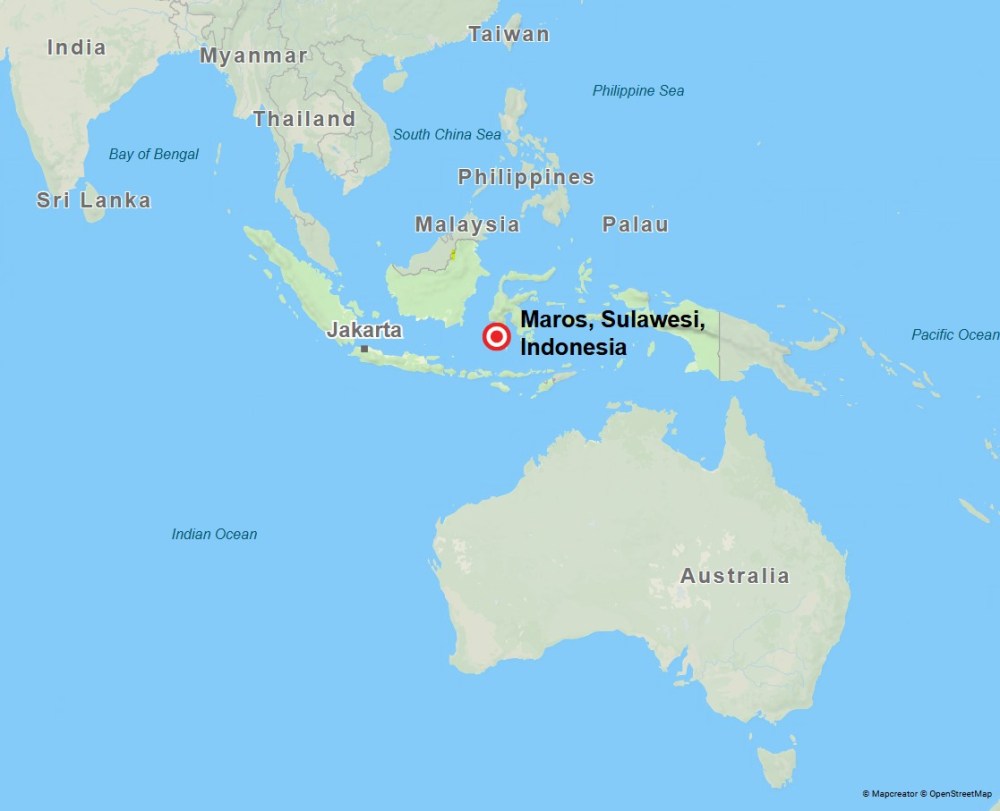
NEW YORK (AP) — Handprints on cave walls in a largely unexplored area of Indonesia may be the oldest rock art studied so far, dating back to at least 67,800 years ago.

The tan-colored prints analyzed by Indonesian and Australian researchers on the island of Sulawesi were made by blowing pigment over hands placed against the cave walls, leaving an outline.

Some of the fingertips were also tweaked to look more pointed.
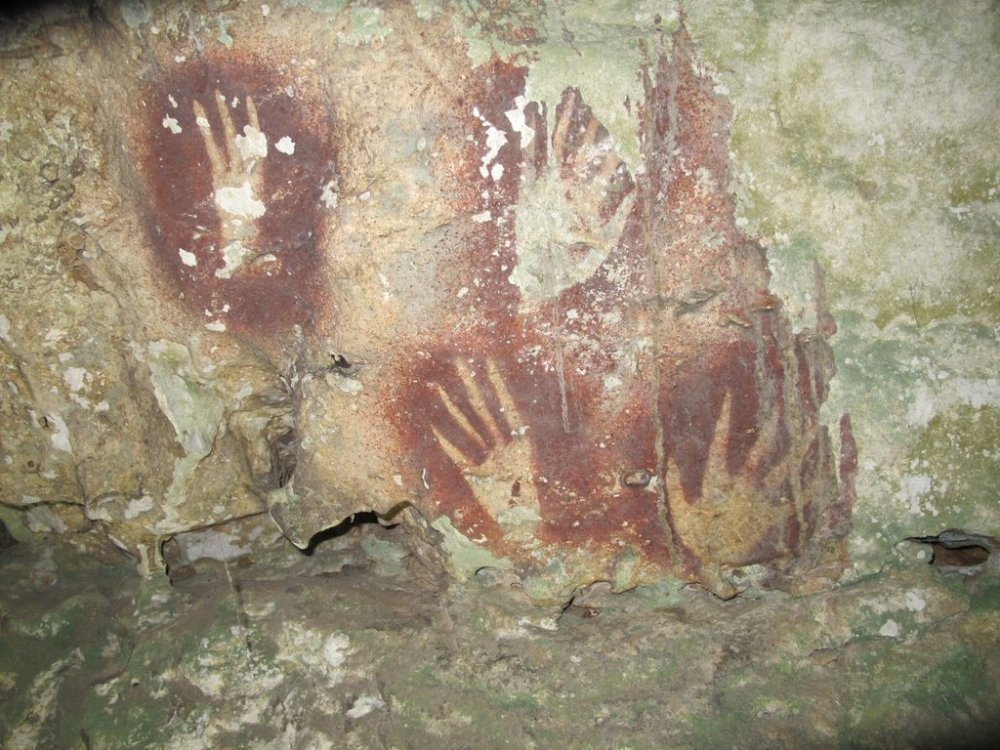
This undated image provided by Maxime Aubert shows handprints with sharpened fingertips in the Maros region of Sulawesi, Indonesia. (Ahdi Agus Oktaviana/Maxime Aubert via AP)

This prehistoric art form suggests the Indonesian island was home to a flourishing artistic culture. To figure out how old the paintings were, researchers dated mineral crusts that had formed on top of the art.

Upon seeing the new study, independent paleoanthropologist Genevieve von Petzinger said she “let out a little squeal of joy.”

“It fits everything I’d been thinking,” she said.

Indonesia is known to host some of the world’s earliest cave drawings, and scientists have analyzed countless examples of ancient art across the globe — including simple marks on bones and stones that go back hundreds of thousands of years.

Cross-hatched markings on a piece of rock in South Africa have been dated to about 73,000 years ago.

The new art from southeastern Sulawesi is the oldest to be found on cave walls.
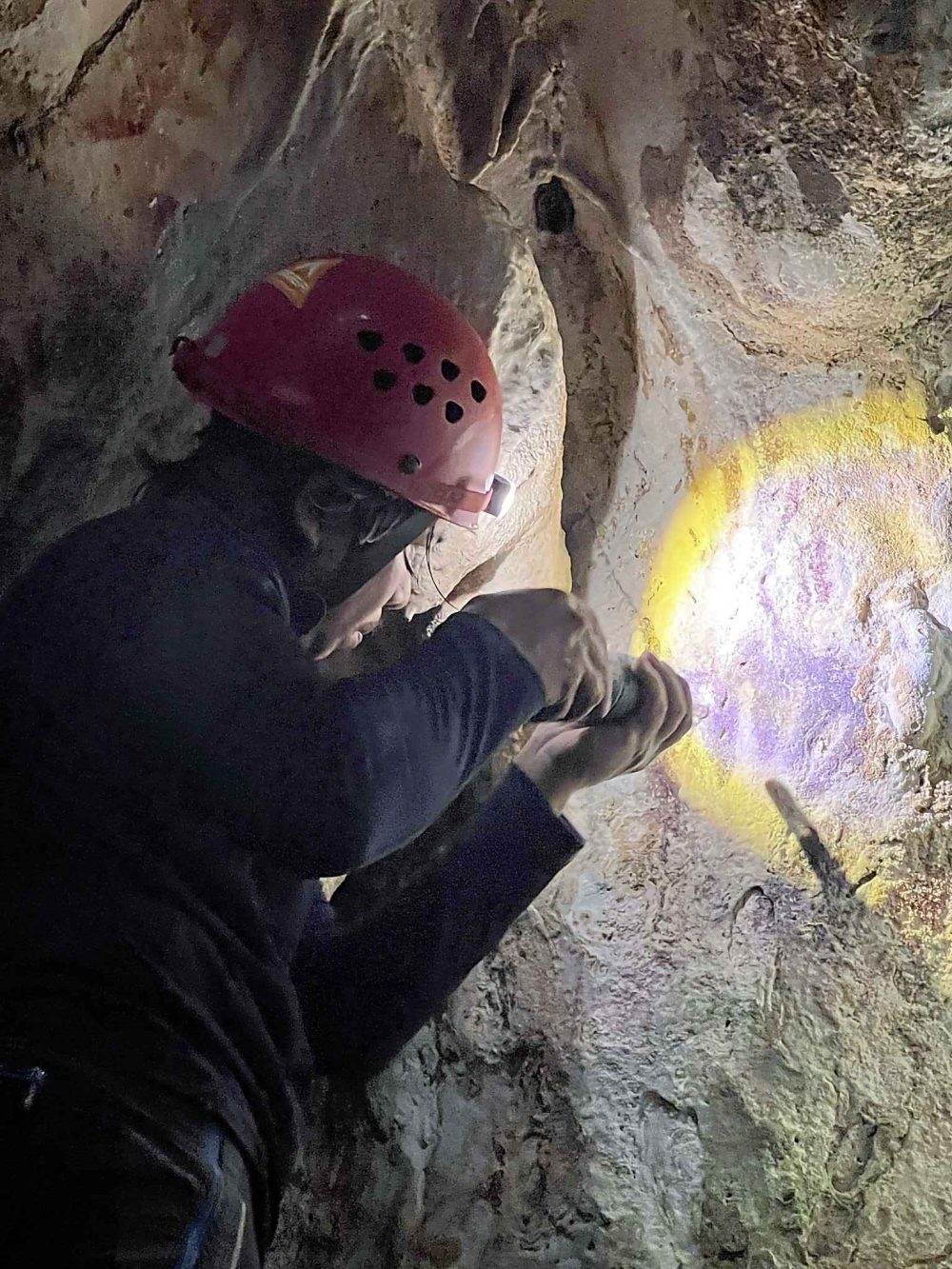
This image provided by Maxime Aubert shows scientist Adhi Agus Oktaviana studying handprints on the walls of a cave in Sulawesi, Indonesia.  (Maxime Aubert via AP)
This image provided by Maxime Aubert shows scientist Adhi Agus Oktaviana studying handprints on the walls of a cave in Sulawesi, Indonesia. (Maxime Aubert via AP)

The stencils also represent a more complex tradition of rock art that could have been a shared cultural practice, said study author Maxime Aubert with Griffith University, who published the study Wednesday in the journal Nature.

Scientists are eager to understand when early humans learned to make art, moving from dots and lines to more meaningful representations of themselves and the world around them.

These cave drawings help firm up a timeline for the dawn of human creativity.

It’s not yet clear whose hands made the prints. They could be from an ancient human group called Denisovans who lived in the area and may have interacted with our Homo sapiens ancestors before eventually going extinct.

Or they may belong to modern humans venturing away from Africa, who could have wandered through the Middle East and Australia around this time.
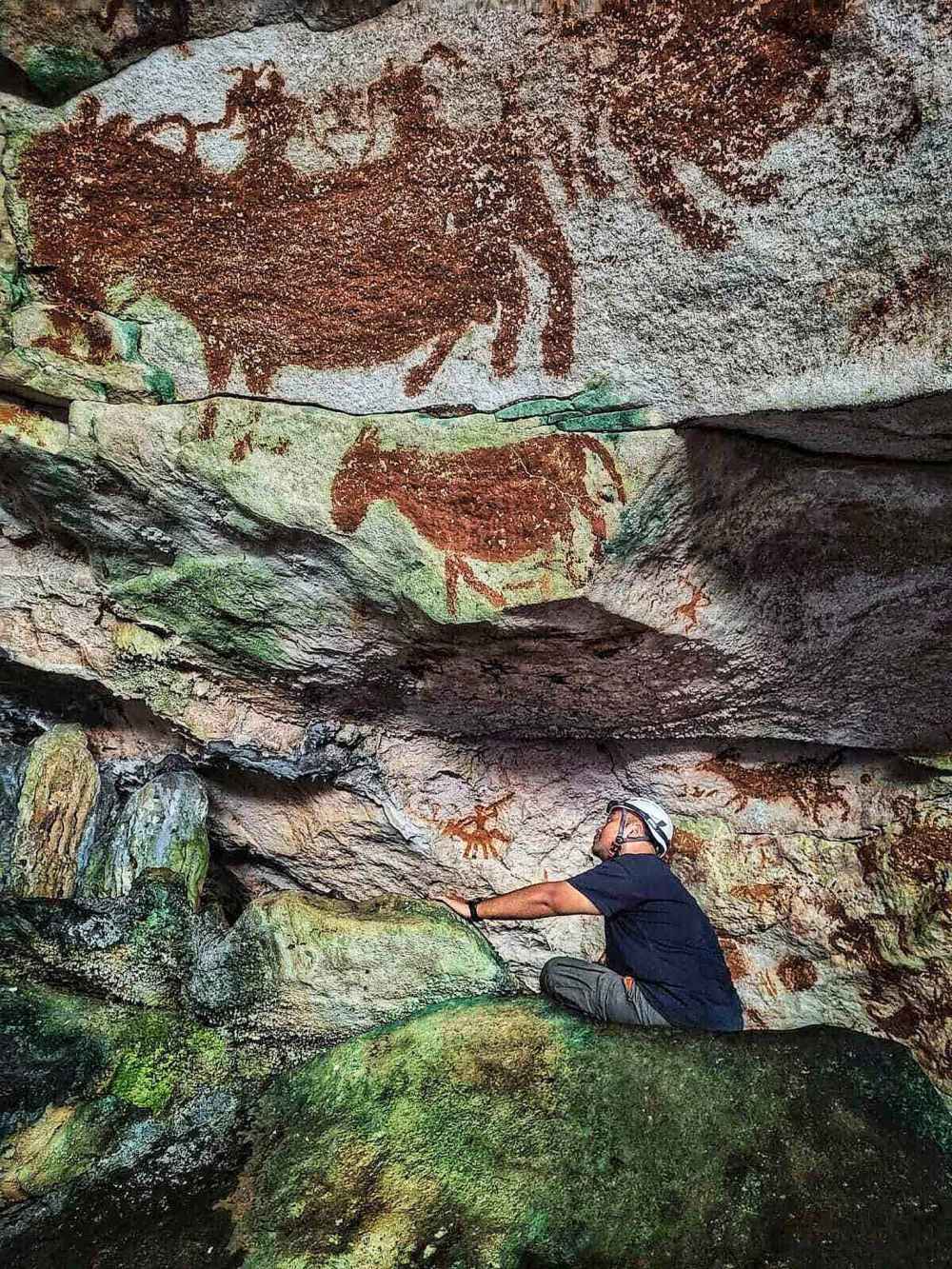
This image provided by Maxime Aubert shows scientist Shinatria Adhityatama studying cave art found in Sulawesi, Indonesia.  (Maxime Aubert via AP)
This image provided by Maxime Aubert shows scientist Shinatria Adhityatama studying cave art found in Sulawesi, Indonesia. (Maxime Aubert via AP)

Fine details on the cave art, including the intentionally modified fingertips, point to a human hand.

Other drawings discovered in the same area of the island, including a human figure, a bird and horselike animals, were found to be created much more recently, some of them about 4,000 years ago.

There’s likely more art to be found on nearby islands that could be even older than the handprints.

Future studies may help scientists understand how these artistic traditions spread across the globe and how they’re woven into the fabric of humanity’s early days.

“For us, this discovery is not the end of the story,” Aubert said in an email. “It is an invitation to keep looking.”
___

The Associated Press Health and Science Department receives support from the Howard Hughes Medical Institute’s Department of Science Education and the Robert Wood Johnson Foundation. The AP is solely responsible for all content.

Report Error Submit a Tip

More Stories

Klein vows to freeze water, sewer rate for next two years

Joyanne Pursaga 5 minute read Preview

Klein vows to freeze water, sewer rate for next two years

Joyanne Pursaga 5 minute read 6:09 PM CDT

Mayoral candidate Kevin Klein is promising to cancel a water and sewer rate hike proposed for next year and freeze the fee for two years.

Klein said Winnipeggers are simply paying far too much for the utility.

“I think we have to freeze them right now because we’ve seen (a substantial increase) in the last four years. We are facing some of the most difficult financial times for families right now,” he said.

He would also ask the provincial Public Utilities Board to set Winnipeg’s future water and sewer rates, a power currently held by city council.

Read
6:09 PM CDT

Teacher barred for ‘repeated boundary-crossing conduct’

Maggie Macintosh 3 minute read Yesterday at 11:01 PM CDT

A disciplinary panel has ordered the cancellation of a Chinese-Canadian teacher’s certificate because of her “repeated boundary-crossing with a student” during her tenure at an international school with local ties.

Janice Wen Ying Ma is permanently barred from teaching on Manitoba soil or at a Manitoba-accredited institution as of Sept. 14.

The new ruling concludes that Ma engaged in inappropriate physical interaction and “emotionally intimate online messages” with a girl who attended Clifford International School in Guangzhou, China in 2024-25.

“This conduct represents a fundamental departure from the standards expected of a teacher,” the panel, chaired by public representative Gordon Schumacher, wrote in its 22-page decision.

Billions of dollars spent on health, but scattershot financial reporting leaves decision-makers, Manitobans in the dark, auditor general says

Nicole Buffie 3 minute read Preview

Billions of dollars spent on health, but scattershot financial reporting leaves decision-makers, Manitobans in the dark, auditor general says

Nicole Buffie 3 minute read 5:20 PM CDT

Manitoba’s auditor general says significant gaps in health-sector financial reporting make it difficult to understand how billions of dollars in public funds are spent.

Auditor General Tyson Shtykalo is calling for clearer, more transparent reporting in his latest report, titled Observations on Health Sector Financial Reporting and Accountability in Manitoba.

“Manitoba spends nearly $10 billion annually on health care, but current financial reporting does not provide a clear picture of how that money is spent, what services cost, or the financial pressures facing the system,” Shtykalo said in a news release.

While some financial information is available, the reports do not provide a “complete, consistent, or easily understood” picture of how health-care funds are spent, the report said.

Read
5:20 PM CDT

Port of Churchill signs agreement with Dutch port

Aaron Epp 2 minute read Preview

Port of Churchill signs agreement with Dutch port

Aaron Epp 2 minute read 4:40 PM CDT

Arctic Gateway Group, operator of the Port of Churchill, has signed an agreement with the Port of Rotterdam in the Netherlands to attract business and strengthen supply chains linking Western Canada and Europe.

The agreement enables the two ports to work together to develop new trade in critical minerals and energy products, connect Canadian producers with European buyers, and identify opportunities to improve the supply chain from Western Canadian resource projects through Churchill and into European markets.

The Port of Rotterdam is Europe’s largest port and home to more than 3,000 businesses across its industrial complex, serving as a major gateway for critical raw materials and energy.

Meanwhile, the Port of Churchill has been identified as a transformative national strategy for Canada and is emerging as a northern trade corridor connecting Western Canada’s resources to global markets.

Read
4:40 PM CDT

Retiree sues neighbour over alleged dog attack

Scott Billeck 2 minute read 2:00 AM CDT

A Winnipeg man is suing his neighbour over an alleged dog attack he says occurred while he was helping him with a lawnmower.

Arthur Cabel, a retiree who lives on Selkirk Avenue, is seeking unspecified damages from neighbour Saisamone Saegone, according to a statement of claim filed in the Manitoba Court of King’s Bench last week.

Cabel claims he went to Saegone’s home in the afternoon on Sept. 23, 2024, to help him with his lawnmower.

According to the lawsuit, Saegone’s large dog, initially in a fenced backyard, escaped, approaching Cabel and “mauling, attacking and biting him.”

Hydro reports $446-M loss in 2025-26, points to fourth drought year in past five

Scott Billeck 3 minute read Preview

Hydro reports $446-M loss in 2025-26, points to fourth drought year in past five

Scott Billeck 3 minute read 6:38 PM CDT

Manitoba Hydro posted a $446-million loss in 2025-26, as drought conditions slashed hydroelectric generation, forcing the Crown corporation to buy more power while leaving it with less electricity to sell outside the province.

The loss was $666 million worse than the $220-million profit Hydro had budgeted. The utility posted a $63-million loss the previous year, according to the utility’s annual report released Tuesday.

Hydro said the 2025-26 fiscal year, which ended on March 31, marked its fourth low-water year in the past five years, among the worst stretches of water-flow conditions in its recorded history.

Hydroelectric generation fell 23 per cent to 24 billion kilowatt-hours from 31 billion the previous year, leaving Hydro a net importer of electricity.

Read
6:38 PM CDT