‘Creeping snow drought’: Canadian research shows less snowpack a concern

Advertisement

Advertise with us

New research shows less snowpack in certain regions of Canada can have wide-ranging effects on everything from farms and wildlife to the broader economy. 

Read this article for free:


or

Already have an account? Log in here »

To continue reading, please subscribe:

Subscribe and receive a limited-edition Free Press branded hat or tote.

Digital Subscription

One year of digital access for only $205*

  • Enjoy unlimited reading on winnipegfreepress.com
  • Read the E-Edition, our digital replica newspaper
  • Access News Break, our award-winning app
  • Play interactive puzzles

*First annual payment billed as $205.00 + GST for one year. This annual subscription will automatically renew at $233.00 + GST every 52 weeks (10% off the regular annual price of $259.35). Offer available to new and qualified returning subscribers only. Cancel any time.

To continue reading, please subscribe:

Add Free Press access to your Brandon Sun subscription for only an additional

$1 for the first 4 weeks*

  • Enjoy unlimited reading on winnipegfreepress.com
  • Read the E-Edition, our digital replica newspaper
  • Access News Break, our award-winning app
  • Play interactive puzzles
Start now

*Your next Brandon Sun subscription payment will increase by $1.00 and you will be charged $17.95 plus GST for four weeks. After four weeks, your payment will increase to $24.95 plus GST every four weeks.

Hey there, time traveller!
This article was published 29/01/2026 (191 days ago), so information in it may no longer be current.

New research shows less snowpack in certain regions of Canada can have wide-ranging effects on everything from farms and wildlife to the broader economy. 

The Concordia University study, published in the Nature journal “Communications Earth and Environment,” says the usable water from snowpacks has dropped sharply in areas of the Canadian Rockies.

The mountainous region is the headwaters of major rivers in British Columbia and the Prairies, feeding communities and habitats. 
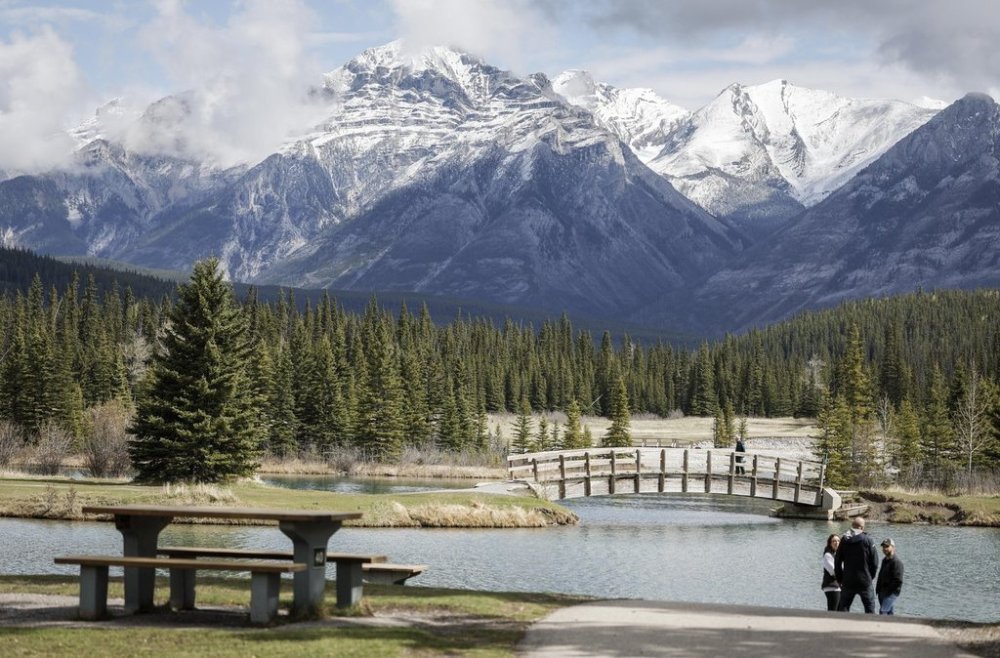
Visitors explore Cascade Ponds in Banff National Park, Alta., Thursday, May 15, 2025.THE CANADIAN PRESS/Jeff McIntosh

Ali Nazemi, an associate professor at the university and an author of the study, has called the finding “creeping snow drought,” which he says threatens Canada’s water supply. 

“You don’t really realize it up to the time that you are in the middle of a crisis,” Nazemi said in an interview.

The researchers analyzed snowpack data from 2000 to 2019, finding three per cent of Canada’s land mass — areas of the Canadian Rockies — saw declines. 

To determine losses, they measured the amount of water available in snowpack using satellite data and climate reanalysis techniques, Nazemi said. 

He said while three per cent may seem small, the losses are situated in critical headwaters that downstream users heavily rely upon.

“(There) are a lot of social and economic activities blended there,” Nazemi said. 

The paper cites past Canadian climate events that suggest were a result of snowpack issues. 

It says during a drought in 2015, low snowpack contributed to water shortages in British Columbia’s Okanagan region where sockeye salmon populations collapsed. A lack of cooler water from mountain runoff caused warmer stream temperatures the fish couldn’t survive in, the paper says.

The drought that year also reached the Prairies, causing less inflows into Saskatchewan’s Lake Diefenbaker, a major reservoir. It resulted in strains to hydroelectric power generation and agricultural irrigation. 

The paper also says a lack of snow more than 10 years ago in parts of Ontario and Quebec had affected the shipping industry. 

It says due to little snow in 2011, there wasn’t much meltwater to replenish the Great Lakes. It triggered an emergency situation, where harbours were dredged and ships lightened their loads.

In Quebec, dams were released so ships could come and go at the Port of Montreal, Nazemi said.

“We showed that St. Lawrence River might be one of the vulnerable places due to this,” he said. “Perhaps we cannot take hydropower anymore (for) granted.”

Despite declines in the Rockies, snowpack has increased in other areas, the research shows.

Nazemi said Canada’s north is seeing more snow due to warming ice in the Arctic Ocean. As the ice melts, it releases more moisture into the atmosphere. 

“This global warming is basically corresponding with both increasing snow water availability in the north … and also decreasing in the south in the mountains,” he said.

“There are some other factors, like atmospheric and oceanic factors playing in that. So, we can say it’s a combination of climate change and natural climate variability.” 

Nazemi said it would be alarming if the trends continue.

“We need to really think again about how we are managing our water and how we are developing around that new reality of water,”  he said. “We have a lot of people talking about the fact that the water future might actually be different from what we have now.”

He said the Canada Water Agency, along with the Global Institute for Water Security in Saskatchewan, are working to address future scarcity issues.

But there needs to be better ways to assess problems at local levels, he added.

“What is actually happening in a neighbourhood, in a community, in a farm, in a wetland?” he said. “In part of this paper, we showed that when we go to the smaller scale … the uncertainties can actually be skyrocketing.” 

The research received funding from the Canadian government through grant programs.

This report by The Canadian Press was first published Jan. 29, 2026.

Report Error Submit a Tip

More Stories

Local medical scrubs retailer feeling abandoned by U of M, RRC Polytech nursing programs

Maggie Macintosh 4 minute read Preview

Local medical scrubs retailer feeling abandoned by U of M, RRC Polytech nursing programs

Maggie Macintosh 4 minute read Yesterday at 7:01 PM CDT

A Winnipeg uniform store is appealing to medical students to shop locally for scrubs this back-to-school season as it grapples with growing competition online and an apparent shutout by local campuses.

Unimor Healthwear has long ordered uniforms in bulk in navy blue, burgundy and pewter, as nurses-in-training are required to wear those colours based on where they’re enrolled in the province.

“It’s not like it used to be,” Evan Schwartz said about customer traffic to his store at 98 Sherbrook St.

The company’s director estimated he spent about $15,000 to stock up on scrubs in pewter in preparation for the launch of Red River College Polytechnic’s upcoming nursing intake.

Read
Yesterday at 7:01 PM CDT

Quaker movement fuelled by a fierce sense of social justice

Josiah Neufeld 11 minute read Preview

Quaker movement fuelled by a fierce sense of social justice

Josiah Neufeld 11 minute read Yesterday at 6:00 PM CDT

A few weeks ago, the erstwhile punk-rock-poet John Samson Fellows taught an auditorium full of people how to fold a paper cup.

With each fold, he explained that origami is an activity he likes to do with people who are incarcerated.

“It can be really empowering to make something with your hands in that environment,” he explained over the rustle of fingers creasing paper.

Samson Fellows is perhaps best known as the former frontman for the indie-rock band the Weakerthans and the author of an anthem beloved in his hometown for its self-deprecating refrain: “I hate Winnipeg.”

Read
Yesterday at 6:00 PM CDT

A Winnipeg man who targeted female seniors during a month-long purse-snatching spree has been sentenced to three years in prison.

“This isn’t just a matter of opportunity, this is a matter of forethought,” provincial court Judge Jay Funke said at a sentencing hearing Thursday for Ryan Allingham.

“He targets these individuals because they are easier to steal from,” Funke said. “It doesn’t get much worse — he’s stealing from little old ladies.”

Allingham, 49, pleaded guilty to multiple charges of robbery and theft involving eight victims, six of whom were between the ages of 62 and 82.

Jefferson, face of the Bombers defensive line, shares game day routine

Taylor Allen 8 minute read Preview

Jefferson, face of the Bombers defensive line, shares game day routine

Taylor Allen 8 minute read 5:48 PM CDT

Clearly, Willie Jefferson’s game-day routine works wonders.

The future Hall of Famer is still as dominant as ever at age 35 and is currently tied for the CFL lead with six sacks.

But what does the lead-up to kickoff at Princess Auto Stadium typically look like for the face of the Winnipeg Blue Bombers’ defence?

The Free Press had a lengthy chat with the defensive end before the bye week to find out.

Read
5:48 PM CDT

Trucking operation linked to fatality in Brandon shut down by Alberta government

Malak Abas 5 minute read Preview

Trucking operation linked to fatality in Brandon shut down by Alberta government

Malak Abas 5 minute read 5:24 PM CDT

The Alberta government has shut down Conquer Transport Inc., the trucking company linked to a crash near Brandon in which a 49-year-old woman, who had the right of way, was killed.

Devin Dreeshen, Alberta’s transport minister, said the province launched an investigation into Conquer Transport after one of its semi-trucks ran a stop sign on May 27, 2026 at Highway 110 at Richmond Avenue East.

The semi hit an SUV driven by Xiaoyun Zhang, a Chinese immigrant who worked at the nearby pork processing plant. She died at the scene and the truck driver, 35-year-old Brijpal Panwar, has been charged with dangerous driving causing death.

“Our investigative team went out and … saw numerous non-compliance issues, whether it was hours of service with their drivers not being recorded properly, vehicle maintenance and inspections being insufficient, their safety program also being insufficient.”

Read
5:24 PM CDT

Winnipeggers hoping for shorter waits in rural ERs delay care for all, Selkirk nurse says

Nicole Buffie 5 minute read Preview

Winnipeggers hoping for shorter waits in rural ERs delay care for all, Selkirk nurse says

Nicole Buffie 5 minute read Updated: Yesterday at 8:38 PM CDT

Nurses and union leaders say Winnipeggers — who are frustrated with wait times at city hospitals — head to rural emergency rooms instead, but the facilities don’t have enough staff to meet the extra demand.

As a result, patients in the Selkirk Regional Health Centre emergency department have waited up to 18 hours during peak times, said one nurse who works there.

The nurse, who spoke to the Free Press on the condition of anonymity, said in recent years they have noted more Winnipeg patients who’ve driven the 25 kilometres north to Selkirk’s ER, believing the wait for treatment would be shorter than in the three emergency departments inside the Perimeter.

“They’re all trying to access health care, right? And everybody deserves health care. And I feel bad, because people have to come out here thinking that the wait times are less,” the nurse said. “I can’t blame people for wanting to seek care, and they’re desperate to see someone.”

Read
Updated: Yesterday at 8:38 PM CDT