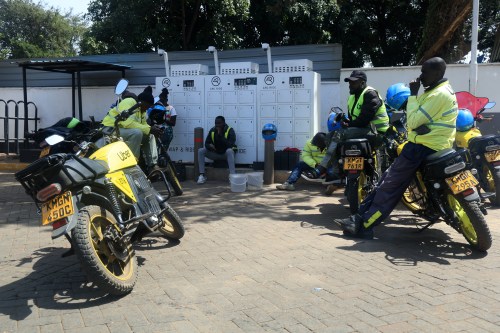
Electric motorcycle riders in Kenya demand more flexible battery networks
Advertisement
Read this article for free:
or
Already have an account? Log in here »
To continue reading, please subscribe:

Digital Subscription
One year of digital access for only $205*
- Enjoy unlimited reading on winnipegfreepress.com
- Read the E-Edition, our digital replica newspaper
- Access News Break, our award-winning app
- Play interactive puzzles
*First annual payment billed as $205.00 + GST for one year. This annual subscription will automatically renew at $233.00 + GST every 52 weeks (10% off the regular annual price of $259.35). Offer available to new and qualified returning subscribers only. Cancel any time.
To continue reading, please subscribe:
Add Free Press access to your Brandon Sun subscription for only an additional
$1 for the first 4 weeks*
- Enjoy unlimited reading on winnipegfreepress.com
- Read the E-Edition, our digital replica newspaper
- Access News Break, our award-winning app
- Play interactive puzzles
*Your next Brandon Sun subscription payment will increase by $1.00 and you will be charged $17.95 plus GST for four weeks. After four weeks, your payment will increase to $24.95 plus GST every four weeks.
Read unlimited articles for free today:
or
Already have an account? Log in here »
Hey there, time traveller!
This article was published 06/02/2026 (221 days ago), so information in it may no longer be current.
NAIROBI, Kenya (AP) — For weeks, popular Kenyan podcaster and radio presenter Francis Kibe Njeri has used his social media platforms to spotlight a problem he says many electric motorcycle riders face but few companies in the industry acknowledge: batteries unable to be swapped across networks and motorcycles that can be remotely disabled after periods of inactivity.
Electric motorcycles, also known as electric mobility bikes or e-bikes, are gaining ground throughout Africa, led by companies such as Ampersand, ARC Ride and Roam. The continent’s largest e-bike firm, Spiro, operates more than 1,200 battery charging and swap stations and has deployed about 60,000 electric motorcyles, according to its most recent public filing in late 2024.
Njeri claims in his widely shared posts that some operators’ remote lockout features have rendered electric motorcycles unusable, stranding riders who depend on them for their livelihood. He is among many calling for more open, standardized battery systems.
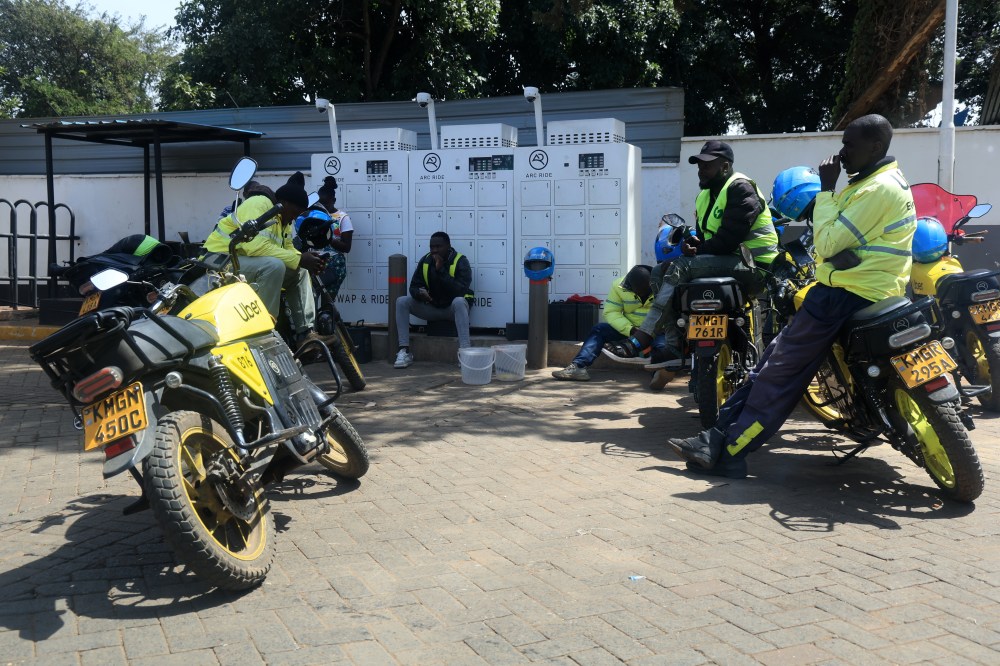
“It is not fair that we purchase the bikes, but the battery remains the property of the manufacturer, and we can only use their stations and not charge them at home,” Njeri said.
EV bike riders take to the streets
Hundreds of Kenyan e-bike riders in Nairobi and the coastal city of Mombasa took to the streets in November, chanting and waving placards demanding more battery-swap stations and open access across networks.
“I lose up to 500 Kenyan shillings ($4.50) every time I can’t find a swap point and sit waiting,” said Oscar Okite, a Nairobi-based rider who has embraced e-bikes for lower operating costs but says scarce swap stations limit his earnings potential. “We need battery networks that work everywhere, not just in the city.”
Electric motorcycles powered by replaceable lithium-ion batteries are cheaper to use than gas-powered bikes. Most of these firms say riders can save up to 40% on daily operating expenses because electricity is cheaper than fuel and maintenance is simpler.
Yet there is still uneven access to swap stations, hubs where riders trade drained batteries for charged ones in minutes. In Nairobi and other urban centers, networks operated by Spiro, Ampersand and their competitors have set up dozens of stations, but gaps remain outside major corridors and in outlying areas.
“It’s great when I’m near a proper swap site,” Njeri said. “But go two or three towns away and you’re likely to be stuck.”
E-bike ecosystems limit flexibility
Africa’s electric motorcycle companies have mostly built vertically integrated systems, where vehicles, batteries and charging infrastructure are designed to work only within a single brand’s ecosystem.
The latest figures by the Africa E-mobility Alliance show East Africa leads with over 89 active e-mobility companies, followed by 46 in Southern Africa, 39 in West Africa and 19 in North Africa. There are only six such companies in Central Africa.
Most are e-bike companies, with 16% offering three-wheelers.
East Africa also accounts for mostof the e-mobility investments, at $207 million as of September, followed by West Africa at $173 million and Southern Africa at $100 million.
The mainstay of the e-bike business is battery-swap networks, an energy system that has proven effective in parts of Asia and Europe. But critics say fragmented systems where batteries and stations are tied to specific brands due to their proprietary technologies are hindering growth despite supportive government policies.
“The lack of interoperability across charging and battery-swapping stations remains one of the biggest bottlenecks to scaling the sector,” said Eric Tsui, commercial manager at asset financing firm Watu Africa.
“From a financing and consumer perspective, the worst-case scenario is having many swap stations that cannot serve all riders,” he said. “We need interoperability so that batteries can be charged or swapped at any station, regardless of the operator.”
Businesses say sharing is complicated
Sharing swap networks is critical for scaling up electric mobility. But investment costs are high.
Building a network involves not just batteries and charging stations, but also land, security, software systems and continual maintenance. Millions of dollars are needed before companies make any return on their investments. Standardizing battery sizes, safety protocols and payment systems across firms also involves complex technical and commercial negotiations.
Spiro CEO Kaushik Burman said he is open to network sharing if it’s done safely, pointing to battery safety standards set by Singapore and India. He added that his company welcomes “manufacturers who will want to build e-bikes that can run on our battery system.”
“Before we allow them in, we will integrate, test and certify,” he said. “However, openly allowing any battery to enter any swap station without integration is a recipe for disaster which we cannot accept.”
There are signs of change
Ampersand announced plans in January to extend its battery-swap network to other electric motorcycle makers, allowing compatible bikes to use its infrastructure in the first such system in Africa.
“This open-platform approach means more manufacturers can enter the market without the need to build separate charging infrastructure,” Ampersand CEO Josh Whale said. “In Africa’s e-mobility space, one company often controls the bike and the battery network, but that’s not how energy markets should work.”
Ampersand sees itself as the electric battery “fuel station” where electric bikes whose battery packs meet quality and safety standards should be able to plug in, Whale said. E-bikes from other companies, such as Wylex Mobility, can tap into Ampersand’s network in Kenya and Rwanda, expanding access for riders.
The changes are overdue, riders say.
“It’s hurting my business when I can’t swap on time,” said Kevin Macharia, a Nairobi e-bike rider who sometimes declines rides and delivery requests when his charge is low for fear of venturing too far from a swap station. “We went electric to earn more, not stand by the roadside.”
___
The Associated Press’ climate and environmental coverage receives financial support from multiple private foundations. The AP is solely responsible for all content. Find the AP’s standards for working with philanthropies, a list of supporters and funded coverage areas at AP.org.