White House urges Congress to take a light touch on AI regulations in new legislative blueprint
Advertisement
Read this article for free:
or
Already have an account? Log in here »
To continue reading, please subscribe:

Digital Subscription
One year of digital access for only $205*
- Enjoy unlimited reading on winnipegfreepress.com
- Read the E-Edition, our digital replica newspaper
- Access News Break, our award-winning app
- Play interactive puzzles
*First annual payment billed as $205.00 + GST for one year. This annual subscription will automatically renew at $233.00 + GST every 52 weeks (10% off the regular annual price of $259.35). Offer available to new and qualified returning subscribers only. Cancel any time.
To continue reading, please subscribe:
Add Free Press access to your Brandon Sun subscription for only an additional
$1 for the first 4 weeks*
- Enjoy unlimited reading on winnipegfreepress.com
- Read the E-Edition, our digital replica newspaper
- Access News Break, our award-winning app
- Play interactive puzzles
*Your next Brandon Sun subscription payment will increase by $1.00 and you will be charged $17.95 plus GST for four weeks. After four weeks, your payment will increase to $24.95 plus GST every four weeks.
Read unlimited articles for free today:
or
Already have an account? Log in here »
Hey there, time traveller!
This article was published 20/03/2026 (210 days ago), so information in it may no longer be current.
WASHINGTON (AP) — The White House said Friday that Congress should “preempt state AI laws” that it views as too burdensome, laying out a broad framework for how it wants Congress to address concerns about artificial intelligence without curbing growth or innovation in the sector.
The legislative blueprint outlines a half-dozen guiding principles for lawmakers, focusing on protecting children, preventing electricity costs from surging, respecting intellectual property rights, preventing censorship and educating Americans on using the technology.
House Republican leaders swiftly endorsed the framework and said they’re ready to work “across the aisle” to pass legislation, but doing so would be a heavy lift, requiring agreement with Democrats in the Senate as public divisions over AI run deep.
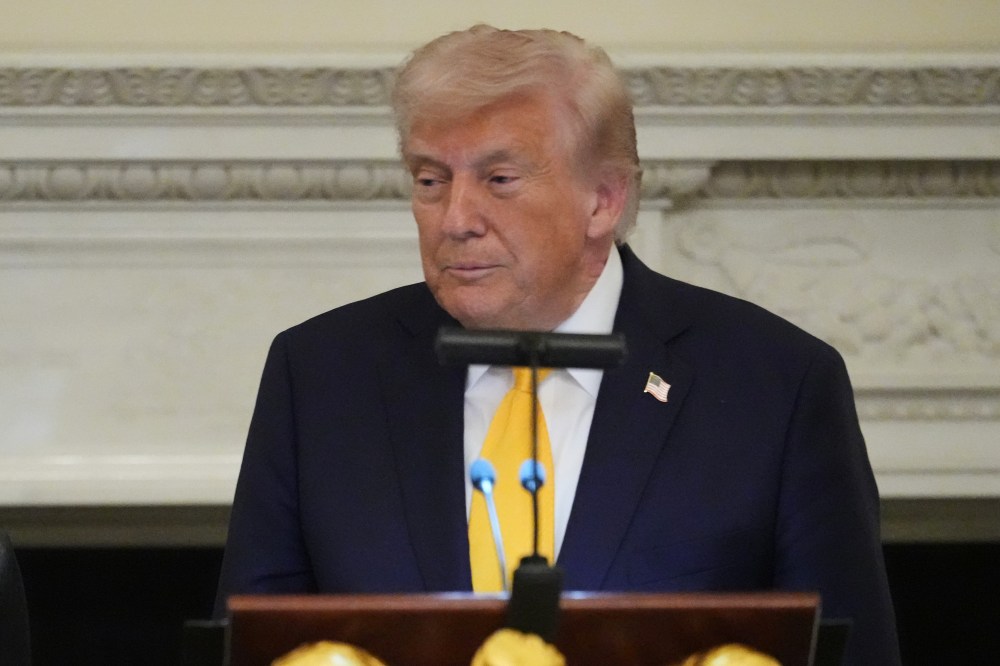
The announcement comes as state governments have forged ahead on their own regulations for AI while civil liberties and consumer rights groups lobby for more regulations on the powerful technology. The industry and the White House have pushed back, arguing that a patchwork of rules would hurt growth. Trump signed an executive order in December to block states from crafting their own regulations.
“This was in response to a growing patchwork of 50 different state regulatory regimes that threaten to stifle innovation and jeopardize America’s lead in the AI race,” said White House AI czar David Sacks in a social media post Friday.
Sacks said the next step is to work with Congress to turn the administration’s principles into federal legislation.
AI legislation could need bipartisan support to pass
While passing sweeping AI legislation will be difficult, especially in a midterm election year, the framework appeared designed to appeal to some AI-wary Republicans and Democrats with a focus on widespread and bipartisan concerns, such as the harms that AI chatbot companionship can pose to children and the electricity costs of AI infrastructure.
“It covers basically all the key sticking points I think that might stop an AI bill from moving through Congress,” said Neil Chilson, a Republican former chief technologist for the Federal Trade Commission who now leads AI policy at the Abundance Institute. “It reads to me as an attempt to build a larger tent, even if it doesn’t give everybody everything that they want.”
But it has already been panned by some Democrats, including U.S. Rep. Josh Gottheimer of New Jersey, who said in a statement it “fails to address key issues, including strong accountability for AI companies, under the guise of protecting children, communities, and creators. Americans need protection — but this means nothing if we allow the AI industry to be the Wild West.”
Whether AI legislation can pass both chambers of Congress could also rely heavily on the support of Republicans like U.S. Sen. Marsha Blackburn of Tennessee, who has introduced her own AI bill, and last year was instrumental in thwarting Trump’s earlier attempt to deter state governments from regulating AI. Blackburn on Friday called Trump’s framework a roadmap and welcomed the administration to the “important discussion” of getting a bill passed.
States already regulating AI don’t want to be preempted
Several states — including California, Colorado, Texas and Utah — have already passed laws that set some rules for AI across the private sector.
With bipartisan support in the Texas legislature, a new AI law that took effect this year in the Republican-led state requires government agencies and health care providers to disclose when they are using AI to interact with consumers or answer questions. The law also prohibits the development of AI that encourages a person to commit suicide, harm themselves, harm another person or engage in criminal activity.
A federal law following Trump’s framework “could knock out parts of Texas’s AI code while leaving some parts standing,” said Saurabh Vishnubhakat, a professor at Yeshiva University’s Cardozo School of Law. “The fact that it’s a Republican governor I don’t think is going to save Texas’ law from preemption.”
Also vulnerable is Colorado’s law, which is aimed at preventing AI from discriminating against people when making consequential decisions about things like hiring and medical care. It was passed in 2024 but isn’t set to take effect until later this year. Lawmakers hope to rework the regulations before then.
Colorado State Rep. Jennifer Bacon, a Democrat, said voters don’t want to stifle innovation or fall behind China “but our constituents are interested in not becoming China.”
California’s Democratic Gov. Gavin Newsom has vetoed some AI bills while signing into law others. His office criticized Trump’s framework Friday.
“Yet again, Donald Trump is trying to gut laws in California that keep our residents safe and protect consumers — a core state responsibility,” Newsom’s spokesperson Marissa Saldivar said in a statement.
The Trump administration says it doesn’t think Congress should preempt all state regulatory powers over AI, including enforcement of general laws against AI developers, “to protect children, prevent fraud, and protect consumers.” It also says Congress shouldn’t interfere with local authorities in deciding where to place data centers and other AI infrastructure, or how states procure their own AI tools for law enforcement or education.
However, it says states “should not be permitted to regulate AI development,” shouldn’t penalize AI developers for a third party’s unlawful conduct using their product, and “should not unduly burden Americans’ use of AI for activity that would be lawful if performed without AI.”
Trump’s AI proposal appeals to concerns about data centers, copyright
As backlash against data centers has increased along with rising power prices, the White House had previously stepped up pressure on AI companies and the power sector to do more to address the issue — including having AI companies sign voluntary pledges earlier this month to build their own power generation plants.
Some AI safety advocates are pushing for Blackburn and other influential Republicans to insist on more protections against AI’s most catastrophic risks to national security or the economy, such as out-of-control AI agents or the widespread replacement of human workers.
“We have companies that explicitly are hoping to replace human labor,” said Brendan Steinhauser, a former Republican strategist who now leads The Alliance for Secure AI and believes Trump’s framework doesn’t do enough to address risks. “Tinkering at the edges with upskilling and job training is just not going to make an impact on that. I just don’t think we as a country are taking this seriously enough.”
The framework aims for a more balanced approach to another controversial topic: AI and copyright.
It recommends against wading into the legal fights between artists and creators and the technology companies that have ingested huge amounts of copyrighted works to build AI systems that can generate new text, images and sound.

The Trump administration “believes that training of AI models on copyrighted material does not violate copyright laws,” according to the document, but acknowledges “arguments to the contrary exist and therefore supports allowing the Courts to resolve this issue.”
That language was welcomed by trade group AI Progress — a coalition that includes Amazon, Anthropic, Google, Meta, Microsoft, Midjourney and OpenAI.
Tech companies have been fighting dozens of copyright infringement lawsuits from writers and publishers, visual artists, music record labels and others. Judges have largely sided with AI developers in allowing for the “fair use” of copyrighted works to create something new, but some have questioned how the materials were obtained. A federal judge in September approved a $1.5 billion settlement between Anthropic and authors who allege nearly half a million books had been illegally pirated to train its chatbot.
—
O’Brien reported from Providence, Rhode Island. Contributing to this report were AP writers Colleen Slevin in Denver, Trân Nguyễn in Sacramento, California, and John Hanna in Topeka, Kansas.
Related Articles
AI-generated images, shoddy musicianship lead to walkouts of unauthorized soundtracks
Advertisement Advertise With Us
Advertisement Advertise With Us