Maritime historical groups earn UNESCO recognition for Black Loyalist archive

Advertisement

Advertise with us

HALIFAX - Detailed ledgers, business receipts and church records from Black Loyalists in the 1780s and onward are more than just rich historical texts to Andrea Davis.

Read this article for free:


or

Already have an account? Log in here »

To continue reading, please subscribe:

Subscribe and receive a limited-edition Free Press branded hat or tote.

Digital Subscription

One year of digital access for only $205*

  • Enjoy unlimited reading on winnipegfreepress.com
  • Read the E-Edition, our digital replica newspaper
  • Access News Break, our award-winning app
  • Play interactive puzzles

*First annual payment billed as $205.00 + GST for one year. This annual subscription will automatically renew at $233.00 + GST every 52 weeks (10% off the regular annual price of $259.35). Offer available to new and qualified returning subscribers only. Cancel any time.

To continue reading, please subscribe:

Add Free Press access to your Brandon Sun subscription for only an additional

$1 for the first 4 weeks*

  • Enjoy unlimited reading on winnipegfreepress.com
  • Read the E-Edition, our digital replica newspaper
  • Access News Break, our award-winning app
  • Play interactive puzzles
Start now

*Your next Brandon Sun subscription payment will increase by $1.00 and you will be charged $17.95 plus GST for four weeks. After four weeks, your payment will increase to $24.95 plus GST every four weeks.

HALIFAX – Detailed ledgers, business receipts and church records from Black Loyalists in the 1780s and onward are more than just rich historical texts to Andrea Davis.

“This is a part of my history… it means so much to us as a community,” she said in an interview Saturday.

Davis is an eighth generation descendant of Black people who left the United States for Nova Scotia at the end of the American Revolution, siding with the British. The Black Loyalists were offered land, protection and freedom, but they were not given the rations, assistance or fertile land they were promised.
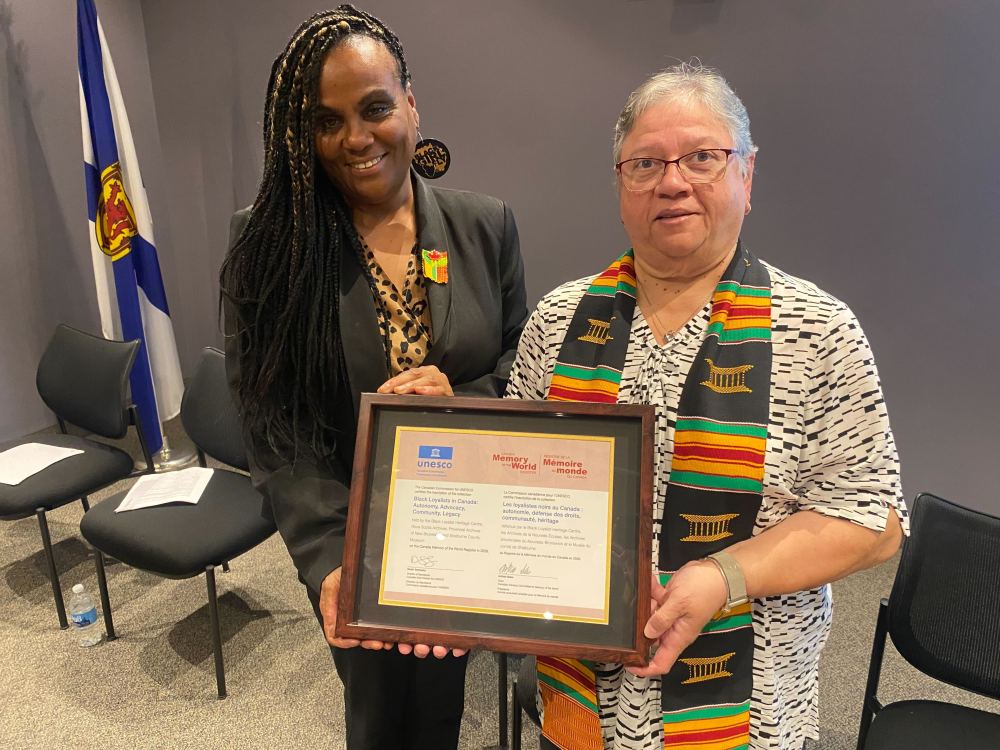
Andrea Davis, left, the executive director of the Black Loyalist Heritage Centre, and Sheila Hartley-Scott, president of the Black Loyalist Heritage Society's volunteer board are shown at the Nova Scotia Archives in Halifax on Saturday, March 21, 2026. THE CANADIAN PRESS/Lyndsay Armstrong

“My ancestors, they are a group of people that were not meant to survive, but they did. And so to be here to represent the Black Loyalists and my ancestors is extremely rewarding,” she said.

Davis, the executive director of the Black Loyalist Heritage Centre in Shelburne, N.S., was among those recognized Saturday by the Canadian branch of the United Nations Educational, Scientific and Cultural Organization, otherwise known as UNESCO.

The Nova Scotia Archives, Black Loyalist Heritage Centre, Shelburne County Museum and Provincial Archives of New Brunswick partnered to produce an archival collection called “Black Loyalists in Canada: Autonomy, Advocacy, Community, Legacy.” The collection was added to UNESCO’s Canada Memory of the World Register, which recognizes documentary heritage of national significance.

Davis said the documents, some of which were on display at the Nova Scotia Archives in Halifax on Saturday, provide detail into the rich lives of the Black Loyalists who settled in Shelburne, where she lives today.

The documents “show their intelligence… show me the strength and resilience that was always there… it’s so emotional and so compelling for me as an eighth generation to have these texts on hand and share it with the next generations after me,” she said.

Saturday’s ceremony at the archives included music on the drums and piano, and a prayer from Sheila Hartley-Scott, president of the Black Loyalist Heritage Society’s volunteer board.

“Our ancestors were not given very good odds to survive when they arrived here, they suffered unspeakable hardships … not only were they facing hardships, they were facing racism. All they really wanted was (something) better and to be able to raise their family and contribute to their communities,” Hartley-Scott said.

“Our people are people of strength and courage, tenacity, hope and faith.”

John Macleod, manager of the Nova Scotia Archives, said the land petitions, legal documentation, settlement plans and transaction records and other documents included in the collection “tell the story of Nova Scotia.”

Part of what makes this collection significant is that the documents show the Black Loyalists “speaking for themselves and being agents of their destiny in this time period.”

“They are actually going to courts and pleading cases and making their presence known. And that presence of course has persisted for more than 200 years from the settlement of Shelburne,” Macleod said Saturday.

The Canada Memory of the World Register is administered by the Canadian Commission for UNESCO as part of the organization’s Memory of the World Programme, which seeks to safeguard and promote access to heritage documents of universal value.

“This archival collection provides a rare and valuable account of the Black Loyalists and their descendants in their own voices. In it, we see the perseverance and dedication that the Black Loyalists brought to building communities despite the immense challenges,” David Schimpky, director of secretariat for the Canadian Commission for UNESCO, said in a statement.

“Archival holdings such as these are central to building understanding of the experiences and impacts of the Black Loyalists in Canada, a story that is important to recognize through inscription on the Canada Memory of the World Register,” he said.

This report by The Canadian Press was first published March 22, 2026.
Report Error Submit a Tip

More Stories

RCMP are seeking the public’s help to identify a person of interest after an all-terrain vehicle and other belongings were stolen from a cottage in southern Manitoba.

The theft happened near near Provincial Road 440 in the Rural Municipality of Louise, about 150 kilometres southwest of Winnipeg, on Aug. 11.

Police said surveillance video showed a man walking onto the property at about 2:30 p.m. while covering his face and holding power tools.

A grinder was used to open a locked shipping container, where a 1982 Honda ATC200 all-terrain vehicle, a Honda EU2000i generator and a Stihl FS90 trimmer were among the items stolen, RCMP said. One of two Spypoint trail cameras was also reported stolen.

Brandon’s gas plant: a health decision

Riley De Blonde and Scott Blyth 5 minute read 2:00 AM CDT

Imagine a Manitoba in which our lives are powered by clean, affordable electricity that Manitobans own and which doesn’t pollute the air and water we depend on.

That future is within reach and, as doctors, we know it would protect people’s health now and for many generations.

Instead, Manitoba Hydro wants to spend $3 billion on three new gas-fired turbines in Brandon.The Public Utilities Board is now considering this proposal, before our provincial leaders make a final decision that could lock us into burning harmful fossil fuels for decades.

Every day doctors witness the toll of air pollution, hotter summers and smokier skies on our patients — the child struggling through an asthma attack in the emergency room, the senior dangerously overheating during a heat wave. These health crises are not inevitable. They are the consequence of decisions, by governments and corporations, to keep burning fossil fuels.

City crews cleaning up drug paraphernalia, weapons having some impact on inner-city life

Malak Abas 7 minute read Preview

City crews cleaning up drug paraphernalia, weapons having some impact on inner-city life

Malak Abas 7 minute read Monday, Aug. 17, 2026

A three-person crew, employed by the city as part of its recently expanded proactive cleanup program, allowed the Free Press to follow along last week while they worked to make the Freight House Recreation Centre's property safe to play in.

Read
Monday, Aug. 17, 2026

Letters, Aug. 19

6 minute read Preview

Letters, Aug. 19

6 minute read 2:00 AM CDT

Nellie McClung was a trailblazer as both a suffragette and an elected official. As an advocate of eugenics, she supported the forced sterilization of women.

Read
2:00 AM CDT

Close to 5,000 net new health-care workers added since 2023 election, province says

Chris Kitching 7 minute read Preview

Close to 5,000 net new health-care workers added since 2023 election, province says

Chris Kitching 7 minute read Updated: Yesterday at 6:43 PM CDT

More doctors and nurses are working in Manitoba than ever before but health-care challenges remain, Premier Wab Kinew says.

The province has added 4,725 net new health-care workers to the provincial system since the NDP won the October 2023 election, Kinew told reporters Tuesday.

The government’s total includes 370 doctors, 1,464 nurses, 2,152 health-care aides and 607 allied health professionals, a group that includes physiotherapists, dietitians, paramedics, medical lab technologists and others.

Kinew said more doctors and nurses are working in Manitoba than ever before.

Read
Updated: Yesterday at 6:43 PM CDT

The common abuse of ‘common sense’

Alex Passey 5 minute read 2:00 AM CDT

If you spend any amount of time having deep conversations on sensitive subject matters, you will undoubtedly encounter patterns of thought and speech peppered into the discourse as if certain people were helpless but to utter them.

Perhaps you are trying to get to the heart of a complicated matter and the disagreement with your conversational partner starts to get a little heated. Often somebody will dust off the old diplomatic gem of “let’s agree to disagree” to extinguish further argument.

Or perhaps you are trying to console a grief-stricken person who has gone through a traumatic event. People in such a state will often rail against the state of the universe with powerful philosophical sentiments, demanding to know how such injustice could be permitted. You would not be the first person to misguidedly try to soothe them with something like “everything happens for a reason.” Or, less secularly, “God works in mysterious ways.”

These are known as thought-terminating clichés. Pithy little sayings that sound like folksy wisdom but serve mostly to sever a train of thinking, often because it is either uncomfortable or more complicated than the person is willing to engage. Admittedly, they often come from a good-natured place of keeping the peace, though it could easily be argued that they mostly serve to preserve to comfort or indulge the intellectual laziness of those who speak them.