The sea beneath Arctic and Antarctic ice holds many secrets. These scientists dive to find them.

Advertisement

Advertise with us

KILPISJÄRVI, Finland (AP) — As bubbles rippled across the frigid Finnish lake, diver Daan Jacobs emerged from a hole carved out of the thick, crackling ice.

Read this article for free:


or

Already have an account? Log in here »

To continue reading, please subscribe:

Subscribe and receive a limited-edition Free Press branded hat or tote.

Digital Subscription

One year of digital access for only $205*

  • Enjoy unlimited reading on winnipegfreepress.com
  • Read the E-Edition, our digital replica newspaper
  • Access News Break, our award-winning app
  • Play interactive puzzles

*First annual payment billed as $205.00 + GST for one year. This annual subscription will automatically renew at $233.00 + GST every 52 weeks (10% off the regular annual price of $259.35). Offer available to new and qualified returning subscribers only. Cancel any time.

To continue reading, please subscribe:

Add Free Press access to your Brandon Sun subscription for only an additional

$1 for the first 4 weeks*

  • Enjoy unlimited reading on winnipegfreepress.com
  • Read the E-Edition, our digital replica newspaper
  • Access News Break, our award-winning app
  • Play interactive puzzles
Start now

*Your next Brandon Sun subscription payment will increase by $1.00 and you will be charged $17.95 plus GST for four weeks. After four weeks, your payment will increase to $24.95 plus GST every four weeks.

KILPISJÄRVI, Finland (AP) — As bubbles rippled across the frigid Finnish lake, diver Daan Jacobs emerged from a hole carved out of the thick, crackling ice.

The journey had taken him 8 meters (26 feet) beneath the surface, where sunlight filtered through the Arctic ice and fish swam around a rock formation. It’s a remote place few will ever see, especially in winter, when snow blankets the ice and temperatures on land approach minus 40 degrees in both Celsius and Fahrenheit.

But Jacobs, a biodiversity adviser in the Netherlands, is one of a growing number of fortunate underwater explorers.

He was part of the Polar Scientific Diving class in the far north of Finland earlier this month, a program designed by the Finnish Scientific Diving Academy to train the next generation of scientists and researchers to dive beneath the Arctic and Antarctic ice to study the flora and fauna below.

“The view is beautiful,” Jacobs said, gulping for air following his 45-minute dive.

The Arctic is warming four times faster than the rest of the planet. From impacting worldwide weather patterns to making the polar bear population smaller, weaker and hungrier, because they rely on the sea ice to hunt from, higher temperatures at the North Pole spell disaster for the entire globe.

In Antarctica, meanwhile, global warming is leading to melting of ice sheets, prompting sea level rise and disrupting ocean ecosystems.

Human divers still needed

So scientists need to study what’s underneath the remaining Arctic — and Antarctic — ice, and determine how climate change is affecting the plants and animals that have traditionally survived along the seafloor with little to no sunlight. But carrying out such research requires specialized scuba diving skills plus the proper scientific background — qualifications that experts say only a few hundred people in the world currently have.
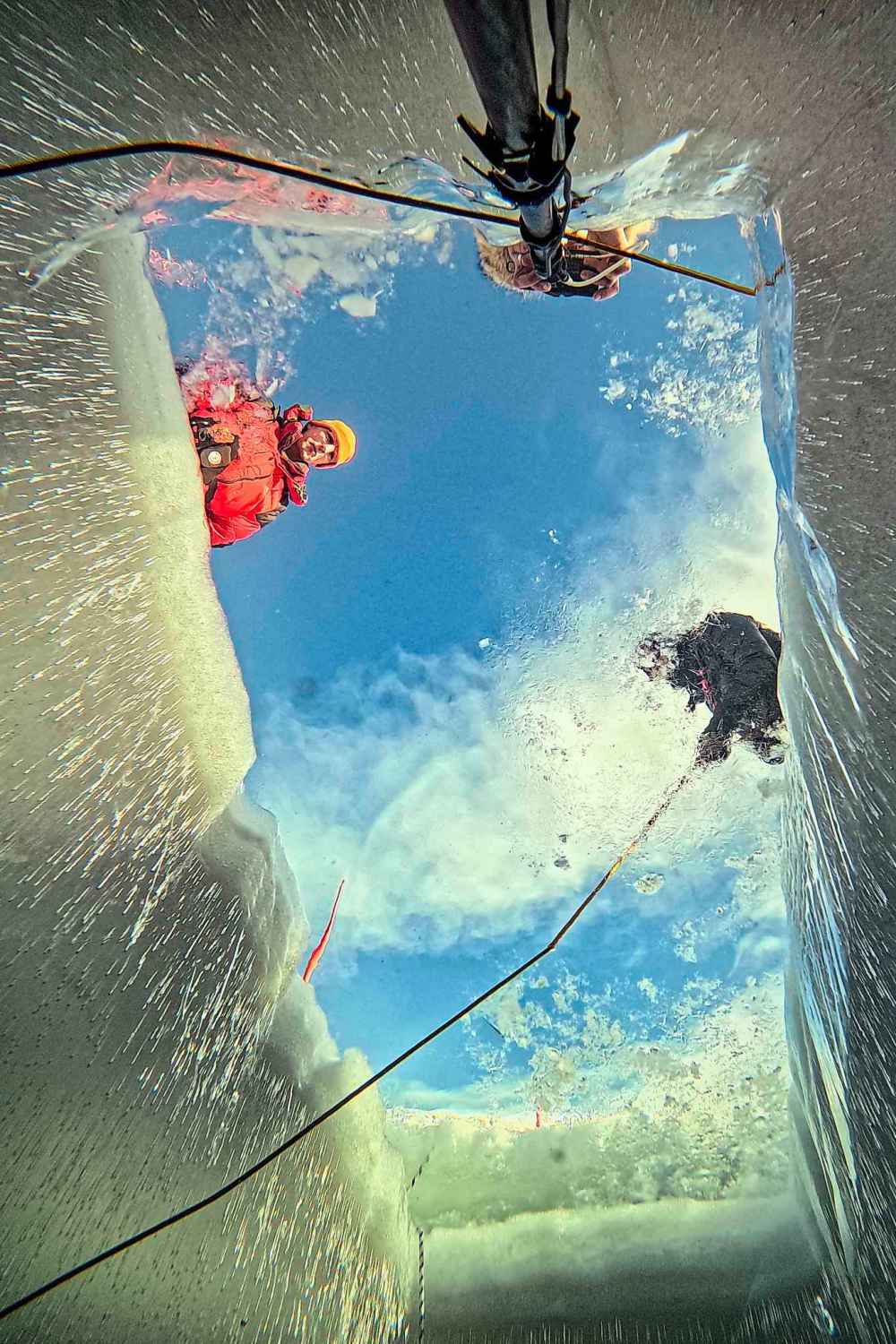
In this photo provided by Pata Degerman, participants in a Polar Scientific Diving class look into an ice hole as a diver descends beneath the surface in Kilpisjärvi, Finland, March 4, 2025. (Pata Degerman via AP)

The Finnish Scientific Diving Academy’s class aims to not only train more divers, but also to convince the world that the polar ice crisis requires additional research.

“Because it is melting so fast, we need to have more people deployed there — more science to be done — to understand better what happens,” said Erik Wurz, a marine biologist and one of the class’s scientific diving instructors. “We have to do more and we need to be fast to save this unique ecosystem in the Arctic, but also the Antarctic.”

And in a world that’s increasingly outsourcing work to artificial intelligence and robots, British Antarctic Survey marine biologist Simon Morley said that human hands are still necessary for this. Dragging nets across the seafloor would destroy the habitat, and a remotely operated submersible or robot can usually only pick up one specimen at a time.

“A diver can go down and pick up 12 urchins, put them in a bag and not affect the rest of the system,” said Morley, who isn’t part of the course.

Challenging conditions

During each 10-day session, the academy’s instructors drill a dozen experienced divers on a frozen lake at the University of Helsinki’s Kilpisjärvi Biological Station. The program began in 2024 and the demand has allowed them to add a second session per year.
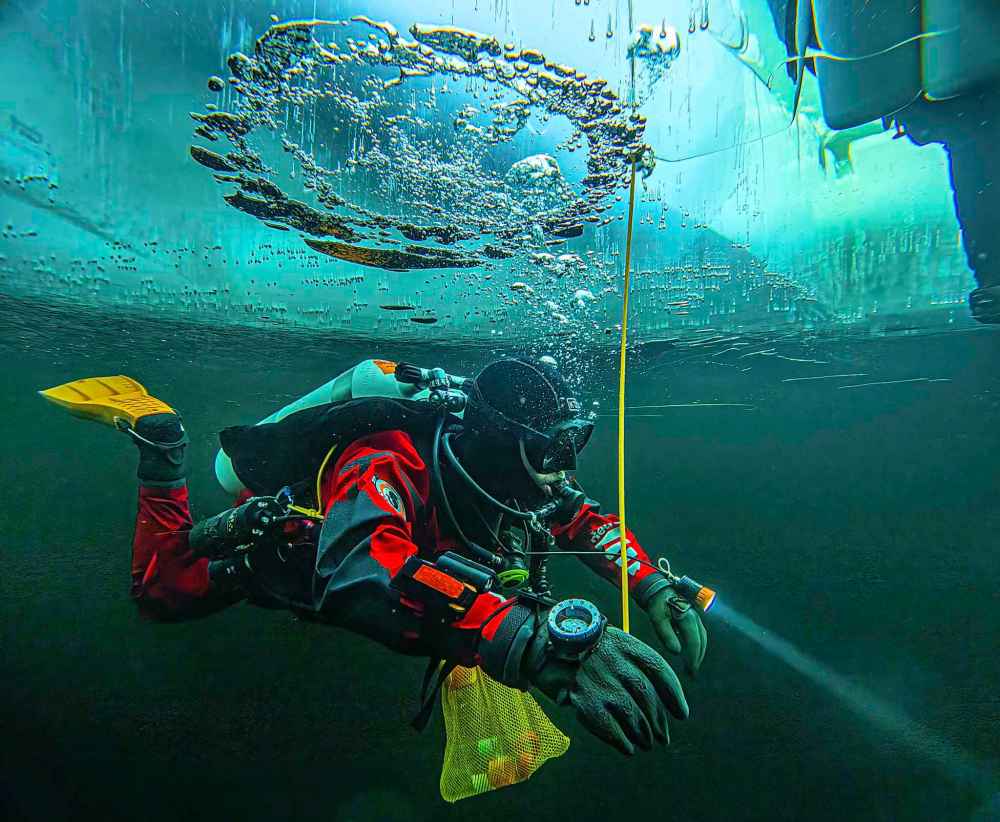
In this photo provided by Pata Degerman, a diver swims under the ice during a Polar Scientific Diving class in Kilpisjärvi, Finland, March 13, 2024. (Pata Degerman via AP)

The participants range from marine and freshwater biologists and other scientists to highly skilled recreational divers and documentary filmmakers.

Ruari Buijs, a marine biology and oceanography student at the University of Plymouth in England, ultimately wants to work in Antarctica and research marine megafauna. He enrolled in this month’s polar diving class in an effort to be more employable upon graduation.

“I thought this would be a very good stepping stone toward that goal,” he said.

Meanwhile, Caroline Chen, a scientific diver and research assistant in Germany, said it’s her dream to dive in the polar regions. She believes that her experience in this course will help her design future experiments in such challenging conditions.

The students must learn more than just diving under ice that’s nearly a meter (around three feet) thick and into water temperatures that hover just above freezing. For starters, there’s the frigid air temperatures and whipping winds over Lake Kilpisjärvi.

That challenges the topside support team, which must operate equipment to keep the diver safe while fending off their own risk of frostbite. They also have to learn how to become safety divers in case of an emergency, like if the primary diver can’t find the hole in the ice to surface after 45 minutes below.
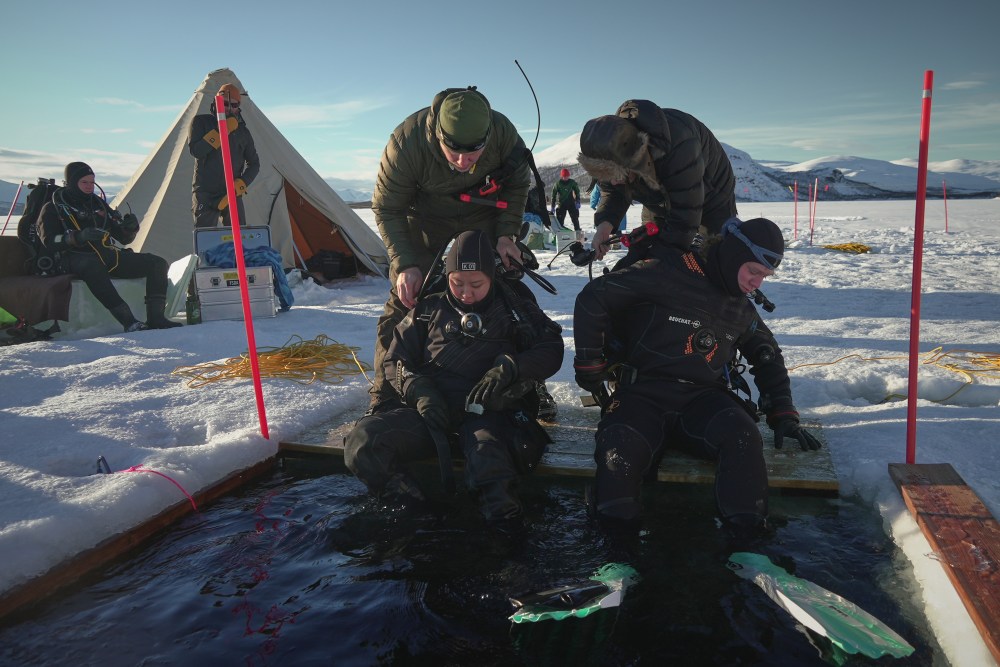
Ruari Buijs, a marine biology and oceanography student, right, and Caroline Chen, a scientific diver and research assistant, prepare to dive during a Polar Scientific Diving class in Kilpisjärvi, March 15, 2026. (AP Photo/Kostya Manenkov)

But once they’re underwater, the divers say it’s an incredible experience. During this month’s session, the group dived beneath ice roughly 80 centimeters (around 2 1/2 feet) thick. Chen spotted some fish along the sea floor and then took a moment to look to the surface as sunlight streamed through the ice, seemingly mimicking another Arctic phenomenon.

“It looks insane from the bottom up,” Chen said. “It changes all the time, like the Northern Lights.”

Buijs said that the cold doesn’t affect the covered parts of a diver’s body. But the area around their mouth remains exposed underwater.

“I think the worst thing is like your lips feel very numb afterward and they like stick out a lot,” he said, laughing. “You kind of get Botox lips a little bit.”

___

Stefanie Dazio reported from Berlin.
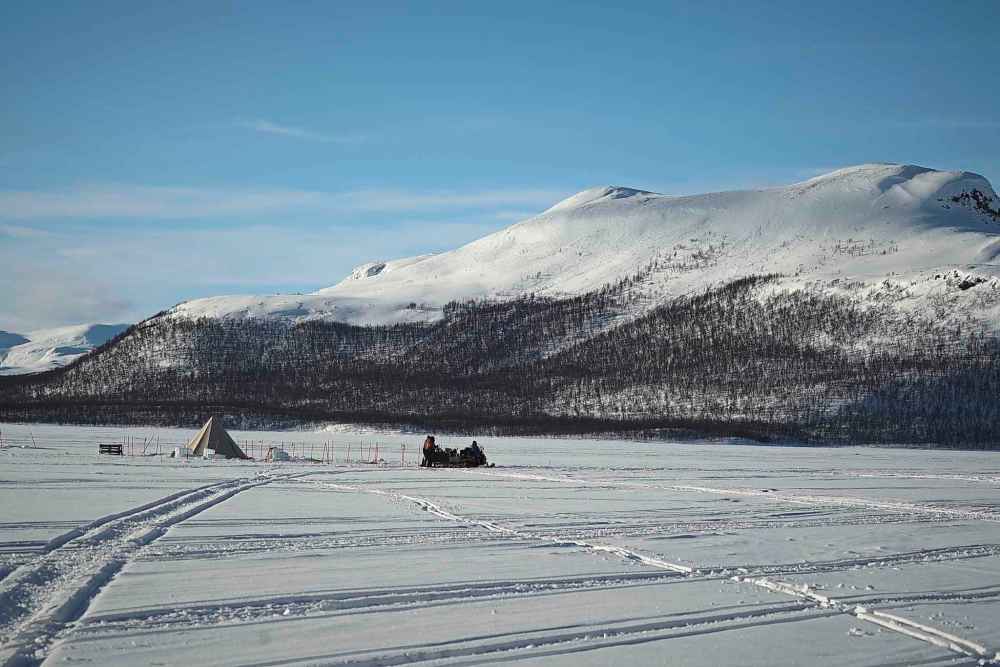
A snowmobile parked at Lake Kilpisjärvi during a Polar Scientific Diving class in Kilpisjärvi, Finland, March 15, 2026. (AP Photo/Kostya Manenkov)

The Associated Press’ climate and environmental coverage receives financial support from multiple private foundations. The AP is solely responsible for all content. Find the AP’s standards for working with philanthropies, a list of supporters and funded coverage areas at AP.org.


 

Report Error Submit a Tip

More Stories

Council candidate calls out vandalism after campaign signs defaced in Waverley West

Scott Billeck 3 minute read Preview

Council candidate calls out vandalism after campaign signs defaced in Waverley West

Scott Billeck 3 minute read Updated: 3:15 PM CDT

Waverley West council candidate Nafiya Naso said she will not be “intimidated” after 16 of her campaign signs were vandalized this week.

Jasmine Brar, who is also running for the ward seat, had some her signs vandalized earlier this month.

Naso’s signs, located along Waverley Street near Tim Sale Drive and across from École South Pointe School in southwest Winnipeg, were spray-painted with derogatory words written across her name and photograph.

The Winnipeg Police Service confirmed Naso reported the vandalism, but provided no other details.

Read
Updated: 3:15 PM CDT

At the city’s busiest fire and paramedic hall, first responders face a relentless workload

Scott Billeck 24 minute read Preview

At the city’s busiest fire and paramedic hall, first responders face a relentless workload

Scott Billeck 24 minute read Yesterday at 6:00 AM CDT

As a soft rain begins to fall between the concrete walls of “Hope Alley,” little feels further away than the place’s namesake.

Winnipeg Fire Paramedic Service crews have been called to the narrow downtown passage, named by Al Wiebe, a formerly homeless man turned advocate. People regularly pass through here, moving between the shelters, drop-ins and resource centres clustered around Main Street between Logan and Higgins avenues.

Against a wall, as the sky switches into night mode, a man sits bleeding from his nose, seemingly unaware of how he ended up with blood running down his T-shirt.

His situation has already set Winnipeg’s emergency response network in motion.

Read
Yesterday at 6:00 AM CDT

NDP trying to solve health-care problems from every angle — except the one likely to have the biggest impact

Tom Brodbeck 5 minute read Preview

NDP trying to solve health-care problems from every angle — except the one likely to have the biggest impact

Tom Brodbeck 5 minute read Yesterday at 12:46 PM CDT

Winnipeg’s emergency-room wait times hit a record high in July, according to the latest data released Thursday by the Winnipeg Regional Health Authority.

The 90th-percentile wait for all emergency rooms and urgent-care sites hit a staggering 13.02 hours last month, the longest wait ever recorded since the WRHA began publishing monthly data.

Thirteen hours is not a wait, it’s an endurance test. And it’s getting worse.

The 90th percentile is the point at which nine out of 10 patients experienced a shorter wait and one in 10 waited even longer.

Read
Yesterday at 12:46 PM CDT

Jets’ Hellebuyck trade request marks pivotal moment for the franchise

Ken Wiebe 6 minute read Preview

Jets’ Hellebuyck trade request marks pivotal moment for the franchise

Ken Wiebe 6 minute read Thursday, Aug. 27, 2026

Connor Hellebuyck has broken his silence in an effort to expedite his departure from the Winnipeg Jets.

In a statement released by agent Ray Petkau on Thursday afternoon, Hellebuyck confirmed he has asked to be moved by the team that chose him in the fifth round of the 2012 NHL draft.

“I have never forgotten June 23, 2012. That’s the day the Winnipeg Jets took a chance on a goalie playing in Odessa, Texas. I gave everything I had from that moment to prove the Jets made the right decision,” Hellebuyck said in the statement.

“Several months ago, I privately requested a trade. I have tried to handle the situation quietly and respectfully, while giving the organization time to explore its options. With training camp approaching, I felt it was important to publicly confirm my request. My position has not changed and I believe moving on is the best path forward for me and my family.”

Read
Thursday, Aug. 27, 2026

Puzzles Palace

1 minute read Monday, Jul. 27, 2026

To solve our puzzles, please subscribe with this special offer: |

Beware invasive, ‘frightening’ waterhemp

Laura Rance-Unger 4 minute read Preview

Beware invasive, ‘frightening’ waterhemp

Laura Rance-Unger 4 minute read 2:01 AM CDT

There’s a threat lurking on the edge of Manitoba farmers’ fields this fall that’s even scarier than the escalating trade war with their biggest customer.

Provincial extension advisers are warning farmers to watch for a weed known as “tall waterhemp,” which, true to its name, may already be towering above ready-to-harvest crops.

Those wispy tentacles waving in the breeze look pretty innocuous from a distance. But this highly invasive member of the pigweed family produces hundreds of thousands of seeds that are just itching for dispersal through farmers’ combines and across their fields.

Each of those tiny seeds — one small pill container filled halfway holds 44,000 — can produce plants with stems the width of saplings and heights of two to five metres. One or two plants can quickly turn into a patch. If waterhemp takes over a field, it can choke out the growing crop and cut yields by more than 90 per cent.

Read
2:01 AM CDT