Artemis II mission highlights deep space effects on astronauts’ bodies

Advertisement

Advertise with us

MONTREAL -  The Artemis II mission is showing how even a short 10-day journey in deep space presents significant challenges to the human body, including exposure to radiation and other effects scientists are still studying.

Read this article for free:


or

Already have an account? Log in here »

To continue reading, please subscribe:

Subscribe and receive a limited-edition Free Press branded hat or tote.

Digital Subscription

One year of digital access for only $205*

  • Enjoy unlimited reading on winnipegfreepress.com
  • Read the E-Edition, our digital replica newspaper
  • Access News Break, our award-winning app
  • Play interactive puzzles

*First annual payment billed as $205.00 + GST for one year. This annual subscription will automatically renew at $233.00 + GST every 52 weeks (10% off the regular annual price of $259.35). Offer available to new and qualified returning subscribers only. Cancel any time.

To continue reading, please subscribe:

Add Free Press access to your Brandon Sun subscription for only an additional

$1 for the first 4 weeks*

  • Enjoy unlimited reading on winnipegfreepress.com
  • Read the E-Edition, our digital replica newspaper
  • Access News Break, our award-winning app
  • Play interactive puzzles
Start now

*Your next Brandon Sun subscription payment will increase by $1.00 and you will be charged $17.95 plus GST for four weeks. After four weeks, your payment will increase to $24.95 plus GST every four weeks.

MONTREAL –  The Artemis II mission is showing how even a short 10-day journey in deep space presents significant challenges to the human body, including exposure to radiation and other effects scientists are still studying.

The combination of radiation exposure, microgravity, and confined living conditions can place significant strain on the human body, said Dr. Farhan Asrar, a physician, space medicine researcher and associate dean at Toronto Metropolitan University’s School of Medicine.

The Artemis II mission marks a return to deep space for the first time in 50 years, offering a rare opportunity to closely monitor how astronauts are affected.

“There are still many effects of deep space on the body that we don’t fully understand,” Asrar said.

Radiation is the primary concern in deep space, Asrar said.

“Levels are higher than in low Earth orbit or on the (International Space Station), and it’s not just the amount — it’s the type.”

He explained that this form of cosmic radiation can affect cells, organs, and DNA differently than what astronauts experience closer to Earth.

“Some of these particles are more penetrating and potentially more damaging, which makes this mission a step into the unknown,” he said.

The space mission will provide data for scientists, despite its short length.

“Even short exposures can help us understand how the cardiovascular system, immune system, and even cognitive function might be impacted on longer missions,” Asrar said.
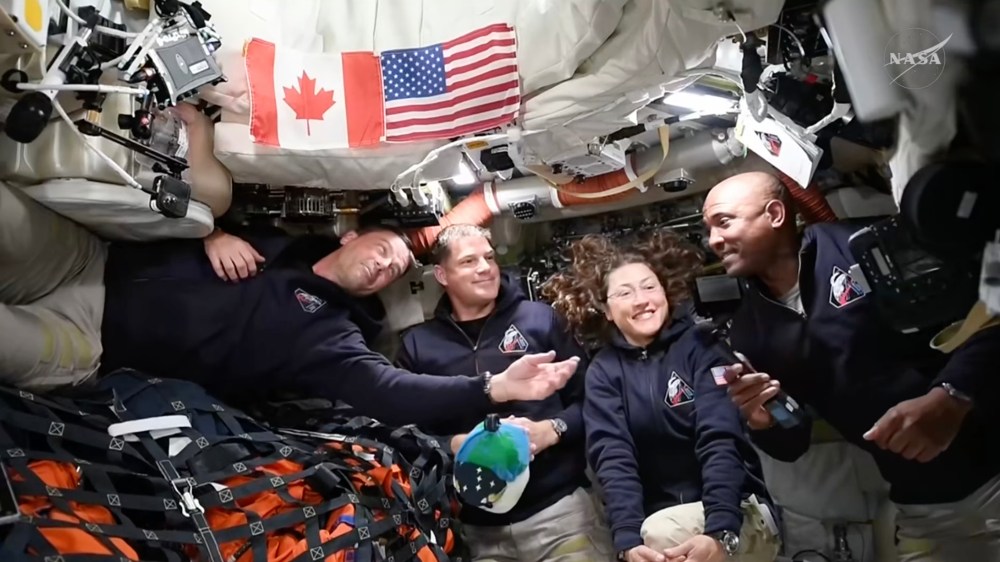
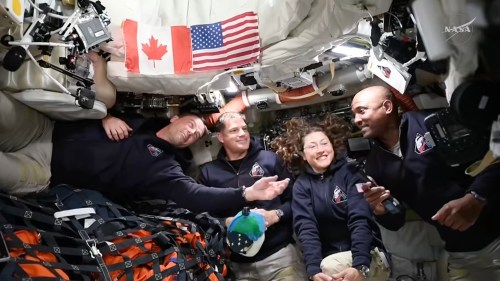
In this image from video provided by NASA, Artemis II astronauts, from left, Reid Wiseman, Jeremy Hansen, Christina Koch and Victor Glover gather for an interview en route to the moon on Saturday, April 4, 2026. (NASA via AP)

The mission, which launched earlier this month, is on a 10-day journey where the spacecraft will circle the moon. Its crew includes Canadian astronaut Jeremy Hansen, who will become the first Canadian in deep space, as well as American astronauts Reid Wiseman, Christina Koch, and Victor Glover.

Every stage of the mission affects the astronauts’ bodies, Asrar said, adding, “It’s quite a disabling and extreme environment.” The most common side-effect tends to be motion sickness.

He noted that extensive training helps the crew manage these challenges.

“Many of them are also trained as pilots, which factors into how they handle symptoms and adapt to the conditions,” he said.

The mission also marks the first time a woman has gone into deep space, with Koch joining the flight. “The female perspective is a critical part of understanding how different bodies respond to deep space,” Asrar said. “We’ve never had a woman in deep space before, so this mission provides essential data for future exploration.”

Understanding these differences, believes Asrar, is not just about observation — it also informs how astronauts must care for their bodies during the mission.

Astronauts must rely on specialized exercise to stay fit in space, Asrar said, with about 30 minutes a day recommended for the Artemis II crew — far less than the up to two hours required on the International Space Station.
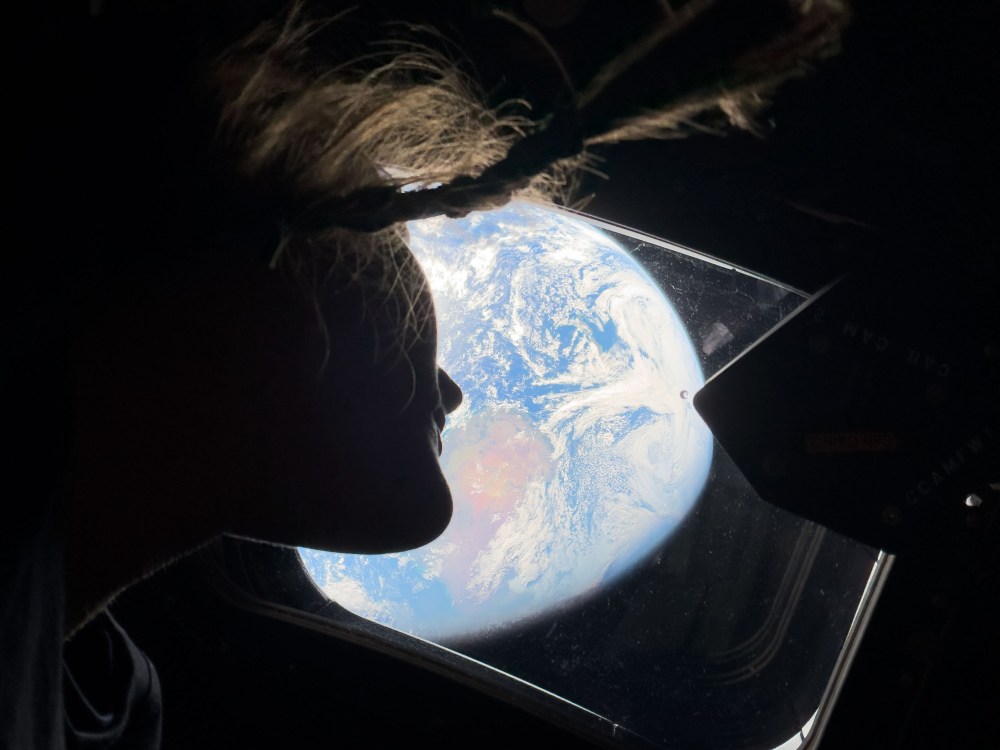
This image provided by NASA, astronaut and Artemis II mission specialist Christina Koch peers out of one of the Orion spacecraft's main cabin windows, looking back at Earth, as the crew travels towards the Moon on Thursday, April 2, 2026. (NASA via AP)

He said staying active is critical to slowing rapid muscle and bone loss in microgravity.

“Even a short mission can cause deconditioning if the body isn’t kept active,” he said, noting astronauts can lose up to one to 1.5 per cent of bone mass for each month spent in space.

During a live question-and-answer session with Canadian children, Hansen described one of the most noticeable effects of microgravity.

“I’m sure my face is a lot puffier now because there’s a lot more blood up in my upper regions of my body,” he said.

Asrar explained that the sensation is caused by fluid shifts that push blood toward the head in the absence of gravity.

“Without gravity pulling fluids downward, there’s increased pressure in the upper body, which can affect the eyes, sinuses, and balance,” he said.

Asrar added that these changes can also affect vision, kidney function, and the immune system, underscoring how even short missions trigger a cascade of physiological adjustments.
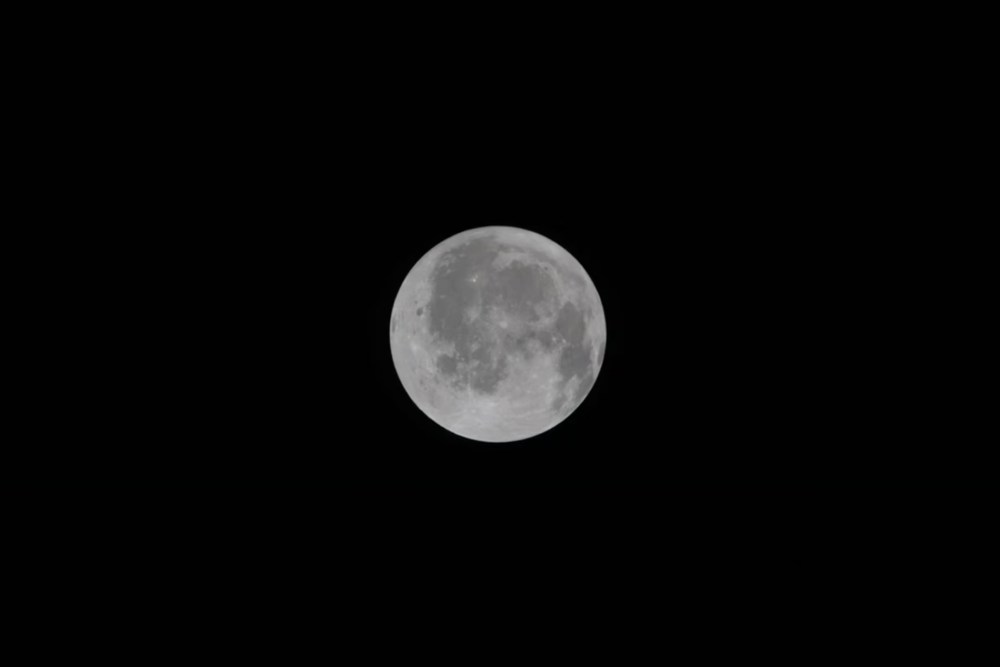
This photo provided by NASA shows the moon seen from the Orion spacecraft Integrity during the Artemis II mission on Friday, April 3, 2026. (NASA via AP)

Beyond the physical strain, deep space missions also bring significant mental and logistical challenges. Astronauts must carefully manage limited food, water and medical supplies while living in tight quarters with little privacy, Asrar explained.

Asrar said team dynamics are crucial, as crews eat, sleep and work side by side throughout the mission.

“It’s important to have a team you want to be with and can work with, because literally 24/7 you’re together,” he said, adding that aside from the toilet, there are no real barriers separating crew members.

After returning to Earth, the crew will undergo rehabilitation to rebuild muscle strength, restore bone density and readjust to gravity. Asrar said tracking that recovery is just as important as studying the mission itself.

“The way the body adapts and re-apapts gives us critical information for designing countermeasures for longer missions,” he said.

He added that even a 10-day flight can provide valuable data on fluid shifts, cardiovascular changes and organ function, helping prepare humans for future missions to Mars and beyond.

The Artemis II capsule and its crew are scheduled to splash down in the Pacific Ocean off San Diego on April 10. Asrar noted that re-entry also places additional strain on the body.

This image from video provided by NASA shows a view of earth taken by NASA astronaut and Artemis II Commander Reid Wiseman from one of the Orion spacecraft's four windows after completing the translunar injection burn, Thursday, April 2, 2026. (NASA via AP)

“The forces during re-entry can be strenuous,” he said, “and the body needs time to readjust to gravity.”

This report by The Canadian Press was first published April 5, 2026.


Report Error Submit a Tip

More Stories

Foster mom pleads guilty to assault that left six-year-old-girl paralyzed

Dean Pritchard 4 minute read Preview

Foster mom pleads guilty to assault that left six-year-old-girl paralyzed

Dean Pritchard 4 minute read Friday, Aug. 14, 2026

A Winnipeg foster mother has admitted to violently assaulting her ill foster daughter and leaving her paralyzed after the girl resisted the woman’s efforts to provide her with medication, a court has heard.

Marilyn Keno, 26, pleaded guilty Friday to one count of aggravated assault.

Keno remains in custody and will be sentenced at a later date following the completion of a court-ordered pre-sentence report.

The maximum sentence for aggravated assault is 14 years in prison. Crown attorney Alanna Littman and defence lawyer Jeremy Kostiuk did not disclose what sentences they will be recommending.

Read
Friday, Aug. 14, 2026

West Kildonan Industrial residents call for speed bumps after child hit by truck

Morgan Modjeski 3 minute read Preview

West Kildonan Industrial residents call for speed bumps after child hit by truck

Morgan Modjeski 3 minute read Updated: Yesterday at 3:09 PM CDT

Residents in the West Kildonan Industrial neighbourhood are calling on the city to install speed bumps in their area after a child was hit and dragged by a vehicle Thursday.

Katelyn Bemister lives near the area where the child — who was hospitalized as a result of the incident and has been upgraded to stable condition — was struck. She says people frequently speed in the area.

“They’re going really fast, and they’re not really paying attention at all to the pedestrians in the area,” says Bemister.

In video supplied to the Free Press by a resident, the child can be seen riding a bike down a sidewalk along the 500 block of North Point Boulevard.

Read
Updated: Yesterday at 3:09 PM CDT

Don’t be a big loser — check out Real Love Summer Fest ReunionBig Loser takes the stage at 8:20 p.m. tonight as part of the Real Love Summer Fest Reunion, a one-day event put on by the indie promotion company, which ran the festival in the Interlake area for a decade until last summer’s final edition near Teulon.

Bookers Gil Carroll and Adam Soloway have programmed a full day of music at Blue Note Park (220 Main St.), the outdoor venue adjacent to Times Change(d) High and Lonesome Club.

First up at 4 p.m. is folk-rock songwriter tofusmell, followed at 5 p.m. with a rare performance by indie-songwriting darlings Animal Teeth, a group with several summer fest bills under its belt. Up-and-coming pop-rockers Synthetic Friend take the stage at 6, followed at 7 by the fun electronic dance pop of French Class.

After playing with his full band at last month’s Winnipeg Folk Festival, Amos the Kid will perform a solo set at 8 p.m. Sans band, the performer shows off his affable roots as a Gord Downie acolyte with catchy earworms to match.

Rainbow Stage’s Legally Blonde a lovely legal musical

Holly Harris 6 minute read Preview

Rainbow Stage’s Legally Blonde a lovely legal musical

Holly Harris 6 minute read Friday, Aug. 14, 2026

Omigod, you guys! Rainbow Stage kicked off its penultimate summer production Thursday with a high-octane joy machine bathed in a sea of pink.

Inspired by the 2001 Hollywood film starring Reese Witherspoon, and Amanda Brown’s same-titled novel, the award-winning Legally Blonde: The Musical — featuring a book by Heather Hach, with music/lyrics by Laurence O’Keefe and Nell Benjamin — opened on Broadway in April 2007, followed by a subsequent West End run.

The tale — equal parts cheesy rom-com and potent siren call for female autonomy and empowerment — focuses on quintessential Cali-girl Elle Woods (a pitch-perfect Claire Mac Master). A proud daughter and president of Delta Nu sorority house, she enrols at Harvard Law School to win back her upwardly mobile ex-boyfriend, Warner Huntington III (Duncan Cox).

Laser-focused on marrying a “Jackie, not a Marilyn,” Warner dreams of becoming an American senator, latching onto uber-preppy fellow pupil Vivienne Kensington (Julie Davis), who becomes Elle’s arch nemesis.

Read
Friday, Aug. 14, 2026

News briefs for Sunday, August 16, 2026

1 minute read Updated: 12:40 PM CDT

A collection of breaking news briefs filed on Sunday, August 16, 2026

Cross-border abduction under investigation

12:36 PM

A cross-border kidnapping from Winnipeg to Minnesota is under investigation, according to North Dakota state patrol.

Poilievre’s lips moving, but Canadians aren’t interested in what he’s saying

Tom Brodbeck 5 minute read Preview

Poilievre’s lips moving, but Canadians aren’t interested in what he’s saying

Tom Brodbeck 5 minute read Thursday, Aug. 6, 2026

Pierre Poilievre’s biggest political challenge right now isn’t Prime Minister Mark Carney’s popularity.

It’s the fact that he still seems to be campaigning against a political landscape that no longer exists.

More than a year after the 2025 federal election, the Conservative leader is still relying on the same message, the same themes and the same attacks that defined his party’s campaign before voters went to the polls.

And Canadians appear to be tuning it out.

Read
Thursday, Aug. 6, 2026