Q&A: Apollo astronaut Schmitt talks about getting back to the moon and life in the universe
Advertisement
Read this article for free:
or
Already have an account? Log in here »
To continue reading, please subscribe:

Digital Subscription
One year of digital access for only $205*
- Enjoy unlimited reading on winnipegfreepress.com
- Read the E-Edition, our digital replica newspaper
- Access News Break, our award-winning app
- Play interactive puzzles
*First annual payment billed as $205.00 + GST for one year. This annual subscription will automatically renew at $233.00 + GST every 52 weeks (10% off the regular annual price of $259.35). Offer available to new and qualified returning subscribers only. Cancel any time.
To continue reading, please subscribe:
Add Free Press access to your Brandon Sun subscription for only an additional
$1 for the first 4 weeks*
- Enjoy unlimited reading on winnipegfreepress.com
- Read the E-Edition, our digital replica newspaper
- Access News Break, our award-winning app
- Play interactive puzzles
*Your next Brandon Sun subscription payment will increase by $1.00 and you will be charged $17.95 plus GST for four weeks. After four weeks, your payment will increase to $24.95 plus GST every four weeks.
Read unlimited articles for free today:
or
Already have an account? Log in here »
ALBUQUERQUE, N.M. (AP) — It was 1972 and Apollo astronauts Harrison “Jack” Schmitt and Eugene Cernan had just stepped onto the moon’s surface to begin collecting rock and soil samples.
The mission would mark the end of an era for the American space program, but Schmitt already was looking to the future. His voice crackling over a high-frequency radio signal that day, he shared his thoughts with Cernan and those listening in at Mission Control.
“Well, I tell you Gene, I think the next generation ought to accept this as a challenge. Let’s see them leave footsteps like these someday,” Schmitt said.
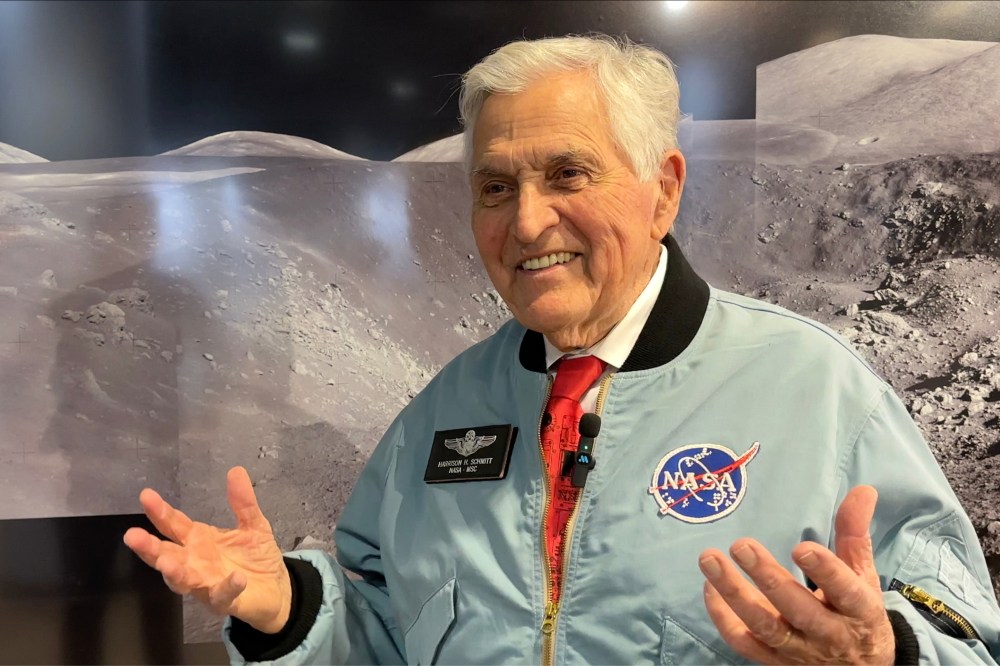
Schmitt, 90, is one of the four Apollo moonwalkers still alive today. A field geologist, he was the first scientist to set foot on the moon and his expertise helped answer questions about the origin of that big rock up there and what it tells us about the solar system.
Schmitt felt the thrill again when the Artemis II crew rocketed into space on a historic lunar flyby. Pure excitement and the potential for so much more. And he’s hopeful as new generations get back to the moon and beyond.
Interviewed by The Associated Press, the former U.S. senator from New Mexico spoke about everything from the importance of having a lunar base to tapping new energy sources and whether we’re alone in the universe. Dark matter and quantum entanglement also were mentioned, with Schmitt saying many discoveries are yet to come.
“You’ve just got to remember,” he said, “what used to be called supernatural probably should be called unknown physics.”
This interview has been edited for brevity.
Q: What about having a lunar base?
Well, I think a lunar base makes a lot of sense and it always has for a lot of reasons. One is geopolitical. Probably the most important one is a geopolitical presence in deep space — and in preparation for going on to Mars.
The moon has resources that are going to reduce the cost of actually going to Mars and it gains experience. One of the things people keep forgetting about is you’ve gone through several generations and the new generation has to gain experience — psychologically as well as practically about how you work in deep space. And they’re doing that. That was probably the most important part of Artemis II, is it gave the ground people, Mission Control and others, the experience now to really have the risk as real rather than as part of a simulation.
Q: What was your mission during Apollo 17?
I had a lot of understanding of what other crews had learned, what had been learned from some of the early sample analyses and so we were trying to put sort of the frosting on the cake of answering questions in a very complex geologic area called Taurus-Littrow.
Taurus-Littrow actually is deeper than the Grand Canyon and so it has a three-dimensional aspect to it that we hadn’t had on other missions. And plus having a field geologist like myself on board meant that we should be more efficient at gathering samples that had a meaningful aspect to our further understanding of the origin of the moon, its relationship to the Earth and, it turns out, also its relationship to the history of the sun.
Q: So we’re building upon our knowledge of the universe around us?
Well there’s no question that the moon has a history to tell us.
It’s been recording the history of the solar system ever since the solar system formed about 4.5 billion years ago. That is really what the moon gives us — that library of knowledge, of potential knowledge about how the solar system evolved and then what the sun has been doing in that 4.5 billion years.
In the recent work that I’ve been doing in that layer of debris, the regolith, we find that the sun became even more active than it had been about the same time as we had an explosion of life in the oceans on Earth, and so the oceans may have been and almost certainly were warming to that more active sun and life likes warmth. So it multiplied not only in quantity but in diversity. The mammals started to appear soon after that, life started to move up onto the continents that had formed so things were really starting to move about a half-billion years ago.
Q: Tell us about the moon rocks
This is a sample of a basalt lava and we have a lot of basalt lavas here in New Mexico. This is different in that it is rich in titanium, more rich than most terrestrial basalts. And that titanium turns out to be very important in terms of the resources that are available on the moon. It has a property of concentrating some of those resources, particularly hydrogen and helium.
There’s an isotope called helium-3 and that is going to be, I think, ultimately very, very important in the production of energy. It’s going to be extremely useful in quantum computing, in cancer therapy and other things here on Earth. We just don’t have much on Earth, so the moon is going to be a our reservoir, our source of this very important isotope of helium-3.
Q: How important will this isotope be in the future?
Helium-3 offers a possibility of having nuclear energy without nuclear waste. We’ve known that for decades, and so the moon now offers that opportunity to begin to substitute a nuclear form of energy that doesn’t produce nuclear waste for what we have today.
Q: Is it just as much an energy race as a space race?
There’s no question about it. China is interested in it, we’re interested in it. And that’s probably one of the big technological drivers of this new race to the moon, a new space race, a Cold War that’s on now primarily involving China and I think helium-3 is a big actor in that right now.
Q: What was it like in the Taurus-Littrow Valley?
First of all, we were in a valley deeper than the Grand Canyon. The mountains on either side were as high as the Grand Canyon from the bottom. Secondly, you’re in one-sixth gravity so that means you can walk much more easily than you could here on Earth. Now we were covered by a pressure suit but still walking around was like being a kid again … if you fell you didn’t fall very hard and you certainly didn’t cry about it. But the moon is really a very easy place to work so as long as you have the right equipment surrounding you. You have to have that atmosphere of course to breathe.
Q: Any downsides to working in a weightless environment?
For me, it was a very comfortable environment to be in and you get a little bit lazy. For example, if you’re taking notes with a pad of paper and a pen or pencil and somebody says would you take the SCS switch to off, well you just let go and it floats there and you go over to the switch and come back and start to dictate those notes again.
You’ve got to be careful though because you’re brain gets lazy. When I got on the carrier after splashdown, I was taking my first drink of water and I just let go of the cup and of course it broke on the floor. Human beings tend to take advantage of their environment very quickly and the brain does get a little bit lazy like that. It took about three days to get comfortable again back here on Earth.
Q: So we’ll have no problem living on the moon?
No, I think living on the moon is going to be very good. Now long term civilization on the moon, there’s still some major issues. The radiation issue has to be dealt with and we can. There are ways to do that. Going to Mars is another issue and that’s why you’ll almost certainly need fusion rockets to cut that time frame.
Q: We’ve heard a lot lately about UFOs. What are your thoughts on that?
Well there are billions of sunlike stars out there and so you just have to imagine that life may have originated on some other planet, although the conditions for life to originate here on Earth are really unique. Everything sort of fit together and creation for us sort of leads to you thinking of an infinitely intelligent being that made it all happen. But the technical potential statistically is very high that you could have had the similar kind of conditions develop elsewhere in the universe.

Now are they visiting us? My feeling is if they’re really so advanced they could be here, they’d communicate better than they have and so I just don’t know. But it’s plausible. Let’s put it that way. Unlikely maybe, but plausible.
Q: Would you take the opportunity to go back to the moon or to Mars?
Oh surely. Teresa, my wife, would like very much to go with me — that would be one condition. But I think a trip to Mars is going to be fantastic for those people.
So youth is extremely important and the education of those youth particularly in mathematics is extraordinarily important, and NASA now has a younger agency than they had grown to be during the shuttle era.
Look what has happened since Apollo. The commercial sector has developed new technologies, new ways of doing things and NASA is now trying to integrate those into a new approach to deep space exploration.