Iran’s monthslong internet shutdown is crushing businesses in an already battered economy
Advertisement
Read this article for free:
or
Already have an account? Log in here »
To continue reading, please subscribe:

Digital Subscription
One year of digital access for only $205*
- Enjoy unlimited reading on winnipegfreepress.com
- Read the E-Edition, our digital replica newspaper
- Access News Break, our award-winning app
- Play interactive puzzles
*First annual payment billed as $205.00 + GST for one year. This annual subscription will automatically renew at $233.00 + GST every 52 weeks (10% off the regular annual price of $259.35). Offer available to new and qualified returning subscribers only. Cancel any time.
To continue reading, please subscribe:
Add Free Press access to your Brandon Sun subscription for only an additional
$1 for the first 4 weeks*
- Enjoy unlimited reading on winnipegfreepress.com
- Read the E-Edition, our digital replica newspaper
- Access News Break, our award-winning app
- Play interactive puzzles
*Your next Brandon Sun subscription payment will increase by $1.00 and you will be charged $17.95 plus GST for four weeks. After four weeks, your payment will increase to $24.95 plus GST every four weeks.
Read unlimited articles for free today:
or
Already have an account? Log in here »
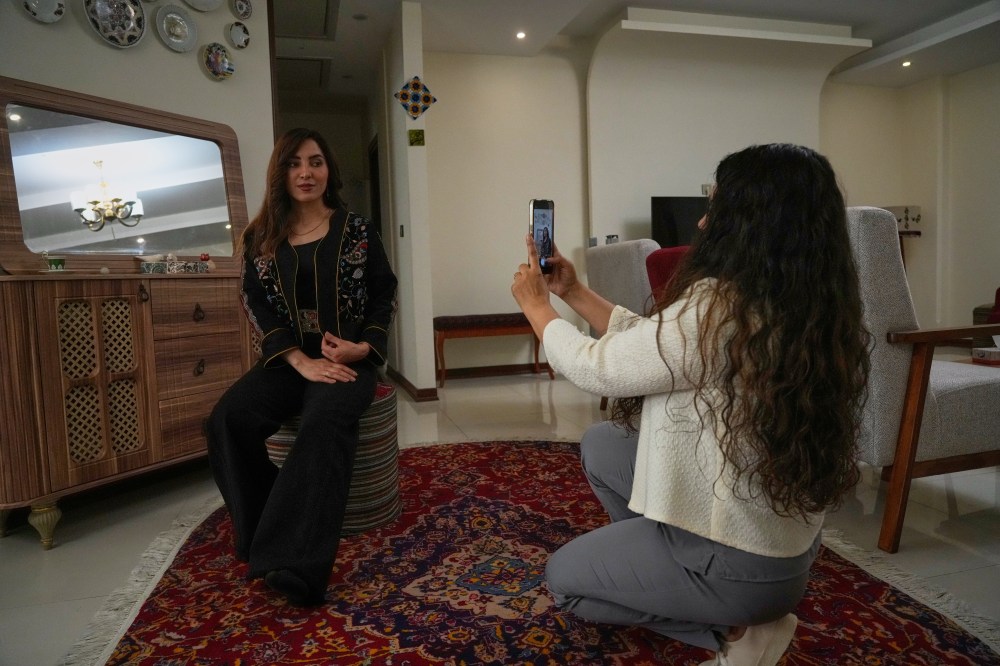
TEHRAN, Iran (AP) — At her studio in Iran’s capital, Amen Khademi prepared a fashion shoot for a jacket she designed with Persian-inspired motifs. But even as she applied lipstick to the model, she was distracted, worrying if her business would survive after four months without its main link to customers — the internet.
Iran’s 90 million people have been cut off from the internet for most of 2026, one of the world’s longest and strictest national shutdowns. That is devastating an online economy that had long defied government restrictions and international sanctions. From fashion to fitness, to advertising and retailers, many have seen their incomes evaporate.
Khademi hasn’t made a sale in months. “The internet outage in the past four months has completely destroyed not only my business, but many online businesses,” she said.
Despite an uneasy truce with the U.S. and Israel, Iran’s rulers have refused to reverse the shutdown they have depicted as a wartime necessity. But they are facing an outcry as it adds to mass job losses from strikes on key industries and an ongoing U.S. blockade.
Before January, Iranians could access the internet, but authorities blocked a large amount of content. Now all access to the global web has been shut down. Some workarounds exist, but they have become enormously expensive, out of reach for most Iranians.
The internet cutoff costs the economy an estimated $30-40 million daily, with indirect losses likely twice that much, a member of Iran’s Chamber of Commerce, Afshin Kolahi, told a local newspaper. About 10 million people have jobs that depend on internet connectivity, according to the communications minister, Sattar Hashemi.
An unprecedented shutdown guts an online economy
Throughout years of economic turmoil in Iran brought on by sanctions and mismanagement, platforms like Instagram and WhatsApp helped small businesses to find customers, and people to earn extra income to afford skyrocketing prices for basic goods.
Iranian authorities first shut down the internet in January during mass anti-government protests. That cutoff was just starting to ease when the government imposed a complete internet blackout on Feb. 28 as the U.S. and Israel launched the war.
Mahsa Alimardani, an expert on internet censorship, said Kashmir and Myanmar have had longer blocks affecting specific regions or platforms. Countries like China, with its “Great Firewall,” and North Korea, have always strictly limited access to the global internet.
“What makes Iran’s shutdown unprecedented is the combination of scale and severity: an entire country of 90 million people with a developed digital economy deliberately reverted to a controlled national intranet,” said Alimardani, an associate director for technology threats and opportunities at the rights group Witness.
A flagship company of Iran’s digital economy, online retailer DigiKala, recently said it was laying off 200 people, about 3% of its workforce. The pain extends to “production, foreign trade and even traditional business,” Reza Olfatnasab, head of a national group representing digital businesses, said in comments published in Iranian media.
Khademi’s shopfront is Instagram. But her studio’s page — with more than 30,000 followers — is now inactive. She was doing the photo shoot to save the pictures for later, hoping to find an alternative.
Her model, Farnaz Ojaghloo, is also a fitness coach. The shutdown has dried up both her modeling gigs and the online courses she ran for people inside Iran and abroad.
“Psychologically, it really hits hard,” Ojaghloo said. “All the plans you had for six months or a year ahead get pushed aside, and your only concern becomes surviving in the moment.”
The alternatives are ‘terrible’
For years, authorities in Iran have enforced filters and policed content on platforms like YouTube and Instagram. But before the war, Iranians could bypass restrictions with cheap virtual private networks, known as VPNs, and other easy workarounds.
Now, the shutdown has stoked high prices for black-market VPNs. Iranian state media routinely report arrests of people for using illegal VPNs or the American satellite system Starlink, which was banned last year.
Senior government officials are awarded “white” SIM cards granting them access to the global internet. Under pressure to alleviate the economic harm, the government is now allowing less-restricted internet access to a small number of professions, business and media.
An e-commerce trade group in Tehran condemned the tiered system in Iranian media on Wednesday, calling it “an abuse of an obvious need of every citizen.” It said the outage threatens “the destruction of the country’s infrastructure at the hands of our own decision-makers.”
The vast majority of people have no choice but Iran’s national net.
A Tehran resident who works in advertising said sponsors have little interest in paying for content that can’t be posted on major platforms like Instagram, where he has tens of thousands of followers. He said his income is down to near zero since the war began.
A gamer in Isfahan — also with a large following on YouTube and Instagram — said Iran’s domestic net “is terrible” — slow, insecure and full of bugs. He too has lost almost all his income from sponsors and donations.
Iran has its own social media platforms modeled on services like WhatsApp and YouTube, but content is closely monitored and often censored.
“Nobody really wants to use these platforms, but there is no other option,” the gamer said. Both he and the advertising worker spoke on condition of anonymity out of security concerns.
A growing number of street vendors
The shutdown has piled new pressures on Iran’s once large and educated middle class, already struggling in the face of a prewar currency crash.
Economic decline in Iran has spurred waves of anti-government protests, most recently in December. Now, more Iranians are thinking of emigrating, a software developer said.
The developer — likewise speaking on condition of anonymity out of safety fears — said the internet shutdown has wiped out remote work. He lost his own job when his former company laid off almost all its employees in recent weeks, he said.

The consequences are visible in the rising numbers of street peddlers in Tehran. Reza Amiri, a 32-year-old former employee of an internet provider, now sells hats and umbrellas by a metro stop. He lost his job after the war started and has not received his last month’s salary, he said.
Monireh Pishgahi sells ornaments and accessories on the capital’s famed Vali Asr Street. She said her tailoring business used to supply three online shops. As business dried up, she shut down and laid off her five employees.
One downtown shopkeeper, Mohammad Rihai, said he had given up on trying to persuade street vendors to stop blocking the sidewalk outside his store. “After the war, you see them all along the sidewalk. I cannot fight them anymore.”
___
Radjy reported from Cairo.