Astronomers believe they’ve detected an atmosphere around a tiny, icy world beyond Pluto

Advertisement

Advertise with us

CAPE CANAVERAL, Fla. (AP) — A new study suggests that a tiny, icy world beyond Pluto harbors a thin, delicate atmosphere that may have been created by volcanic eruptions or a comet strike.

Read this article for free:


or

Already have an account? Log in here »

To continue reading, please subscribe:

Subscribe and receive a limited-edition Free Press branded hat or tote.

Digital Subscription

One year of digital access for only $205*

  • Enjoy unlimited reading on winnipegfreepress.com
  • Read the E-Edition, our digital replica newspaper
  • Access News Break, our award-winning app
  • Play interactive puzzles

*First annual payment billed as $205.00 + GST for one year. This annual subscription will automatically renew at $233.00 + GST every 52 weeks (10% off the regular annual price of $259.35). Offer available to new and qualified returning subscribers only. Cancel any time.

To continue reading, please subscribe:

Add Free Press access to your Brandon Sun subscription for only an additional

$1 for the first 4 weeks*

  • Enjoy unlimited reading on winnipegfreepress.com
  • Read the E-Edition, our digital replica newspaper
  • Access News Break, our award-winning app
  • Play interactive puzzles
Start now

*Your next Brandon Sun subscription payment will increase by $1.00 and you will be charged $17.95 plus GST for four weeks. After four weeks, your payment will increase to $24.95 plus GST every four weeks.

CAPE CANAVERAL, Fla. (AP) — A new study suggests that a tiny, icy world beyond Pluto harbors a thin, delicate atmosphere that may have been created by volcanic eruptions or a comet strike.

Just 300 miles (500 kilometers) or so across, this mini Pluto is thought to be the solar system’s smallest object yet with a clearly detected global atmosphere bound by gravity, said lead researcher Ko Arimatsu of the National Astronomical Observatory of Japan.

“This is an amazing development, but it sorely needs independent verification. The implications are profound if verified,” said Southwest Research Institute’s Alan Stern, the lead scientist behind NASA’s New Horizons mission to Pluto and beyond. He was not involved in the study.
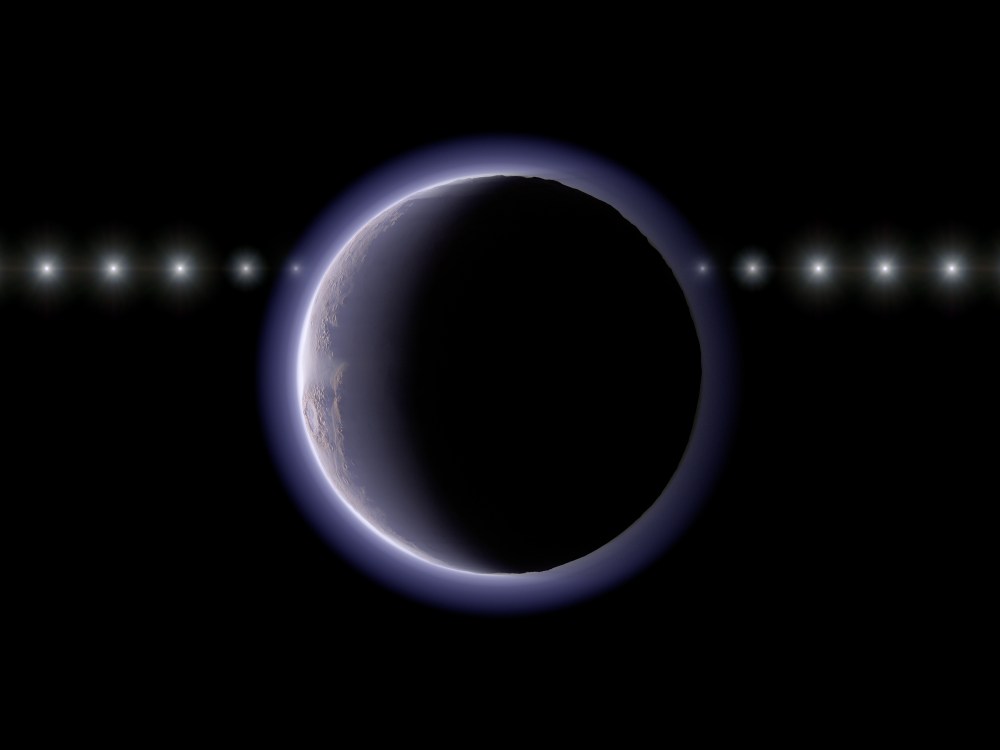
This image provided by NAOJ shows artist’s impression of the trans-Neptunian object (612533) 2002 XV93 occulting a background star. Observations of a stellar occultation in January 2024 revealed gradual fading and recovery of the starlight, providing evidence for a very thin atmosphere around the object. (Ko Arimatsu/NAOJ via AP)

The finding offers fresh insight into our solar system’s farthest, coldest objects in a region known as the Kuiper Belt. Researchers used three telescopes in Japan to observe the object in 2024 as it passed in front of a background star, briefly dimming the starlight.

“It changes our view of small worlds in the solar system, not only beyond Neptune,” Arimatsu said in an email. Finding an atmosphere around such a small object was “genuinely surprising,” he added, and challenges “the conventional view that atmospheres are limited to large planets, dwarf planets and some large moons.”

This so-called minor planet — formally known as (612533) 2002 XV93 — is considered a plutino, circling the sun twice in the time it takes Neptune to complete three solar orbits. At the time of the study, it was more than 3.4 billion miles (5.5 billion kilometers) away, farther than even Pluto, the only other object in the Kuiper Belt with an observed atmosphere.

This cosmic iceball’s atmosphere is believed to be 5 million to 10 million times thinner than Earth’s protective atmosphere, according to the the study appearing Monday in the journal Nature Astronomy.

It’s 50 to 100 times thinner than even Pluto’s tenuous atmosphere. The likeliest atmospheric chemicals are methane, nitrogen or carbon monoxide, any of which could reproduce the observed dimming as the object passed before the star, according to Arimatsu.

Further observations, especially by NASA’s Webb Space Telescope, could verify the makeup of the atmosphere, according to Arimatsu.

“That is why future monitoring is so important,” he said. “If the atmosphere fades over the next several years, that would support an impact origin. If it persists, or varies seasonally, that would point more toward ongoing internal gas supply” from ice volcanoes.

___

The Associated Press Health and Science Department receives support from the Howard Hughes Medical Institute’s Department of Science Education and the Robert Wood Johnson Foundation. The AP is solely responsible for all content.

Report Error Submit a Tip

More Stories

Astronomers believe they’ve detected an atmosphere around a tiny, icy world beyond Pluto

Marcia Dunn, The Associated Press 3 minute read Preview

Astronomers believe they’ve detected an atmosphere around a tiny, icy world beyond Pluto

Marcia Dunn, The Associated Press 3 minute read Saturday, May. 16, 2026

CAPE CANAVERAL, Fla. (AP) — A new study suggests that a tiny, icy world beyond Pluto harbors a thin, delicate atmosphere that may have been created by volcanic eruptions or a comet strike.

Just 300 miles (500 kilometers) or so across, this mini Pluto is thought to be the solar system's smallest object yet with a clearly detected global atmosphere bound by gravity, said lead researcher Ko Arimatsu of the National Astronomical Observatory of Japan.

“This is an amazing development, but it sorely needs independent verification. The implications are profound if verified,” said Southwest Research Institute's Alan Stern, the lead scientist behind NASA's New Horizons mission to Pluto and beyond. He was not involved in the study.

The finding offers fresh insight into our solar system’s farthest, coldest objects in a region known as the Kuiper Belt. Researchers used three telescopes in Japan to observe the object in 2024 as it passed in front of a background star, briefly dimming the starlight.

Read
Saturday, May. 16, 2026

Tory health critic ‘disappointed’ after being rebuffed by health officials

Carol Sanders 4 minute read Preview

Tory health critic ‘disappointed’ after being rebuffed by health officials

Carol Sanders 4 minute read Yesterday at 11:53 AM CDT

The health critic for the Progressive Conservative party says her ability to get information about the accelerated reopening of Dauphin’s emergency department was stymied by Prairie Mountain Health officials because they refused to meet with her.

“I wanted to meet with PMH staff to discuss the status of the facility and the challenges they’re facing and getting services back online,” Kathleen Cook said Friday.

“I was very disappointed that Prairie Mountain Health declined me that opportunity.”

Cook said she asked for a meeting a few days after the Sept. 7 reopening of a temporary ER at the hospital, that was severely damaged by flooding.

Read
Yesterday at 11:53 AM CDT

Retired sportscaster Scott Oake determined as fundraising for women's addictions treatment facility enters home stretch

Melissa Martin 4 minute read Preview

Retired sportscaster Scott Oake determined as fundraising for women's addictions treatment facility enters home stretch

Melissa Martin 4 minute read Thursday, Sep. 10, 2026

For now, the patch of land just east of the Victoria Hospital doesn’t look like much: just a field of rocks, mounded dirt, and concrete piles driven into the earth. Yet when Scott Oake looks over the site, he can already imagine how it will look in just over a year’s time, when the new Anne Oake Family Recovery Centre is expected to open.

It’s easier to picture this time around. In 2020, when the recently-retired CBC sportscaster and his late wife, Anne, were building their first labour of intermingled grief and love, the Bruce Oake Recovery Centre for men, it was hard for him to wrap his mind around how a raw construction site could transform into a welcoming addictions treatment facility.

When that centre opened in 2021, Oake found it looked “almost identical” to the architect’s renderings. So it’s easy to hope the Anne Oake Centre will be the same. It will be the first facility of its kind, its founders believe, not only in Canada but in North America: a place where 50 to 70 women can pursue sobriety while staying with their children.

“At Bruce Oake there’s a culture of love, and most of all a culture of hope,” Oake said, speaking at the site Thursday after a media conference to announce the final push of the centre’s fundraising campaign. “I can feel it every time I walk into that building. And I know it will be the same here.”

Read
Thursday, Sep. 10, 2026

What do we elect a school trustee to do?

Laura Reimer 5 minute read Yesterday at 2:00 AM CDT

On Oct. 28, Manitobans will once again elect the people who serve on our local school boards. School trustee races rarely attract the attention given to other elections. Yet school boards are among our most immediate forms of representative democracy.

Before asking who should be a school trustee, perhaps we should ask a more basic question:

What, exactly, are we electing a school trustee to do?

Trustees are elected to govern a school division. They are not elected to run it.

Is Trump about to poke Quebec’s political beehive?

Peter McKenna 5 minute read Preview

Is Trump about to poke Quebec’s political beehive?

Peter McKenna 5 minute read Yesterday at 2:00 AM CDT

When was the last time that a U.S. president seriously stirred the hornet’s nest of Quebec politics?

My best recollection is former U.S. president Bill Clinton. During the 1994 Quebec referendum campaign, Clinton made clear that the U.S. wholly endorsed a united and strong federal Canada — as opposed to a dismembered one. He went on to add that an independent Quebec would have no guarantee of joining the North American Free Trade Agreement as a full-fledged member.

Today, we see U.S. President Donald Trump inserting himself — unwittingly or wittingly — into the electoral and sovereignty politics of Quebec. It’s pretty clear that the resurgent Coalition Avenir Québec government is trying to make the Oct. 5 provincial election about anything other than its own governmental record and more about Trump’s economic coercion against Canada. Of course, the Parti Québécois, the odds-on-favourite, wants to make the electoral contest a referendum on the CAQ and its party leader, Christine Fréchette.

But what if Trump really wanted to make his presence felt in Quebec’s political life? How much influence could he have on shaping political outcomes in Quebec? How much of an “X factor” could he be?

Read
Yesterday at 2:00 AM CDT

Chrétien says Canada bows to no one in fiery address at 9/11 commemoration

Sarah Smellie, The Canadian Press 6 minute read Preview

Chrétien says Canada bows to no one in fiery address at 9/11 commemoration

Sarah Smellie, The Canadian Press 6 minute read Friday, Sep. 11, 2026

GANDER - Former prime minister Jean Chrétien drew a standing ovation inside a Gander, N.L., hockey arena on Friday as he delivered a pointed message to American leaders during a ceremony marking the 9/11 terrorist attacks in the United States, 25 years ago.

The 92-year-old warned Americans never to mistake Canadian generosity for weakness, nor its kindness for softness.

U.S. Ambassador Pete Hoekstra looked on as Chrétien insisted his pointed words were a sign of friendship. Friends tell each other the truth, he said.

“We embraced our friends and we helped them in their moment of need, but we bow to no one,” Chretien said, as the crowd erupted again.

Read
Friday, Sep. 11, 2026