Brazil’s Lula adds pressure on big techs by increasing their liability for illegal user content

Advertisement

Advertise with us

SAO PAULO (AP) — Brazil’s President Luiz Inácio Lula da Silva signed two decrees on Wednesday that add to the pressure on big tech companies by increasing their liability for illegal content shared by its users and paving the way for investigations by a government body into their responses to such cases.

Read this article for free:


or

Already have an account? Log in here »

To continue reading, please subscribe:

Subscribe and receive a limited-edition Free Press branded hat or tote.

Digital Subscription

One year of digital access for only $205*

  • Enjoy unlimited reading on winnipegfreepress.com
  • Read the E-Edition, our digital replica newspaper
  • Access News Break, our award-winning app
  • Play interactive puzzles

*First annual payment billed as $205.00 + GST for one year. This annual subscription will automatically renew at $233.00 + GST every 52 weeks (10% off the regular annual price of $259.35). Offer available to new and qualified returning subscribers only. Cancel any time.

To continue reading, please subscribe:

Add Free Press access to your Brandon Sun subscription for only an additional

$1 for the first 4 weeks*

  • Enjoy unlimited reading on winnipegfreepress.com
  • Read the E-Edition, our digital replica newspaper
  • Access News Break, our award-winning app
  • Play interactive puzzles
Start now

*Your next Brandon Sun subscription payment will increase by $1.00 and you will be charged $17.95 plus GST for four weeks. After four weeks, your payment will increase to $24.95 plus GST every four weeks.

SAO PAULO (AP) — Brazil’s President Luiz Inácio Lula da Silva signed two decrees on Wednesday that add to the pressure on big tech companies by increasing their liability for illegal content shared by its users and paving the way for investigations by a government body into their responses to such cases.

The moves toughen the environment in Brazil for giants like Google, Meta and TikTok, who have long tried to dissociate themselves with crimes online committed by users.

The first decree makes key adaptations to government regulations to align them with a decision by Brazil’s Supreme Court making big tech companies liable if they refuse to remove content by judicial order. It also enables the country’s national agency of data protection to investigate those cases. The second decree establishes guidelines for the protection of women in the digital environment.
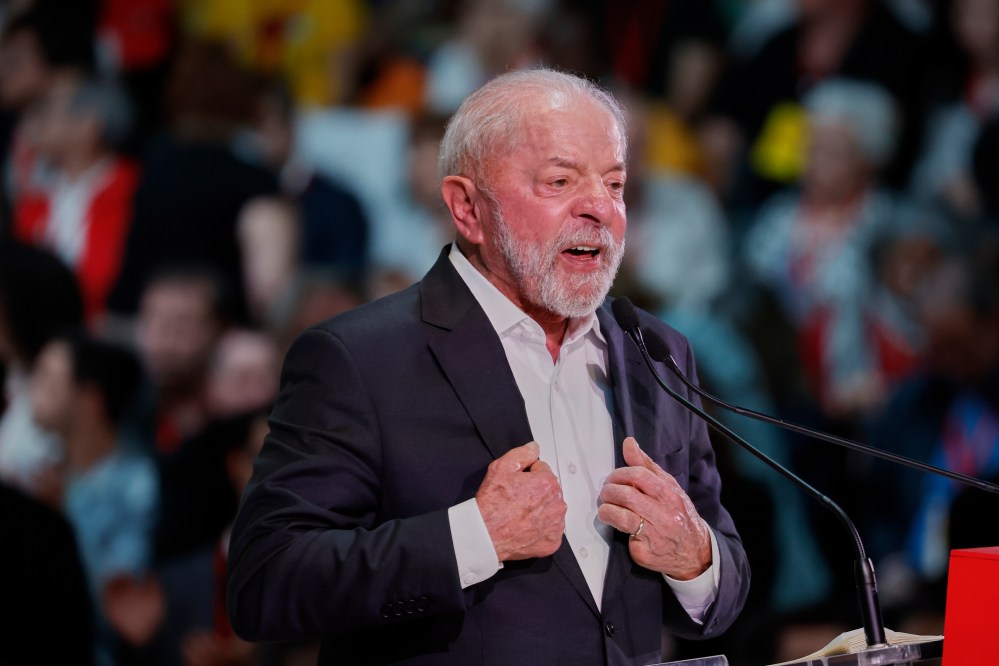
FILE - Brazil's President Luiz Inacio Lula da Silva delivers his speech during the Global Progressive Mobilization summit in Barcelona, Spain, April 18, 2026. (AP Photo/Joan Monfort, File)

Brazil’s government said in a statement that from now on platforms must analyze any complaints, and if the content is deemed criminal, remove it immediately, while communicating the decision to the person responsible. Possible penalties for non-compliance include warnings, fines and temporary suspension.

Big tech companies have not commented on the decision by Brazil’s government.

Patricia Peck, a council member of Brazil’s Data Protection Authority and author of 46 books on law and technology, said the country’s executive and judicial branches have pushed for big techs to be proactive against crimes online despite evident stagnation of the debate in congress.

“We don’t have specific legislation to hold these platforms responsible, we are taking a side road,” Peck told The Associated Press. “Those who develop these technologies must think about it with perspective of ethics, privacy, and security as a standard.”

Since the Brazilian Supreme Court ruling last year, these companies have had to actively monitor content that involves hate speech, racism and incitation to violence and act to remove it.

Lula’s move also expands the current law’s capacity to address the growth of digital fraud, online scams and new forms of online violence.

Mattheus Puppe, an expert on Brazil’s digital law, says the decrees seek to stop platforms from profiting from illegal publications and reinforce the country’s Supreme Court’s decision. But he has doubts on whether the government’s initiatives will indeed hinder online crime.

“It is not clear how well this will work because the agency that was chosen to investigate cases can barely do its job now,” Puppe said. “But it is true that it shouldn’t be up to companies to know what is lawful and what is not.”

Brazil’s approach to big techs is increasingly similar to that of the European Union, which has sought to rein in the power of social media companies and other digital platforms.

But it has unsettled the relationship between the South American nation and the U.S. government. Critics expressed concern that the move could threaten free speech if platforms preemptively remove content that could be problematic.

Earlier this year, a law that seeks to shield minors from addictive, violent, and pornographic online content took effect. The legislation requires minors under 16 to link their social media accounts to a legal guardian to ensure supervision and prohibits platforms from using addictive features such as infinite scroll and the automatic play of videos.

___

Follow AP’s coverage of Latin America and the Caribbean at https://apnews.com/hub/latin-america
Report Error Submit a Tip

More Stories

Quiet opening fitting for controversial site

Melissa Martin 4 minute read Preview

Quiet opening fitting for controversial site

Melissa Martin 4 minute read Yesterday at 2:00 AM CDT

One of this city’s most loudly debated facilities — after all the angst, all the opposition and all the vocal support — began operations in the most low-key way possible.

Read
Yesterday at 2:00 AM CDT

Brazil’s Lula adds pressure on big techs by increasing their liability for illegal user content

Mauricio Savarese And Eléonore Hughes, The Associated Press 4 minute read Preview

Brazil’s Lula adds pressure on big techs by increasing their liability for illegal user content

Mauricio Savarese And Eléonore Hughes, The Associated Press 4 minute read Wednesday, May. 20, 2026

SAO PAULO (AP) — Brazil’s President Luiz Inácio Lula da Silva signed two decrees on Wednesday that add to the pressure on big tech companies by increasing their liability for illegal content shared by its users and paving the way for investigations by a government body into their responses to such cases.

The moves toughen the environment in Brazil for giants like Google, Meta and TikTok, who have long tried to dissociate themselves with crimes online committed by users.

The first decree makes key adaptations to government regulations to align them with a decision by Brazil’s Supreme Court making big tech companies liable if they refuse to remove content by judicial order. It also enables the country’s national agency of data protection to investigate those cases. The second decree establishes guidelines for the protection of women in the digital environment.

Brazil’s government said in a statement that from now on platforms must analyze any complaints, and if the content is deemed criminal, remove it immediately, while communicating the decision to the person responsible. Possible penalties for non-compliance include warnings, fines and temporary suspension.

Read
Wednesday, May. 20, 2026

A new chapter: Renamed Winnipeg Book Festival takes to The Forks this fall

Ben Sigurdson 5 minute read Preview

A new chapter: Renamed Winnipeg Book Festival takes to The Forks this fall

Ben Sigurdson 5 minute read Tuesday, Aug. 11, 2026

Winnipeg’s long-running annual literary festival returns this fall, once again featuring a slate of authors, local and beyond, ready to engage with readers.

New this year is pretty much everything else, including a new name, executive director and team of staff — as well as a shift to a tight, condensed timeline and a move to hold all events under one roof.

The festival formerly known as Thin Air/Livres en fête is now the Winnipeg Book Festival; the event takes place Oct. 1-4 at The Forks Market, with most events offering free admission.

It’s a lot of changes for the stalwart literary festival, which was run for more than two decades by Charlene Diehl, who stepped away in late 2025.

Read
Tuesday, Aug. 11, 2026

Killer apologizes to family of 16-year-old he shot in 2024 before judge delivers 18-year manslaughter sentence

Dean Pritchard 5 minute read Preview

Killer apologizes to family of 16-year-old he shot in 2024 before judge delivers 18-year manslaughter sentence

Dean Pritchard 5 minute read Tuesday, Aug. 11, 2026

Sharon Basarowich’s voice quaked with emotion as she told a court Tuesday of the never-ending pain her family has been left with after her 16-year-old grandson was gunned down outside a Boyd Avenue drug house.

“We have a void that will never be filled,” said Basarowich, whose grandson Trey Basarowich, a talented hockey player and youth mentor, was fatally shot Oct. 5, 2024.

“When Trey died, a part of us died, too,” she said.

Devin Evans, 20, was originally charged with second-degree murder in the killing but in a plea bargain admitted to the lesser offence of manslaughter and was sentenced Tuesday to 18 years in prison.

Read
Tuesday, Aug. 11, 2026

Differing goals of religion, politics

John R. Wiens 5 minute read 2:00 AM CDT

Kudos to David Driedger for modelling a more appropriate and constructive role for religion in politics than the one that has become commonplace today (“Take care of them; there is enough”, Think Tank, July 27).

Resisting the temptation to preach, coerce and control, he has chosen to remind, persuade and challenge. It could hardly more different to what we are witnessing everyday to the south of us. I thank him for his humility, courage and sense of responsibility to humanity.

Our recent experiences with religion’s forays into the political realm, both in the U.S. and parts of Canada have done little to endear us to either one. Religious fundamentalism, in its many forms, has wrought untold havoc on governments across the globe, with some of the most toxic iterations being right on our doorsteps — we might even call it a form of domestic terrorism.

In the U.S., Christian nationalism, represented by MAGA, has contaminated government and ordinary lives like a hazardous toxin escaping containment — corroding and poisoning the presidency, the legislature, the court system and law enforcement, and in the process threatening the very relationships which make a civilized society possible. Simply put, the positive ideal of godliness in the American constitution, which emphasized tolerance for, acceptance of and upheld the equal worth of all peoples is in peril.

Puzzles Palace

1 minute read Monday, Jul. 27, 2026

To solve our puzzles, please subscribe with this special offer: |