Demand soars for Israel’s battle-tested weapons tech despite global criticism of its wartime conduct
Advertisement
Read this article for free:
or
Already have an account? Log in here »
To continue reading, please subscribe:

Digital Subscription
One year of digital access for only $205*
- Enjoy unlimited reading on winnipegfreepress.com
- Read the E-Edition, our digital replica newspaper
- Access News Break, our award-winning app
- Play interactive puzzles
*First annual payment billed as $205.00 + GST for one year. This annual subscription will automatically renew at $233.00 + GST every 52 weeks (10% off the regular annual price of $259.35). Offer available to new and qualified returning subscribers only. Cancel any time.
To continue reading, please subscribe:
Add Free Press access to your Brandon Sun subscription for only an additional
$1 for the first 4 weeks*
- Enjoy unlimited reading on winnipegfreepress.com
- Read the E-Edition, our digital replica newspaper
- Access News Break, our award-winning app
- Play interactive puzzles
*Your next Brandon Sun subscription payment will increase by $1.00 and you will be charged $17.95 plus GST for four weeks. After four weeks, your payment will increase to $24.95 plus GST every four weeks.
Read unlimited articles for free today:
or
Already have an account? Log in here »
TEL AVIV, Israel (AP) — When Israeli defense officials approached Massivit last year about using its unique 3D printers to make military drone parts, CEO Yossi Azarzar jumped at the chance.
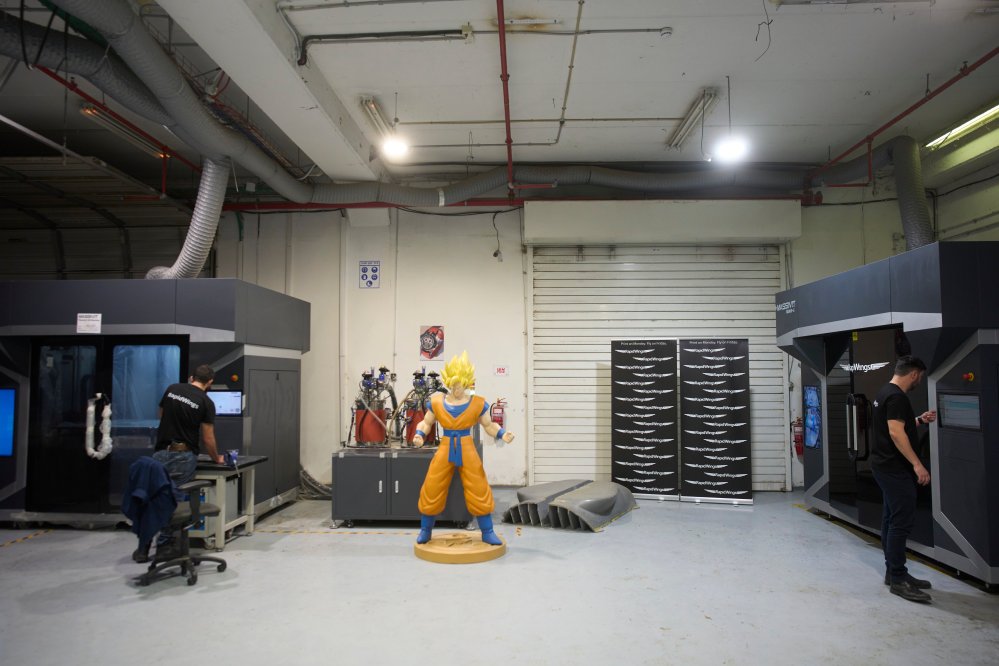
Although the Israeli company had been producing large set pieces and other designs for the likes of Disney, DreamWorks and Netflix, the opportunity to instead quickly churn out large drone parts for the military was too good to ignore.
“I stopped thinking about Hollywood sets,” Azarzar said. “The entertainment industry is a nice customer — defense is a necessity.”
Business has been booming for the Israeli arms sector, despite widespread criticism of the country’s conduct in its wars in Gaza, with Hezbollah and with Iran. Countries that have vowed to shun Israeli weapons makers are nonetheless quietly placing orders, according to industry officials. And manufacturers, including some like Massivit with no previous military know-how, can show that their innovations are being continually combat-tested and improved.
According to Israel’s Defense Ministry, Israeli weapons sales have more than doubled over the past five years, with a record high of nearly $15 billion in 2024. While the ministry hasn’t released overall 2025 figures, leading Israeli weapons makers, including Elbit and Israel Aerospace Industries, both reported double-digit sales growth last year.
More than half of the Israeli arms industry’s sales are for missiles, rockets and air-defense systems. For the first time, Israel has surpassed the United Kingdom in its share of global arms exports, making it the world’s seventh-biggest supplier, according to a March report by the Stockholm International Peace Research Institute.
“This tremendous achievement is a direct result of the successes of the (army) and defense industries. … The world sees Israeli strength and seeks to be a partner in it,” said Israel’s defense minister, Israel Katz.
Solid sales, despite public criticism
This year’s Defense Tech Expo in Tel Aviv reflected the growing international interest in Israeli weapons, with manufacturers promoting arms and other equipment shaped by the country’s recent conflicts. But it also highlighted the tension between showcasing the military technology and the political debate surrounding its use, with event protesters decrying the widespread destruction of Gaza as a testing lab for Israeli weapons.
Last year, Spain canceled a deal for anti-tank missile systems sold by an Israeli company’s subsidiary. Slovenia, meanwhile, announced it would ban the import, export and transit of all weapons to and from Israel in response to the country’s actions in Gaza. After Hamas attacked Israel on Oct. 7, 2023, killing some 1,200 people and taking roughly 250 others hostage, Israel retaliated, killing more than 72,700 Palestinians, according to the Gaza Health Ministry, which doesn’t distinguish between fighters and civilians. Some countries and human rights groups have accused Israel of war crimes.
Israel’s Defense Ministry says it uses its equipment to defend the country and its people, and denies that it uses battlefields as testing grounds.
Human rights advocates, though, say Israel has deployed new weapons and technology during the war in Gaza, including in AI, big data and targeting.
“The regional war has drawn heavily on Israel’s deadly playbook and provided a boon to Israeli and other defense and technology companies able to parlay the use of their products in Gaza to attract more business,” said Omar Shakir, the executive director of DAWN, a U.S.-based group founded by murdered journalist Jamal Khashoggi that pushes for human rights in the Middle East.
Despite criticism that Israel’s weapons sector is profiting off technologies being used and improved on the battlefield, it’s hardly alone, according to experts.
“Countries have had to dramatically increase defenses because of the proliferation of global conflicts and they need systems that will work. And most countries don’t have the time right now to build their own defense systems locally and quickly,” said Seth J. Frantzman, an adjunct fellow at the Foundation for Defense of Democracies who has covered Israel’s arms industry for a decade and wrote the book “Drone Wars.”
A lot of countries are looking to Israel because they’re seeing in real time that these are munitions and systems that work, he said.
High interest in Israeli technology
For Massivit, sales have soared since it pivoted to making drone parts for the military, including a 200% rise in inquiries from interested buyers since Israel and the U.S. attacked Iran at the end of February, according to Azarzar.
The company’s unique 3D printing technology allows it to make large parts for military drones within days instead of weeks. In addition to selling to the Israeli military, the company’s technology has drawn interest from the defense and aeronautical sectors in Europe, the U.S., Southeast Asia and India, he said.
Business has also been good for other defense contractors.
Tomer Malchi, co-founder and CEO of ASIO, said Israeli army orders for the company’s rugged smartphone unit, the Orion, have surged by 400% since the war in Gaza started.
The phones use maps, augmentation and artificial intelligence to help soldiers plan missions, navigate and respond to real-time battlefield threats. ASIO recently signed a deal with a major U.S. defense company and is in talks with about 20 other countries, Malchi said.

One area Israel’s Defense Ministry says will be a future priority for innovation is taking down drones, which has proven challenging during the war with Iran. Drones are hard to pinpoint on radar systems calibrated for spotting high-speed missiles and can be mistaken for birds or planes.
Israel Weapon Industries, a local weapons maker, has developed a system to help soldiers more accurately shoot down tactical drones. At a shooting range in central Israel, an IWI instructor fired rounds at a makeshift drone to show how the system works. A computer chip embeds into a soldier’s rifle, providing more accuracy and efficiency and significantly reducing the influence of fatigue and other factors by allowing the trigger to remain pressed.
The system, known as Arbel, came to market in 2024 and now has more than two dozen countries using it, said Semion Dukhan, head of Europe for IWI.
Among IWI’s buyers are countries that have said publicly that they won’t do deals with Israel, Dukhan said, though he wouldn’t name them.
“People and politicians say things they need to say … what they say is not necessarily what is going on underneath the surface,” he said, noting that at the end of the day, countries want to equip their people with the best gear.