Dying star resembles a billowing crystal ball in new telescope photo
Advertisement
Read this article for free:
or
Already have an account? Log in here »
To continue reading, please subscribe:

Digital Subscription
One year of digital access for only $205*
- Enjoy unlimited reading on winnipegfreepress.com
- Read the E-Edition, our digital replica newspaper
- Access News Break, our award-winning app
- Play interactive puzzles
*First annual payment billed as $205.00 + GST for one year. This annual subscription will automatically renew at $233.00 + GST every 52 weeks (10% off the regular annual price of $259.35). Offer available to new and qualified returning subscribers only. Cancel any time.
To continue reading, please subscribe:
Add Free Press access to your Brandon Sun subscription for only an additional
$1 for the first 4 weeks*
- Enjoy unlimited reading on winnipegfreepress.com
- Read the E-Edition, our digital replica newspaper
- Access News Break, our award-winning app
- Play interactive puzzles
*Your next Brandon Sun subscription payment will increase by $1.00 and you will be charged $17.95 plus GST for four weeks. After four weeks, your payment will increase to $24.95 plus GST every four weeks.
Read unlimited articles for free today:
or
Already have an account? Log in here »
CAPE CANAVERAL, Fla. (AP) — A dying star has never looked so lovely.
The Gemini North Telescope atop Hawaii’s tallest peak, Mauna Kea, captured the star in its last gasps. The image was released Thursday by the National Science Foundation’s NOIRLab, which operates the telescope.
It’s actually a binary star system 1,500 light-years away, nicknamed the Crystal Ball Nebula because of the milky white, spherical cloud around it. A light-year is almost 6 trillion miles.
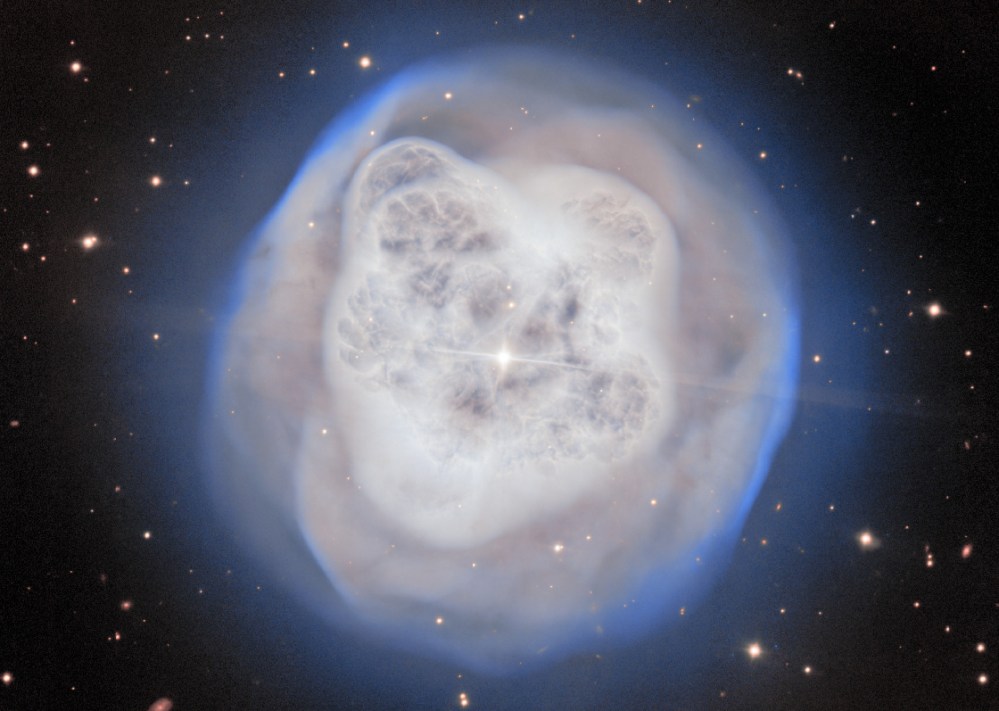
This cloud of gas forms when a star sheds its outer layers near the end of its life. The exposed stellar core heats the cloud to tens of thousands of degrees, giving it an ethereal glow.
Scientists believe one of the planetary nebula’s two orbiting stars — once bigger than our sun — gave up the ghost.
Gemini North last year observed the nebula — formally known as NGC 1514 — and the image was completed in color last week.
___
The Associated Press Health and Science Department receives support from the Howard Hughes Medical Institute’s Department of Science Education and the Robert Wood Johnson Foundation. The AP is solely responsible for all content.