Anthropic pledges $200 million to research AI’s economic impact as CEO suggests job loss solutions

Advertisement

Advertise with us

Anthropic on Wednesday joined growing calls for the artificial intelligence industry to find ways to cushion people from the technology's disruptions, announcing an initial $200 million investment to research AI's impact on jobs and the economy.

Read this article for free:


or

Already have an account? Log in here »

To continue reading, please subscribe:

Subscribe and receive a limited-edition Free Press branded hat or tote.

Digital Subscription

One year of digital access for only $205*

  • Enjoy unlimited reading on winnipegfreepress.com
  • Read the E-Edition, our digital replica newspaper
  • Access News Break, our award-winning app
  • Play interactive puzzles

*First annual payment billed as $205.00 + GST for one year. This annual subscription will automatically renew at $233.00 + GST every 52 weeks (10% off the regular annual price of $259.35). Offer available to new and qualified returning subscribers only. Cancel any time.

To continue reading, please subscribe:

Add Free Press access to your Brandon Sun subscription for only an additional

$1 for the first 4 weeks*

  • Enjoy unlimited reading on winnipegfreepress.com
  • Read the E-Edition, our digital replica newspaper
  • Access News Break, our award-winning app
  • Play interactive puzzles
Start now

*Your next Brandon Sun subscription payment will increase by $1.00 and you will be charged $17.95 plus GST for four weeks. After four weeks, your payment will increase to $24.95 plus GST every four weeks.

Anthropic on Wednesday joined growing calls for the artificial intelligence industry to find ways to cushion people from the technology’s disruptions, announcing an initial $200 million investment to research AI’s impact on jobs and the economy.

Alongside new policy proposals from the maker of the Claude chatbot, Anthropic CEO and co-founder Dario Amodei published an essay on his personal website that expanded on his position that the government should promise economic support for those financially impacted by AI. The technology could produce much larger disruptions to the labor market than previous technological advancements, Amodei wrote, and those disruptions could last longer.

“The key challenge in such a world won’t be incentivizing growth, but finding a way for everyone to share in the benefits,” Amodei wrote.
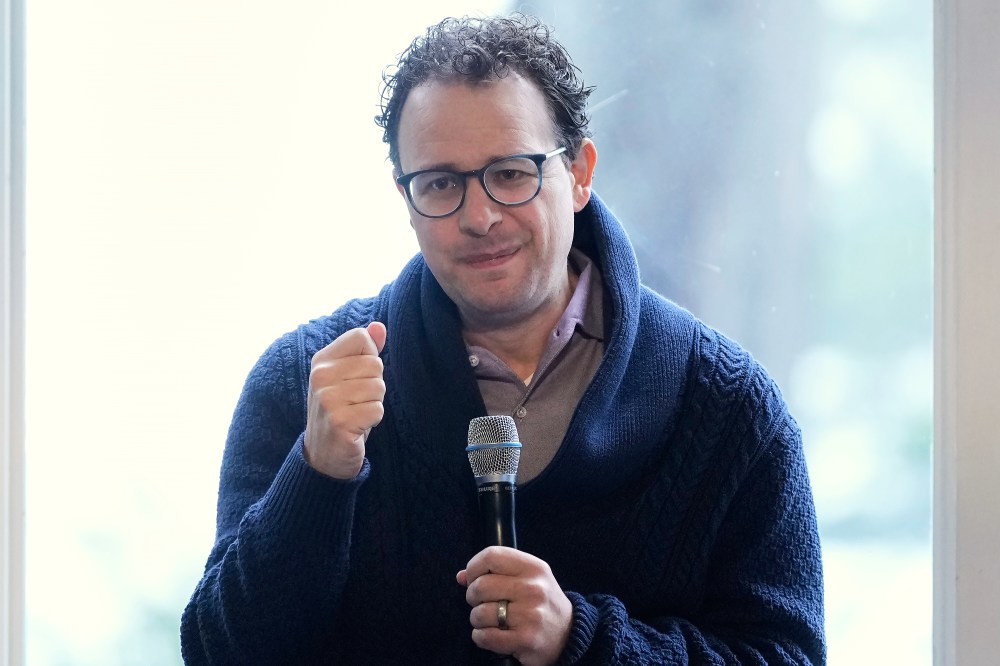
FILE - Dario Amodei, CEO & Co-Founder of Anthropic, speaks on a panel at the convening of the International Network of AI Safety Institutes at the Golden Gate Club at the Presidio in San Francisco, Nov. 20, 2024. (AP Photo/Jeff Chiu, File)

The announcement comes on the heels of Anthropic rival OpenAI on Monday outlining goals that included ensuring gains from the technology are “widely shared.” OpenAI CEO Sam Altman recently met with Sen. Bernie Sanders to discuss a plan for the public to take an ownership stake in artificial intelligence companies like OpenAI, using their stock to create a public wealth fund that would spread the fortune generated by AI behemoths.

In the Oval Office on Wednesday, President Donald Trump told reporters that he will soon meet with executives from several leading AI companies to discuss “giving back” to the public.

“We’re talking about giving back something to the public, and if we do that, the ⁠public will become very rich,” Trump said. “I think they’ll do that, and I think it’ll make it very popular.”

In his essay, Amodei said he has warned of job displacement not because he is “trying to be a ‘prophet of doom’” but because he wants “both policymakers and the private sector to have the best chance to adapt and respond.” He proposed better data collection to track AI job displacement, pro-employment policy incentives to slow or reduce displacement and “mechanisms such as universal basic income” if job displacement more permanently drives down labor demand.

That universal basic income could be financed through taxes on “relevant companies” or by raising the capital gains tax, Amodei wrote.

Scant details were available Wednesday about the $200 million commitment from Anthropic, but the company said it will go to what it calls an Economic Futures Research Fund that will back research trials and “program evaluation” on public policies it deems promising. The company is also establishing a $150 million national fellowship program it says will help early-career professionals “extend the benefits of AI to communities across America.”

Anthropic and OpenAI each recently announced they were moving toward initial public offerings of shares, following Elon Musk’s rocket company SpaceX, which is pitching itself as an AI-focused space company as it prepares to go public.

The economic policy framework Anthropic proposed Wednesday set recommendations for how the U.S. government could respond to three levels of economic disruption caused by AI: one in which the national unemployment rate reaches 5%, 10% and an unspecified, “unprecedented” level. The latest unemployment rate, reported last week, was 4.3%.

In the “unprecedented” scenario, the company wrote that more permanent support will be necessary, and it listed several ways to generate and share revenue broadly, including basic income, sovereign wealth models and equity-sharing mechanisms. This would be “novel economic territory,” the company wrote.

The company’s proposals also outlined several suggestions for mitigating safety and security risks. Anthropic is known for its emphasis on safety and building reliable, “steerable” AI systems, with Amodei and its co-founders splitting off from OpenAI to form the new company in 2021.

The proposals add that the government should be able to “block or deter” the rollout of AI models that “pose a significant risk of catastrophic harms.”

Amodei wrote that AI regulations should match the rigor of Federal Aviation Administration regulations in that AI models would be required to go through technical testing and auditing like airplanes. They wouldn’t be released if they didn’t meet high safety standards.

Last week, Trump signed an executive order on AI oversight that established a framework for the government to vet the national security risks of the most advanced AI systems for up to a month before their public release.

Amodei added existing regulations for aircraft, automobiles and drugs should serve as models for regulating AI. They are all “powerful technologies essential to the modern economy,” he wrote, “but capable of killing large numbers of people if designed or operated poorly.”

Report Error Submit a Tip

More Stories

Six high school hockey programs ceased operations following new Hockey Manitoba policy

Joshua Frey-Sam 7 minute read Preview

Six high school hockey programs ceased operations following new Hockey Manitoba policy

Joshua Frey-Sam 7 minute read Updated: Yesterday at 8:19 PM CDT

She lived the best of both worlds.

For the last three years, the 17-year-old wore a sweater for two different hockey programs — her high school team and AAA club in the Manitoba Female Hockey League — and was preparing to flourish in both colours again this winter.

Recently, however, the blue-liner was disappointed to learn she is no longer eligible to play her Grade 12 season with her school owing to a new policy imposed by Hockey Manitoba that bans players from participating in the Manitoba Women’s High School Hockey League if they are rostered on a U18 AAA team.

The rule applies to all athletes who play for both Winnipeg-based and rural AAA teams.

Read
Updated: Yesterday at 8:19 PM CDT

Volunteer pop-up library axed from Manitoba Youth Centre

Matthew Frank 4 minute read Preview

Volunteer pop-up library axed from Manitoba Youth Centre

Matthew Frank 4 minute read 2:01 AM CDT

Manitoba Corrections has cancelled a pop-up library program at the Manitoba Youth Centre, leaving inmates without librarian services and fewer options to borrow certain books.

The Prison Libraries Committee, part of the non-profit Manitoba Library Association, operated and funded the volunteer program since 2024 before it was shut down by the province last month. The group previously partnered with the province to offer the service because the facility has no dedicated library of its own.

“It is concerning that community members who are incarcerated, especially youth, are losing out on meaningful programming, access to information and rehabilitation efforts, which are offered at no cost to (Manitoba) Corrections. We urge Manitoba Justice to promote more library services and programming, not less,” said a Sept. 24 letter from the non-profit addressed to the justice minister.

Ashley Huot, chair of the Prison Libraries Committee, said she was puzzled when she received an email last month from Manitoba Corrections stating that the pop-up library was no longer needed.

Read
2:01 AM CDT

A day on the campaign trail: Winnipeg's mayor, seeking a second term, does double duty

Malak Abas 12 minute read Preview

A day on the campaign trail: Winnipeg's mayor, seeking a second term, does double duty

Malak Abas 12 minute read Updated: Yesterday at 5:56 PM CDT

In the weeks leading up to the civic election, Scott Gillingham has been performing a juggling act: he’s running to be Winnipeg’s 45th mayor, while still serving as its 44th.

“If someone asks me about the campaign, I’m going to answer them. But I think for most people, I’m the mayor of Winnipeg, even if I’m showing up as a candidate,” Gillingham, 58, says. “I try to do all I can to maintain that distinction.”

The Free Press joined Gillingham on a recent rainy September Saturday on the campaign trail, where he served in both roles during an event-laden day. City council’s final meeting before the Oct. 28 election was days earlier.

In Winnipeg, it’s rare for an incumbent to be defeated. But Gillingham knows his win in 2022 wasn’t exactly a landslide — he won with 27.5 per cent of the vote — and he’s been thinking about his second term ever since.

Read
Updated: Yesterday at 5:56 PM CDT

Khan should’ve taken high road: Goertzen

Carol Sanders 5 minute read Preview

Khan should’ve taken high road: Goertzen

Carol Sanders 5 minute read Yesterday at 6:39 PM CDT

The veteran Progressive Conservative who championed Obby Khan’s leadership bid says the former Blue Bomber dropped the ball by dissing his Tory teammates before he stepped down.

“I wouldn’t recommend it, and I didn’t recommend it,” Kelvin Goertzen (Steinbach) said in an interview Friday.

Khan resigned as PC leader and quit the caucus Monday saying some members were secretly plotting his ouster, even after he won a confidence vote on Sept. 25.

On Tuesday, Khan lashed out in a CJOB interview, naming the alleged plotters, saying constituents deserved to know which of their elected representatives “lacked moral integrity.” Khan told the Free Press he was “deeply emotionally hurt,” and felt stabbed in the back.

Read
Yesterday at 6:39 PM CDT

J’accuse!: Kinew uses French to fry interim Tory leader over alleged caucus subterfuge

Chris Kitching and Maggie Macintosh 4 minute read Preview

J’accuse!: Kinew uses French to fry interim Tory leader over alleged caucus subterfuge

Chris Kitching and Maggie Macintosh 4 minute read Thursday, Oct. 1, 2026

NDP Premier Wab Kinew took a dig at the Progressive Conservatives’ leadership change while facing off with Obby Khan’s short-term replacement for the first time in question period Thursday.

Read
Thursday, Oct. 1, 2026

International flavour: Canadian investors may want to make like Ottawa, diversify beyond U.S.

Joel Schlesinger 6 minute read Preview

International flavour: Canadian investors may want to make like Ottawa, diversify beyond U.S.

Joel Schlesinger 6 minute read 2:01 AM CDT

Canada is learning the hard way about the dangers of putting too many eggs in its U.S. economic basket.

Much has been made about the need to diversify our economy away from the United States.

Diversification is understandably beneficial. The more varied streams of revenue a nation has, the less affected the economy will be when one of those sources is interrupted.

The same can be said about investment portfolios.

Read
2:01 AM CDT