Reactor reboot at world’s largest nuclear plant highlights flaws in Japan’s radioactive waste plans
Advertisement
Read this article for free:
or
Already have an account? Log in here »
To continue reading, please subscribe:

Digital Subscription
One year of digital access for only $205*
- Enjoy unlimited reading on winnipegfreepress.com
- Read the E-Edition, our digital replica newspaper
- Access News Break, our award-winning app
- Play interactive puzzles
*First annual payment billed as $205.00 + GST for one year. This annual subscription will automatically renew at $233.00 + GST every 52 weeks (10% off the regular annual price of $259.35). Offer available to new and qualified returning subscribers only. Cancel any time.
To continue reading, please subscribe:
Add Free Press access to your Brandon Sun subscription for only an additional
$1 for the first 4 weeks*
- Enjoy unlimited reading on winnipegfreepress.com
- Read the E-Edition, our digital replica newspaper
- Access News Break, our award-winning app
- Play interactive puzzles
*Your next Brandon Sun subscription payment will increase by $1.00 and you will be charged $17.95 plus GST for four weeks. After four weeks, your payment will increase to $24.95 plus GST every four weeks.
Read unlimited articles for free today:
or
Already have an account? Log in here »
KASHIWAZAKI, Japan (AP) — Japan has resumed operations at the world’s largest nuclear power plant to help the country meet huge electricity demands during a global oil crisis, but the reboot highlights a big problem: Japan is running out of space for spent nuclear fuel and has no viable plans for permanent disposal of the radioactive waste.
The restart of No. 6 reactor at Kashiwazaki-Kariwa Nuclear Power Station earlier this year was meant to spur a movement to bring more nuclear reactors online. Kashiwazaki-Kariwa is one of three plants whose cooling pools will be full in five years, according to the Federation of Electric Power Companies of Japan.
“Without solid (fuel management) plans, our power generation will stall sooner or later,” Kashiwazaki-Kariwa General Manager Takeyuki Inagaki said.
After decades of seeking permanent storage for highly radioactive spent fuel, the government is considering Minamitorishima, a remote Pacific island south of Tokyo. But the selection has faced skepticism and criticism stemming from Japan’s arbitrary actions on spent fuel and radioactive waste management.
Only 15 of Japan’s 54 reactors have restarted since the March 2011 Fukushima disaster, when a 9.0 earthquake off Japan’s northeastern coast and a subsequent tsunami caused meltdowns at three reactors operated by Tokyo Electric Power Company Holdings, or TEPCO. About 160,000 people fled from Fukushima and some areas remain unlivable.
Kashiazaki-Kariwa, also run by TEPCO, was shut down after the Fukushima disaster as part of a nationwide nuclear power stoppage.
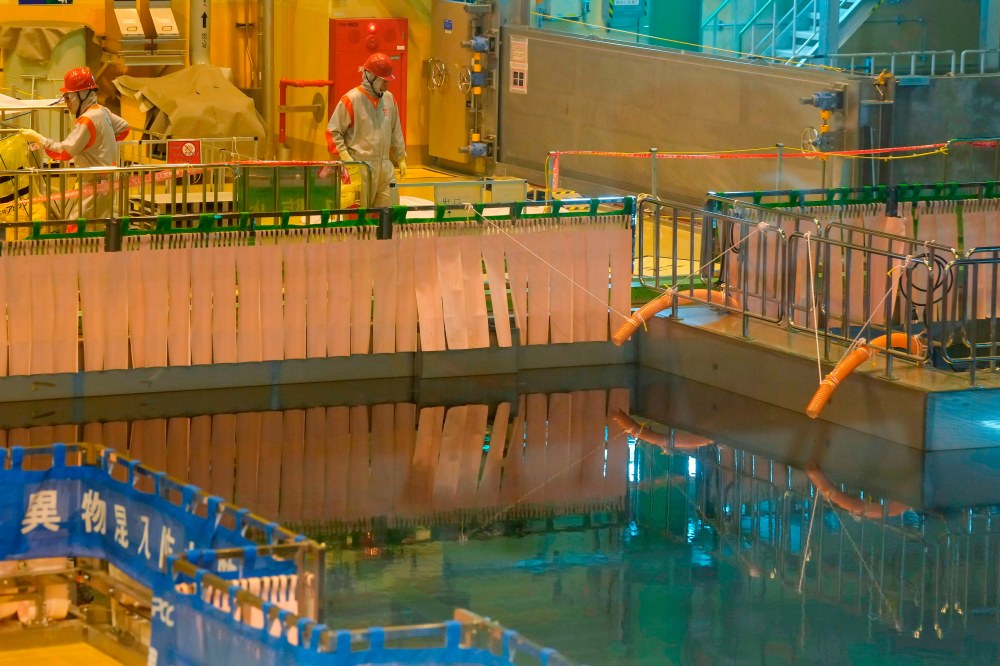
The spent fuel in a cooling pool at Kashiwazaki-Kariwa No. 6 reactor, which is 88% filled, can be seen from a top-floor observation area. TEPCO has installed filtered venting systems and devices to prevent hydrogen explosions among additional safety measures based on lessons from Fukushima.
Prime Minister Sanae Takaichi is pushing to bring more nuclear plants online, resulting in more spent fuel. Without a viable permanent storage plan, there are worries that reactors will have to close when storage space runs out.
Fuel recycling plan has stalled
There are two options for dealing with spent nuclear fuel: direct disposal as waste or recycling to extract plutonium and uranium for reuse.
Japan insists on recycling, saying it will help the resource-poor nation’s energy needs while reducing the toxicity and volume of radioactive waste. But a reactor designed for plutonium reuse, a key part of the recycling, has failed. Reprocessing also won’t be able to handle all the spent fuel, adding to a plutonium stockpile that already is large enough to arm thousands of atomic bombs.
Experts say Japan should also consider the direct disposal option.
As of December 2025, cooling pools at 17 Japanese nuclear power plants held more than 17,000 tons (15,422 metric tons) of spent fuel, using nearly 80% of total storage capacity, according to the Ministry of Economy, Trade and Industry.
Beyond the large amount of radioactive waste from normal reactors, Japan also “has to deal with massive and largely unknown high-level nuclear waste from the Fukushima disaster,” said Lila Okamura, a Senshu University professor and expert on environmental politics and nuclear waste management.
Choosing a final disposal site for spent fuel and building a facility would require 100 years and tens of thousands of years to monitor the storage deep underground. For a generations-long project, Japan should plan carefully and not rush the current plan that is full of uncertainties, Okamura said.
A remote island is a possibility
Weeks after Kashiwazaki-Kariwa’s No. 6 reactor came back online for the first time in 14 years since the Fukushima disaster, Industry Minister Ryosei Akazawa approached Ogasawara village to request a feasibility study for a high-level radioactive waste site on Minamitorishima, an island administered by Ogasawara, which is part of Tokyo.
“With a lot of spent fuel accumulating at nuclear power plants across the country, a final disposal of radioactive waste is a crucial challenge that must be resolved,” Akazawa said in a letter to Ogasawara Mayor Masaaki Shibuya.
The government-owned Minamitorishima, about 2,000 kilometers (1,242 miles) south of Tokyo, has no permanent residents. The Japanese army is constructing a firing range for long-range, surface-to-ship missiles as a deterrent to China. The island also has deep sea deposits rich with rare earth minerals.
“The move seems political,” said Satoshi Takano, a member of a government panel looking at final disposal of spent fuel. “There will be little opposition from a government-owned remote island.”
Some experts say the island, which sits on a geologically stable tectonic plate, could be suitable. Many residents on Ogasawara and two nearby islands raised concerns about safety and tourism.
“I was baffled when I heard about the plan,” Ogasawara assembly member Yusuke Hirano told an assembly meeting. “I think nuclear waste is incompatible with islands that are a UNESCO Natural World Heritage site.”
Struggling to find a final disposal site
Finding a community willing to host a highly radioactive dump site has been difficult, even with a raft of financial enticements. Minamitorishima is the fourth location to have a feasibility study since the government started looking in the early 2000s.
The whole review process will take about two decades. Municipalities participating in the first stage can receive up to 2 billion yen ($12.8 million) in government subsidies. The next stage would bring up to 7 billion yen ($44.7 million). Funding details for a final study haven’t been disclosed.
The world’s first final disposal site for spent nuclear fuel is set to open in Finland later this year. Britain, Germany and the United States have abandoned reprocessing largely because of high costs and technical challenges, while several other countries are discussing plans for direct disposal sites.
Inagaki, the Kashiwazaki-Kariwa general manager, said TEPCO is transferring spent fuel from No. 6 reactor to other reactors at the plant with more space, but the utility hopes to resume shipments to a dry cask storage in northern Japan as a near-term solution. Other utilities with nearly full pools have announced plans to build dry-cask storage at their plants.
Many residents worry about Japan’s growing stockpile because high-density storage of spent fuel could also increase overheating risks.
Mie Kuwabara, a civil activist in Niigata, wondered “where will it go next?”
“It’s irresponsible to accelerate restarts and produce more spent fuel without deciding its final destination,” said Kuwabara, who also is skeptical about using Minamitorishima.
“It’s like saying that it’s OK to put a facility there because nobody is around to complain if there is a problem,” Kuwabara said. “It’s scary.”