UN ambassador Lametti: Canada pushing for safety, equity in artificial intelligence

Advertisement

Advertise with us

OTTAWA - Canada is pushing for safe, equitable adoption of artificial intelligence at the United Nations, where Ottawa's ambassador says AI is a significant priority for his team.

Read this article for free:


or

Already have an account? Log in here »

To continue reading, please subscribe:

Subscribe and receive a limited-edition Free Press branded hat or tote.

Digital Subscription

One year of digital access for only $205*

  • Enjoy unlimited reading on winnipegfreepress.com
  • Read the E-Edition, our digital replica newspaper
  • Access News Break, our award-winning app
  • Play interactive puzzles

*First annual payment billed as $205.00 + GST for one year. This annual subscription will automatically renew at $233.00 + GST every 52 weeks (10% off the regular annual price of $259.35). Offer available to new and qualified returning subscribers only. Cancel any time.

To continue reading, please subscribe:

Add Free Press access to your Brandon Sun subscription for only an additional

$1 for the first 4 weeks*

  • Enjoy unlimited reading on winnipegfreepress.com
  • Read the E-Edition, our digital replica newspaper
  • Access News Break, our award-winning app
  • Play interactive puzzles
Start now

*Your next Brandon Sun subscription payment will increase by $1.00 and you will be charged $17.95 plus GST for four weeks. After four weeks, your payment will increase to $24.95 plus GST every four weeks.

OTTAWA – Canada is pushing for safe, equitable adoption of artificial intelligence at the United Nations, where Ottawa’s ambassador says AI is a significant priority for his team.

“AI governance is something that the UN has to do — has a responsibility to do,” David Lametti told The Canadian Press.

“The UN remains critically important, (it) remains perhaps the only institution in the world that can convene that kind of discussion on a more or less equal footing between Meta, Amazon Web, Microsoft, Apple and Google — and all of these other countries.”

Lametti officially started his role last November, and says AI has taken up “between 10 and 15 per cent” of his time.

Lametti said there is “definitely alignment” on the need for safety in AI, as well as concerns from emerging countries, particularly in Asia, that they might be left behind.

AI was a major theme at the G7 summit in France earlier this month, with leading economies trying to find consensus on how to regulate platforms without hurting economic growth.

“All of these countries in the world, 190-odd countries, don’t just want to be technology-takers,” he said. “They want to have a voice in the adoption. The UN remains the only place where they can do that.”

Lametti noted he had worked on AI governance as federal justice minister and as a McGill University law professor more than a decade ago.

“I think I’ve got a particular experience there that will be useful, to Canada and to the world. So I’m certainly making that a personal priority. It aligns with the government’s priorities about AI safety and AI development — the two together,” he said.

“That will be fast moving, and that will be important,” said Lametti, who will be in Geneva next month for the AI for Good Global Summit.

In May, Lametti hosted the chair of the International AI Safety Report at Canada’s UN mission, for an event on how middle powers can encourage the safe use of AI. That report noted risks ranging from blackmail, loneliness, information manipulation and cyberattacks to “biological and chemical weapons development.”

Last June, Canada co-hosted a panel with Brazil on how inclusive AI can empower people with disabilities, Indigenous Peoples and women — and further inequalities if not properly used.

Prime Minister Mark Carney named Lametti as Canada’s UN ambassador last fall, after a summer as his principal secretary. The two had played together on the Oxford University hockey team in the 1990s.
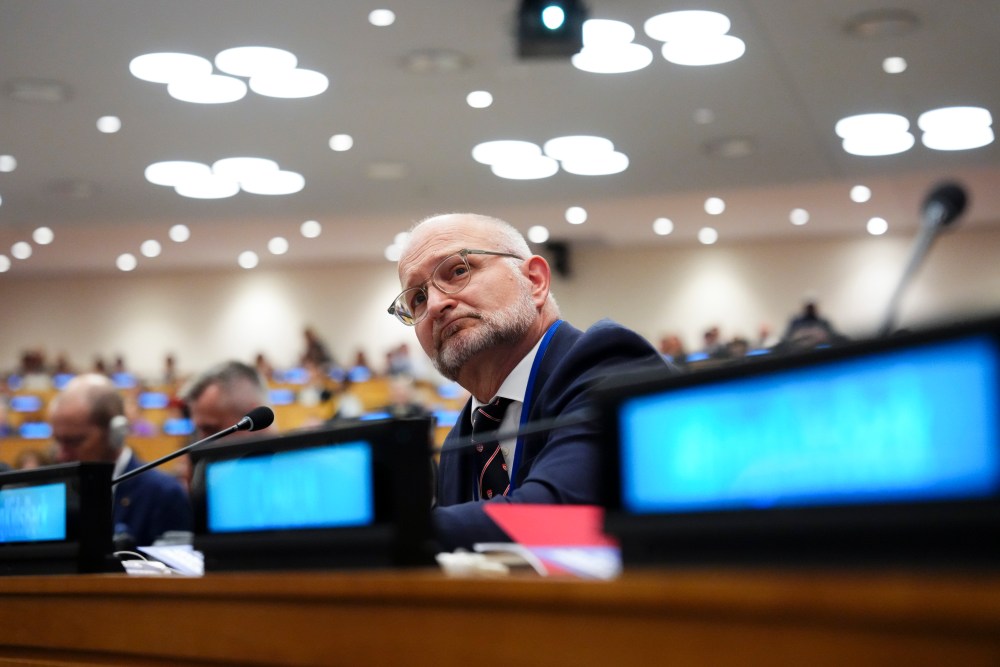
UN Ambassador David Lametti attends a meeting titled
UN Ambassador David Lametti attends a meeting titled "Restoring Childhood and Humanity: Advancing Peace in Ukraine Through the Return of Deported Children" during the United Nations General Assembly in New York on Tuesday, Sept. 23, 2025. THE CANADIAN PRESS/Sean Kilpatrick

He replaced Bob Rae, who frequently made headlines for comments that generally reflected the Trudeau government’s policies though often in more frank framing.

Lametti said he is still continuing many of Rae’s priorities, such as a working group on Haiti’s long-term economic development and democratic transition.

Since 2021, gangs have controlled much of the Caribbean country, resulting in a humanitarian crisis and major security concerns for large swaths of the Western Hemisphere.

He said Haiti touches on all “all three pillars of the UN’s founding document,” namely peace and security, human rights and living standards.

Others topics have become less prominent, such as advocacy for Rohingya people subject to brazen violence by Myanmar officials and Buddhist extremists.

“Because I haven’t taken on other commitments in Asia that Ambassador Rae had taken on, you shouldn’t think of it as a downgrading, but more as a prioritization by me,” Lametti said.

This report by The Canadian Press was first published June 29, 2026.

Report Error Submit a Tip

More Stories

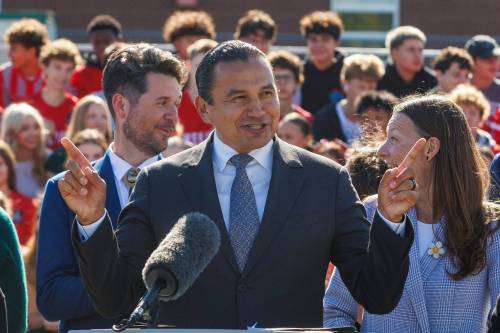
Wab Kinew as ‘communicator in chief’

Paul G. Thomas 6 minute read Preview

Wab Kinew as ‘communicator in chief’

Paul G. Thomas 6 minute read Yesterday at 2:00 AM CDT

Premier Wab Kinew and his party have been riding high in the polls longer than normal for a government one year or less away from its first re-election contest. One reason is his ubiquitous, dominating communications presence as NDP leader and premier.

The argument here is that Kinew has supplemented his prerogatives as premier and party leader (such as appointing cabinet ministers and approving party nominations) with the skilful use of communications to advance his policy agenda, boost his personal popularity and maintain the competitive advantage of his party over the opposition Progressive Conservatives.

Communications has always been a significant part of politics and policy making. However, in the contemporary political and media environments, communications considerations have moved from the background to the foreground of decision-making by political parties, including when they are performing in the role of government. Campaigning and governing now overlap in what has been described as a permanent election campaign.

Political parties use communications strategies for several purposes: to establish an image of the leader which makes a positive emotional connection with voters; to promote a coherent message and to keep party members on message; and to gain favourable media coverage for its policies and other actions on almost a daily basis.

Read
Yesterday at 2:00 AM CDT

First Manitoba-U.K. Defence Summit begins

Free Press staff 1 minute read 2:00 AM CDT

United Kingdom delegates from the aerospace and defence sector are visiting Winnipeg this week for the first Manitoba-U.K. Defence Summit.

Industry executives will discuss trade, investment and collaboration with their Manitoba counterparts, according to a Manitoba Aerospace & Defence news release.

The group started with a conference at the Manitoba Club on Monday. Today, United Kingdom leaders will visit Boeing Winnipeg, StandardAero and Magellan Aerospace, the news release says.

The summit is being led by the Canada-Manitoba Defence Alliance, which the provincial government launched earlier this month.

Legislation needed on vacant buildings

Editorial 4 minute read Preview

Legislation needed on vacant buildings

Editorial 4 minute read 2:00 AM CDT

There is something deeply backwards about a system that lets a property owner keep a building boarded up indefinitely while neighbours are left to live with the consequences.

Read
2:00 AM CDT

Retiree sues neighbour over alleged dog attack

Scott Billeck 2 minute read 2:00 AM CDT

A Winnipeg man is suing his neighbour over an alleged dog attack he says occurred while he was helping him with a lawnmower.

Arthur Cabel, a retiree who lives on Selkirk Avenue, is seeking unspecified damages from neighbour Saisamone Saegone, according to a statement of claim filed in the Manitoba Court of King’s Bench last week.

Cabel claims he went to Saegone’s home in the afternoon on Sept. 23, 2024, to help him with his lawnmower.

According to the lawsuit, Saegone’s large dog, initially in a fenced backyard, escaped, approaching Cabel and “mauling, attacking and biting him.”

Furby Street residents fed up with inaction on drug houses

Carol Sanders 6 minute read Preview

Furby Street residents fed up with inaction on drug houses

Carol Sanders 6 minute read Updated: Yesterday at 8:39 AM CDT

Anxious Furby Street residents contacted the city and their elected officials Friday to — once again — report people coming and going from a boarded-up house they call a dangerous “drug centre” and “den of thieves” that’s just steps away from a house under construction.

Linda Zak, who was holding a yard sale with a group of neighbours Friday morning, described the trouble the home attracts, while a woman slumped on the front steps and a man standing in the yard yelled to someone inside it.

“It is a drug centre,” said Zak, 77. “We know that. A couple of days ago, a person lit the front on fire. Now, as you look at it, you can see where the facade was burning and they were trying to harm people inside.”

“We’re very concerned about it being next to the home this man is building,” she said, pointing to the two-storey that’s nearly completed. The boarded-up house is in the 500 block of Furby.

Read
Updated: Yesterday at 8:39 AM CDT

AI, animals and us

Jordan Laidlaw 4 minute read 2:00 AM CDT

It is now perhaps axiomatic to declare that artificial intelligence will revolutionize the world, as researchers and industry insiders are projecting the novel technology to become the greatest technological breakthrough in human history.