South Korean tech giants to build a $518 billion chipmaking hub to serve soaring AI demand

Advertisement

Advertise with us

SEOUL, South Korea (AP) — South Korean tech giants Samsung Electronics and SK Hynix said Monday they will invest a combined 800 trillion won ($518 billion) in building a new computer chipmaking hub in the country’s southwest region, capitalizing on surging artificial intelligence -driven demand.

Read this article for free:


or

Already have an account? Log in here »

To continue reading, please subscribe:

Subscribe and receive a limited-edition Free Press branded hat or tote.

Digital Subscription

One year of digital access for only $205*

  • Enjoy unlimited reading on winnipegfreepress.com
  • Read the E-Edition, our digital replica newspaper
  • Access News Break, our award-winning app
  • Play interactive puzzles

*First annual payment billed as $205.00 + GST for one year. This annual subscription will automatically renew at $233.00 + GST every 52 weeks (10% off the regular annual price of $259.35). Offer available to new and qualified returning subscribers only. Cancel any time.

To continue reading, please subscribe:

Add Free Press access to your Brandon Sun subscription for only an additional

$1 for the first 4 weeks*

  • Enjoy unlimited reading on winnipegfreepress.com
  • Read the E-Edition, our digital replica newspaper
  • Access News Break, our award-winning app
  • Play interactive puzzles
Start now

*Your next Brandon Sun subscription payment will increase by $1.00 and you will be charged $17.95 plus GST for four weeks. After four weeks, your payment will increase to $24.95 plus GST every four weeks.

SEOUL, South Korea (AP) — South Korean tech giants Samsung Electronics and SK Hynix said Monday they will invest a combined 800 trillion won ($518 billion) in building a new computer chipmaking hub in the country’s southwest region, capitalizing on surging artificial intelligence -driven demand.

President Lee Jae Myung joined the companies’ chairs Monday in announcing the plan, which dovetails with the government’s efforts to expand investment beyond the greater Seoul metropolitan area, the country’s economic center and heart of its semiconductor sector.

The southwest has been a particular focus, as it lacks major industrial hubs and has historically trailed in economic development. The region has long been a political base for Lee’s liberal Democratic Party.
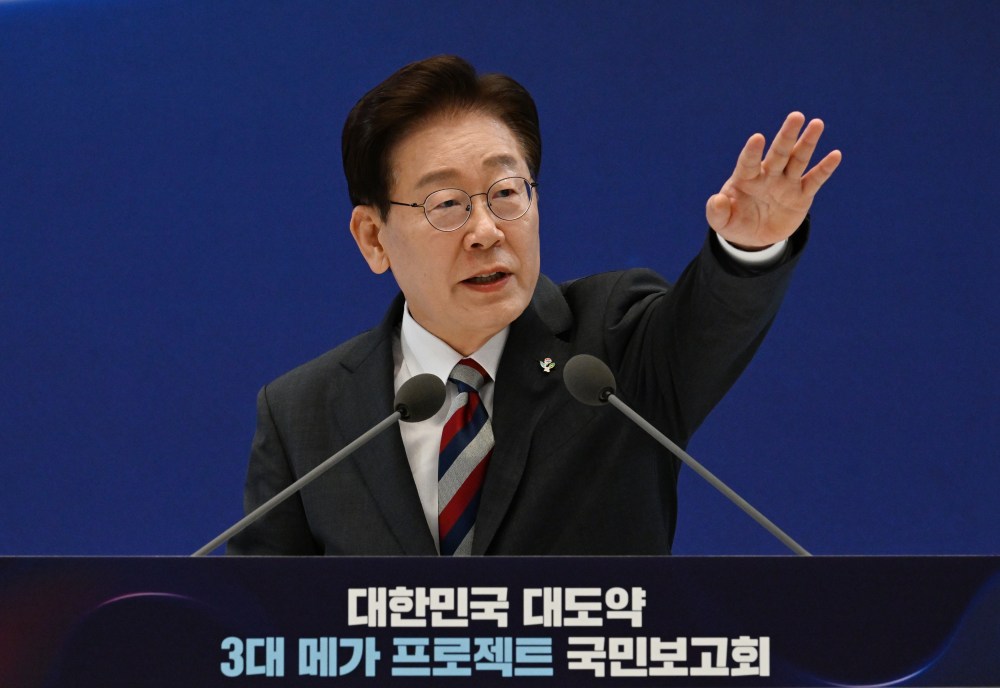
South Korean President Lee Jae Myung attends an announcement with Samsung Electronics Chairman Lee Jae-yong and SK Group Chairman Chey Tae-won at the Blue House presidential office in Seoul, South Korea, Monday, June 29, 2026. (Kim Min-Hee/Pool Photo via AP)

Samsung and SK Hynix, which together produce about two-thirds of the world’s memory chips, said they will each build two fabrication plants in the southwest, expanding beyond their existing manufacturing complexes in Gyeonggi Province, south of Seoul.

Samsung Chairman Lee Jae-yong said the company’s new fabs will be built in the southwestern city of Gwangju, where experts have proposed several potential sites, including the grounds of a military air base slated for relocation.

The companies didn’t specify when the fabs in the southwest regions would be completed. SK Hynix’s Chairman Chey Tae-won said the project would be a complex, large-scale effort requiring “vast sites, along with sufficient power, water and skilled workers.” He said it took nine years for SK Hynix to establish its major manufacturing cluster in Gyeonggi Province. Still, a significant expansion of manufacturing facilities is needed for the company to keep up with global demand, Chey said.

Government officials dismissed questions about whether the southwest has enough power and water to support major semiconductor fabs. They said the region’s strength in renewable energy would give the chipmakers an edge as they face growing global pressure to use cleaner sources of electricity.

Samsung and SK Hynix have reported record profits in recent months as soaring global investment in data centers and other AI infrastructure has fueled demand for memory chips. Government officials and business experts expect AI-driven demand to continue increasing as the technology spreads to AI-powered industrial robots and autonomous vehicles. The chipmakers’ existing semiconductor complexes in Gyeonggi Province may reach capacity sooner than expected, they say.

During Monday’s event, government officials outlined plans to build what they called a nationwide semiconductor ecosystem, with existing manufacturing hubs in the southeast expanding production of chip components and materials, the central Chungcheong region specializing in chip packaging, while data centers are built across the country.

“We must establish the core building blocks of artificial intelligence faster than any other country. Semiconductors, physical AI and AI data centers are the three pillars of our next great leap forward,” the president said.

Report Error Submit a Tip

More Stories

Gillingham in lead with decided voters

Nicole Buffie 6 minute read Preview

Gillingham in lead with decided voters

Nicole Buffie 6 minute read Yesterday at 6:55 PM CDT

A cloud of uncertainty is hanging over Winnipeg as October’s municipal election nears.

Three months after a poll showed more than 40 per cent of Winnipeggers wanted to see someone other than current mayor Scott Gillingham elected, a new Abacus Data poll indicates more than half of Winnipeg voters are undecided heading into next month’s civic election.

Of decided voters, 55 per cent favour Gillingham compared to 23 per cent for former councillor and provincial cabinet minister Kevin Klein and 11 per cent for funeral director Mike Vogiatzakis.

Of all respondents, just over 50 per cent said they were unsure while 13 per cent said they will not vote.

Read
Yesterday at 6:55 PM CDT

Day 1 of Jets training camp in the books with pairings essentially cemented

Ken Wiebe 7 minute read Preview

Day 1 of Jets training camp in the books with pairings essentially cemented

Ken Wiebe 7 minute read Thursday, Sep. 17, 2026

Nearly six minutes into his question-and-answer session, Scott Arniel took a welcome detour from the news of the day.

After exhausting the discussion around the goalie who wasn’t in training camp, the head coach of the Winnipeg Jets finally got a query about the line combinations and defensive pairings that were unveiled in training camp.

And unlike past years, when exhibition games were more frequent and the training camp wasn’t this condensed, Arniel conceded these groupings were intentional and were likely staying together for some time.

The expansion to an 84-game regular season brings with it a reduction to four pre-season games and a much shorter training camp, which could limit the amount of experimentation that Arniel can do during the next two weeks.

Read
Thursday, Sep. 17, 2026

United Way, other charities fight for dollars as donor base shrinks

Scott Billeck 7 minute read Preview

United Way, other charities fight for dollars as donor base shrinks

Scott Billeck 7 minute read Yesterday at 2:00 AM CDT

Winnipeg’s charitable sector is being squeezed from both sides: demand for help is growing while the pool of donors to meet that need is shrinking.

The imbalance is increasingly being carried by a relatively small group of deep-pocketed donors. Last year, 600 people — about three per cent of United Way Winnipeg’s individual donors — accounted for roughly $8 million, or 55 per cent of individual donations.

The fundraising pitch isn’t getting any easier.

Homelessness and public drug use have become increasingly visible, household budgets remain strained and the problems charities are trying to address can seem so entrenched that donors may reasonably wonder what difference another contribution can make.

Read
Yesterday at 2:00 AM CDT

Not falling back means time loop remains unclosed

Jen Zoratti 4 minute read 2:01 AM CDT

I demand restitution. Where’s my hour?

In the traditional fall-back, spring-forward time change set up — you know, ol’ trusty that’s been effect for lo these 63 years — we lost an hour in the spring that we got back in the fall.

That was the social contract: you commit to feeling like you’re on cold medication for a week in March because you know a glorious extra hour of sleep will be returned to you in November. (Unless, of course, you have little kids, but look: we all make our choices.)

Well, that transaction, flawed as it was, isn’t happening this year. That hour you sacrificed to the sun gods in the spring? Gone. Not coming back. We’ve sprung forward and we shan’t be falling back — not in November, and (possibly) not ever. The scale shall remain unbalanced and the loop shall remain unclosed as Manitoba has adopted permanent daylight time.

A quick look at where provinces and territories stand on time changes

The Canadian Press 2 minute read Preview

A quick look at where provinces and territories stand on time changes

The Canadian Press 2 minute read Updated: Yesterday at 6:28 AM CDT

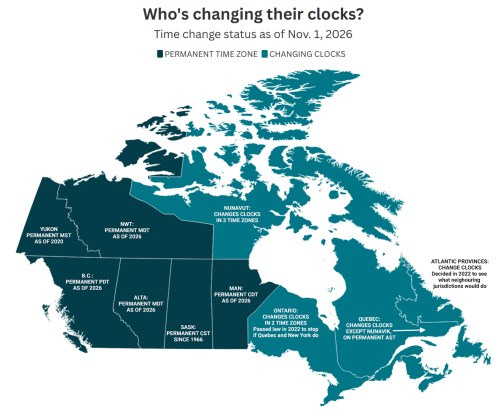
WINNIPEG - Manitoba's government said Thursday the province will be sticking with daylight time year-round, making it the latest jurisdiction to move away from twice-annual time changes. Here's a look at where things stand across Canada:

British Columbia said in March that it was moving to permanent Pacific daylight time. The change also means that parts of northeastern B.C., which have been on mountain standard time year round, are now in alignment with the rest of the province.

Alberta also switched to permanent daylight time this year in what it calls Alberta time. The change means it now has the same time as Saskatchewan year round.

Saskatchewan has been on permanent central standard time since 1966.

Read
Updated: Yesterday at 6:28 AM CDT

Grieving child builds backyard rocket ship

Harriet Zaidman 4 minute read 2:01 AM CDT

I Built a Rocket Ship (Kids Can Press, 32 pages, hardcover, $22) by Winnipegger Anna Lazowski is a tender story for children ages 4-8 about a little girl trying to make sense of her mother’s death. The child engages in conversation with her late mom, agreeing and disagreeing about things said as she carries objects (and of course, the cat) to the backyard. There, she is building a rocket ship she will pilot into the skies to find her mom again.

Jennica Lounsbury’s varied perspectives show the range of emotions the little girl experiences.

● ● ●

Northwoods Lullaby by Mary Casanova (University of Minnesota Press, 32 pages, hardover, $25) is a bedtime book for readers up to age eight, perfect to bring a busy, happy day to a close. Just like children who are listening to adults reading the book, all the animal babies are being tucked into their nests and burrows by loving parents: “Thump and scamper,/nimble clover./ Soon it’s time to rest. Baby loon/ nestles in/as Papa floats along.”