EU chief weighs age restrictions for children using social media
Advertisement
Read this article for free:
or
Already have an account? Log in here »
To continue reading, please subscribe:

Digital Subscription
One year of digital access for only $205*
- Enjoy unlimited reading on winnipegfreepress.com
- Read the E-Edition, our digital replica newspaper
- Access News Break, our award-winning app
- Play interactive puzzles
*First annual payment billed as $205.00 + GST for one year. This annual subscription will automatically renew at $233.00 + GST every 52 weeks (10% off the regular annual price of $259.35). Offer available to new and qualified returning subscribers only. Cancel any time.
To continue reading, please subscribe:
Add Free Press access to your Brandon Sun subscription for only an additional
$1 for the first 4 weeks*
- Enjoy unlimited reading on winnipegfreepress.com
- Read the E-Edition, our digital replica newspaper
- Access News Break, our award-winning app
- Play interactive puzzles
*Your next Brandon Sun subscription payment will increase by $1.00 and you will be charged $17.95 plus GST for four weeks. After four weeks, your payment will increase to $24.95 plus GST every four weeks.
Read unlimited articles for free today:
or
Already have an account? Log in here »
BRUSSELS (AP) — A top European Union official on Monday called for limits to be placed on children using social media as a special EU panel looking into the challenge recommended forbidding access for those under 13 until tech companies can prove their platforms are safe.
Growing awareness of the dangers social media poses for young, developing brains has shown up in a wave of new restrictions globally. Australia, the U.K., Turkey, Indonesia and others have passed bans on kids under 16 or 15 from using platforms like TikTok, YouTube and Instagram.
Laying out a list of her concerns about the use of social media by kids, European Commission President Ursula von der Leyen — a doctor by training — said that children under 3 should have no exposure to screens at all.
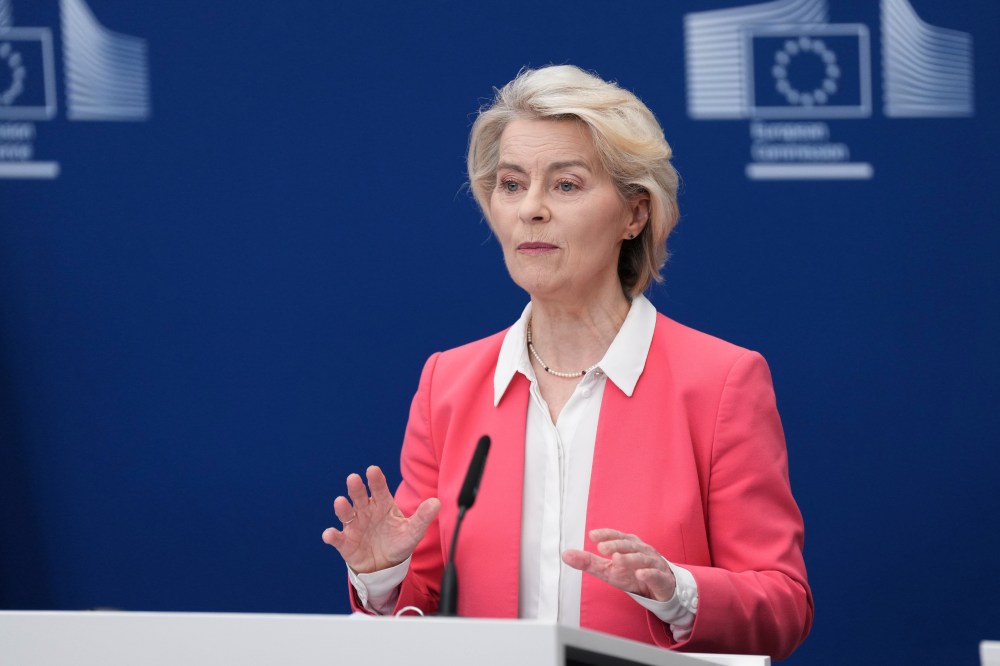
“I believe we need to consider phased and gradual access for different age ranges because childhood won’t wait and once it’s gone, we can never give it back,” von der Leyen told reporters.
“Just as we don’t give our children keys to the car before they have their license, or we do not let them buy alcohol until they are legally allowed. We need to set the age at which they can, the children can, legally access social media,” she said.
Von der Leyen noted infinite scrolling as one of the “addictive” traits that tech companies must address.
The commission has also been targeting tech companies through other means, and last week used its sweeping Digital Safety Act to warn Meta that it needs to disable addictive design features such as infinite scrolling or risk a hefty fine.
Von der Leyen said there should “phased and gradual access for different age ranges” to social media. Children under 13 should only have “time-limited” access under the supervision of parents, teachers or other caregivers, she told reporters.
Teenagers should be given gradual access to platforms that can prove they are “age appropriate” and safe for them, she said.
While she didn’t go into further detail, she and the European Commission — the EU’s powerful executive branch — are likely to come up with a proposal for the 27 member countries to weigh in the near future. Von der Leyen’s policy proposals carry great influence with EU member countries.
A special panel set up to study child safety online delivered its report to the EU chief on Monday. The report said that when it comes to safety, “the burden of proof needs to be on providers, not regulators, parents and children.”
“Until they demonstrate that their services are safe by design, social media and other digital services providers should have restricted access to children under the age of 13 in the EU,” said the report, which is likely to influence von der Leyen’s thinking.
It recommended that “further precautionary age restrictions” should be considered by EU countries for children over 13.
Many social media platforms including Instagram and TikTok already prohibit anyone under the age of 13 from signing up for an account. But those restrictions have been criticized for being too easy to get around and the EU’s digital regulators accused Instagram’s parent Meta Platforms earlier this year of failing to keep underage users of the site.
The European Commission is working on its own age verification app that will let users prove their age while keeping their identity anonymous.
___
Chan reported from Toronto.