China’s new AI model halts new subscriptions as demand swamps capacity

Advertisement

Advertise with us

HONG KONG (AP) — The new, powerful Chinese artificial intelligence model Kimi K3, which has caused a stir in the U.S. tech industry, has suspended new subscriptions after a flood in demand overwhelmed capacity within days of the launch.

Read this article for free:

or

Already have an account? Log in here »

To continue reading, please subscribe:

Subscribe and receive a limited-edition Free Press branded hat or tote.

Digital Subscription

One year of digital access for only $205*

  • Enjoy unlimited reading on winnipegfreepress.com
  • Read the E-Edition, our digital replica newspaper
  • Access News Break, our award-winning app
  • Play interactive puzzles

*First annual payment billed as $205.00 + GST for one year. This annual subscription will automatically renew at $233.00 + GST every 52 weeks (10% off the regular annual price of $259.35). Offer available to new and qualified returning subscribers only. Cancel any time.

To continue reading, please subscribe:

Add Free Press access to your Brandon Sun subscription for only an additional

$1 for the first 4 weeks*

  • Enjoy unlimited reading on winnipegfreepress.com
  • Read the E-Edition, our digital replica newspaper
  • Access News Break, our award-winning app
  • Play interactive puzzles
Start now

*Your next Brandon Sun subscription payment will increase by $1.00 and you will be charged $17.95 plus GST for four weeks. After four weeks, your payment will increase to $24.95 plus GST every four weeks.

HONG KONG (AP) — The new, powerful Chinese artificial intelligence model Kimi K3, which has caused a stir in the U.S. tech industry, has suspended new subscriptions after a flood in demand overwhelmed capacity within days of the launch.

The development highlighted challenges faced by Chinese AI models in serving a growing user base at home and abroad at a time the U.S.-China tech race is heating up.

Chinese open-source, lower-cost advanced AI models, including DeepSeek’s latest V4, have been moving fast in gaining global attention. In early 2025, DeepSeek shook world markets and helped China to be recognized as a serious competitor to the U.S., where Chinese frontier AI models are largely open source, meaning they are made accessible for people to examine and build upon.
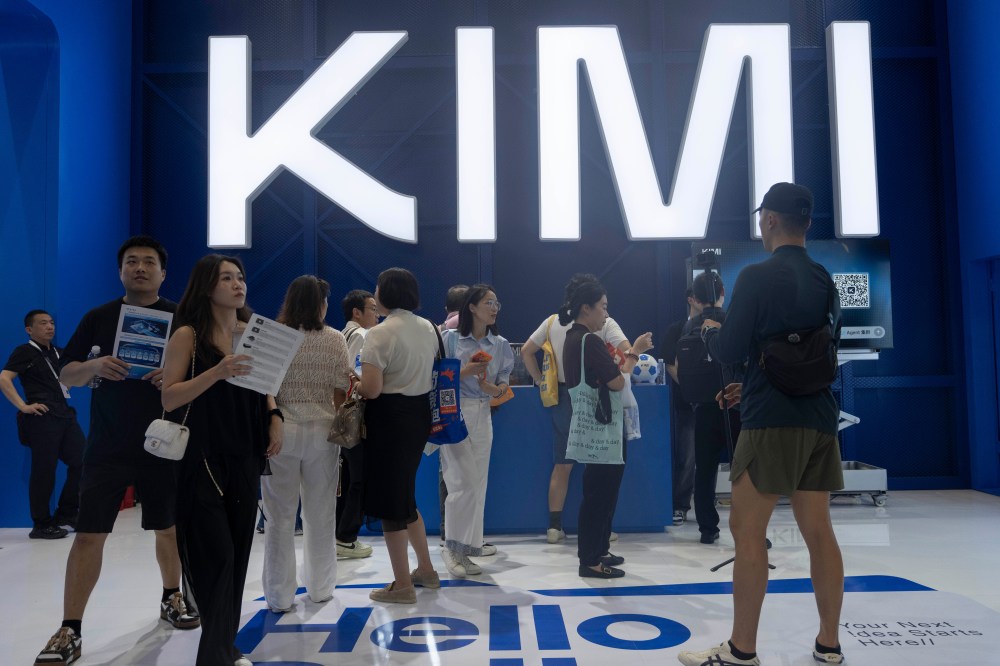
Visitors at the booth for Moonshot's Kimi K3 during World AI Conference in Shanghai, Friday, July 17, 2026. (AP Photo/Ng Han Guan)

“Kimi K3 has received far more love than we expected,” Moonshot AI, which is Beijing-based, wrote in a X post late on Sunday. “Over the past 48 hours, demand has pushed close to the limits of our current capacity.”

Moonshot said that it’s prioritizing existing subscribers and would be temporarily pausing new ones. “We’re adding capacity as fast as we can and will reopen new subscription spots in batches,” it added. The AI startup also posted a similar message on Chinese social media.

K3’s public rollout late last week, aiming at challenging more advanced AI models by Anthropic,
OpenAI and others, has rattled U.S. rivals. At 2.8 trillion parameters, a measurement of an AI model’s capabilities, it’s deemed as the world’s largest open-source AI model.

“New model releases generally trigger massive interest, which can strain existing compute infrastructure,” said Lian Jye Su, a chief analyst at the technology research and advisory group Omdia. “This does show Moonshot AI does not have sufficient compute chips to serve the current surge in demand.”

Su said that the key reason was more likely due to Moonshot not fully anticipating the surge in K3’s popularity. K3 is “very demanding” in terms of compute requirements, he said, making compute allocation challenging and expensive.

By measure of front-end coding capability, a metric for AI models’ performances, Kimi K3 topped the chart of the major advanced AI models in rankings on Arena — an AI model evaluation platform — after its public release.

K3’s release has also put pressure on stocks of American technology titans on worries that more affordable Chinese AI models may undercut the pricing power and demand at the U.S. AI companies, even as U.S.-led restrictions have already barred China from accessing some of the world’s advanced technologies, including the most cutting-edge chips.

K3 is one of the latest new Chinese AI models coming out that have drawn strong global reactions.

Over the weekend, China’s Alibaba also previewed its latest Qwen3.8 Max AI model, which the tech giant said had 2.4 trillion parameters as one of the world’s most powerful models and was second only to Anthropic’s Fable 5. Last month, Chinese startup Zhipu, or Z.ai, also rolled out its GLM-5.2 model, which saw rapid adoption across the world.

Report Error Submit a Tip

More Stories

We’re giving, they’re taking — where’s the win?

Editorial 4 minute read Preview

We’re giving, they’re taking — where’s the win?

Editorial 4 minute read 2:00 AM CDT

In the give-and-take of negotiations so far, Canada seems to be doing all the giving, while the United States does all the taking.

In the last few days, the Canadian government said it was backing away from a five per cent levy to be paid by American streaming services such as Amazon and Netflix after, earlier, dropping the three per cent digital services tax. Then, there was what now appears to be succumbing to American President Donald Trump over the Gordie Howe International Bridge, where Canada agreed to let the U.S. share the net revenues from the bridge, even though Canada paid for the entire construction.

Now, Prime Minister Mark Carney is signalling he won’t use energy exports to the United States as a bargaining chip in the current talks on the Canada-U.S.-Mexico free trade agreement, saying he didn’t “see the value” of using Canada’s energy exports to the U.S. as a trade bargaining chip.

“Canadians are reliable,” Carney said Wednesday in Red Deer, Alta. “One of the biggest commodities, arguably the best, is trust. People trust us, and so, when you’re a supplier of a key commodity, key service, you’ve got to think really hard about not supplying.”

Read
2:00 AM CDT

South Osborne residents fail in bid to prevent construction of 131-unit apartment tower

Malak Abas 4 minute read Preview

South Osborne residents fail in bid to prevent construction of 131-unit apartment tower

Malak Abas 4 minute read Wednesday, Jul. 29, 2026

A proposed 10-storey highrise on an empty south Osborne lot will move forward despite concerns from residents about the impact the building will have on nearby parking and traffic.

The city-owned lot at 425 Osborne St., which previously served as a gas station but has long sat vacant, will be developed into a mixed-use residential building with 131 units, 39 of which would be affordable, along with additional office space for the adjacent Winnipeg Transit garage and the Transit customer service centre across the street, along with a two-level parkade for tenants and Transit employees.

The property is being developed by the University of Winnipeg Community Renewal Corp. 2.0, and designed by Prairie Architects Inc.

At a meeting held by city council’s appeal committee Wednesday, several residents said while they supported the idea of more housing in the Lord Roberts neighbourhood, they had lingering concerns about the impact the development will have on the already-busy area.

Read
Wednesday, Jul. 29, 2026

Keep free youth transit simple

Cordella Friesen and Noëlle DePape 4 minute read 2:00 AM CDT

For too many young Winnipeggers, the cost of a bus pass is a barrier. It can mean missing a class, turning down a job opportunity or staying home from a program that could change their future.

Free transit for youth in Winnipeg is a transformational policy that will pay dividends for decades to come — advancing key environmental, educational and poverty reduction goals in our communities.

As champions for young people across our city, BGC Winnipeg and the YMCA-YWCA of Winnipeg commend Premier Wab Kinew and Mayor Scott Gillingham for recognizing that investing in young people is investing in Winnipeg’s future. By uniting to make transit free for youth across Winnipeg, both levels of government are delivering a forward-thinking policy that has the potential to have generational impact.

At a time when families are stretched to their limits by inflation, free transportation for youth offers real, immediate relief.

BRANDON — A father has admitted in court that he purposely violated his probation order so he could be sent to the Brandon jail to support his son, who’s serving time there.

Dominic Dowan, 46, pleaded guilty to breaching a probation order from November 2024 that prohibits him from owning, possessing, carrying or converting anything into a weapon.

Crown attorney Caroline Lacey called Dowan’s reasoning for wanting to go to jail “bizarre.”

“That’s just ridiculous and honestly a waste of police time to be having to deal with someone trying to go into jail to support someone else,” Lacey said in Brandon provincial court on Thursday.

Province picks CancerCare facility construction manager

Free Press staff 2 minute read 2:00 AM CDT

PCL Constructors Canada will oversee the construction management of CancerCare Manitoba’s new facility.

The provincial government awarded its contract to PCL following a competitive procurement process, a Thursday news release says.

It points to similar projects PCL has undertaken, including the Arthur J.E. Child Comprehensive Cancer Centre in Calgary and Peter MacCallum Cancer Centre in Melbourne, Australia.

In Manitoba, the new Winnipeg facility’s pre-construction phase — including design development and risk management — has launched. Leadership will work with clinicians, patients and other stakeholders throughout 2026, the news release says.

Use it twice: a data centre we could support

Hersh Seth 5 minute read Preview

Use it twice: a data centre we could support

Hersh Seth 5 minute read Yesterday at 2:00 AM CDT

In June, Premier Wab Kinew rejected a massive AI data centre planned near Île-des-Chênes. The project would have used 500 megawatts of power, which is about the same as the Grand Rapids generating station, and would have run on six natural gas turbines. Kinew said the environmental cost was too high and the long-term benefit for Manitobans was too low.

Read
Yesterday at 2:00 AM CDT