Four decades after Chernobyl, a generational divide reshapes Italy’s nuclear debate
Advertisement
Read this article for free:
or
Already have an account? Log in here »
To continue reading, please subscribe:

Digital Subscription
One year of digital access for only $205*
- Enjoy unlimited reading on winnipegfreepress.com
- Read the E-Edition, our digital replica newspaper
- Access News Break, our award-winning app
- Play interactive puzzles
*First annual payment billed as $205.00 + GST for one year. This annual subscription will automatically renew at $233.00 + GST every 52 weeks (10% off the regular annual price of $259.35). Offer available to new and qualified returning subscribers only. Cancel any time.
To continue reading, please subscribe:
Add Free Press access to your Brandon Sun subscription for only an additional
$1 for the first 4 weeks*
- Enjoy unlimited reading on winnipegfreepress.com
- Read the E-Edition, our digital replica newspaper
- Access News Break, our award-winning app
- Play interactive puzzles
*Your next Brandon Sun subscription payment will increase by $1.00 and you will be charged $17.95 plus GST for four weeks. After four weeks, your payment will increase to $24.95 plus GST every four weeks.
Read unlimited articles for free today:
or
Already have an account? Log in here »
ROME (AP) — Four decades after the Chernobyl disaster spewed radiation across Europe and turned Italy off nuclear power, Premier Giorgia Meloni ’s government is laying the groundwork to bring it back as the country seeks to improve its energy security.
The government is counting on a new generation of Italians who see nuclear power as a source of low-carbon electricity, a tool to help fight climate change and a way to strengthen stable energy supplies amid shocks from the Ukraine and Iran wars.
It’s betting that such support will blunt the opinions of Italians who lived through the 1986 nuclear accident, still view atomic energy through the lens of risk and disaster, and twice rejected nuclear power in national referenda, experts say.
Next week, Parliament is expected to approve government-sponsored legislation establishing a legal framework for next-generation nuclear technologies. The government would then have 12 months to draft implementing decrees covering reactor licensing, safety standards, waste management and siting.
“The duty of the government at this moment is to create the conditions so that those who will eventually decide on installations will be able to do so,” Gilberto Pichetto Fratin, minister for the Environment and Energy Security, told The Associated Press in an interview ahead of the vote.
A reversal of positions after Ukraine
Italy’s debate comes as several European countries, including France and Poland, expand or pursue nuclear power amid concerns about energy security and climate goals. Unlike them, however, Italy is trying to rebuild an industry voters dismantled decades ago.
Italy was once among Europe’s nuclear pioneers. Four reactors operated until a 1987 referendum effectively ended the country’s nuclear program in the aftermath of Chernobyl. Another attempt to revive nuclear power collapsed after Japan’s Fukushima disaster in 2011, when about 94% of voters opposed plans for new reactors.
As a result, Italy’s shift would mark one of Europe’s most ambitious energy reversals.
Meloni’s government argues that rising electricity demand, climate goals and energy-security concerns following Russia’s invasion of Ukraine justify bringing nuclear power back into Italy’s energy mix.
Pichetto Fratin said electricity demand could increase by at least 30% within about a decade, requiring a broader mix of energy sources than renewables alone.
Rather than reviving the large plants of the past, the government is focusing on small modular reactors, or SMRs, and other advanced technologies that supporters say could be safer, more flexible and faster to build.
“We are talking about the third advanced generation (of nuclear power), much more workable compared to what are the needs, much safer because it is small in size with very short construction times,” Pichetto Fratin said.
“When people ask me for a timeline, I say 2033, 2034, 2035,” he added, referring to when the first next-generation reactors could realistically begin operating.
Nuclear power produces about 10% of the world’s electricity, equivalent to about a quarter of all low-carbon power. Italy’s aim for a nuclear comeback is part of a global trend of countries re-booting nuclear power options, bolstered by steady improvements in technology, including more safety features and making reactors cheaper to build and operate.
A country divided by generations
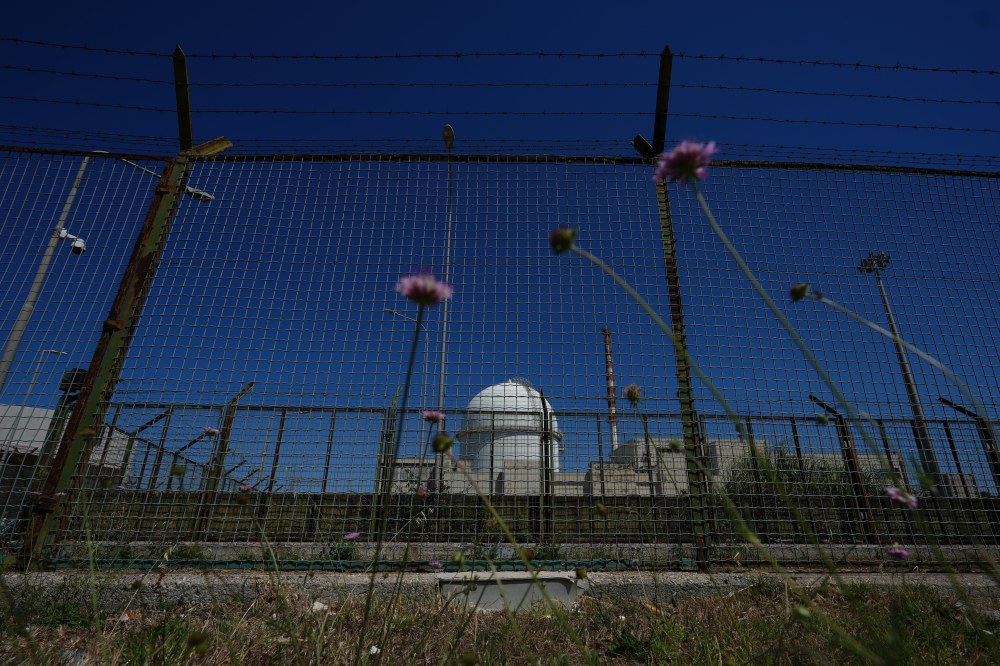
At the sprawling Latina nuclear power plant south of Rome, workers in protective suits and masks are still dismantling the remains of Italy’s first nuclear era even as politicians discuss how to build a second.
The contrast is not lost on Viviana Cruciani, who oversees nuclear decommissioning at the site run by the state-owned company Sogin.
“There is a generation that came right after Chernobyl that still sees nuclear energy in light of the accident at Chernobyl only,” Cruciani told AP.
“But there is another generation, a lot younger, that is enthusiastic about nuclear, and it is even sorry that the country has not yet made any progress towards a comeback to this technology.”
A June 2026 survey by research firm Only Numbers found that about 55% of Italians support next-generation nuclear plants.
Michele Governatori, a senior energy adviser at climate and energy think tank ECCO, said support is more visible among younger Italians.
“There is greater openness, especially among younger generations,” he said, noting that many associate nuclear power with technological progress rather than with the accidents that shaped public opinion in earlier decades.
Cruciani said younger Italians are more likely to view nuclear power through the prism of future energy needs and climate goals than through memories of Cold War-era disasters.
“I think nuclear power can help the environment too. It’s more sustainable,” said Cristian Giannetti, a 20-year-old tourist from the Tuscan seaside town of Forte dei Marmi visiting Rome.
Asked about the possibility of another Chernobyl-type accident, he said technological advances had reduced the risks.
“With the expertise we have and all the resources available today, I think the probability is really minimal.”
Others support a return to nuclear power for practical reasons.
“We have an energy problem, so it’s very important that nuclear power gets the green light in Italy too,” said Paola Giovannini Pasti, president of Confagricoltura Donna, the women’s branch of Italy’s main agricultural lobby.
Critics question the economics
Not everyone is convinced.
“If we use nuclear as a backup … the average energy costs become devastating. So unfortunately it’s not a good complement to renewables and it’s not cheap,” Governatori said.
Pichetto Fratin acknowledged that nuclear power is not a short-term solution to high electricity prices.
“Nuclear power does not lower consumers’ bills today,” he said. “The nuclear power of tomorrow can help reduce them.”
Industry estimates suggest a single 300-megawatt SMR could cost between 3 billion and 6 billion euros before infrastructure and grid expenses. The government hopes much of that financing would come from private capital, Pichetto Fratin said.
Governatori believes that cost remains the weakest part of the government’s case.
“Nuclear power that is being built today in Europe has exorbitant costs,” he said. “On the one hand, costs are extremely high, and on the other, private investors are running away.”
He also questioned whether SMRs would dramatically improve those economics, noting that the technology has yet to be commercially proven at scale.
Even so, some critics support establishing a regulatory framework that could allow future projects to be evaluated on their merits.
The political test ahead
The biggest political obstacle might be finding locations to build reactors and store the waste.
Italy still lacks a national repository for existing nuclear waste, much of which remains stored at temporary facilities across the country. Any future reactor or waste-storage site is likely to face strong local opposition.
Even if Parliament approves the legislation, opponents — including environmental groups and left-wing parties — could seek a new referendum once specific reactor locations and waste-storage plans emerge.
Surveys suggest support for nuclear power drops sharply when people are asked whether they would accept a reactor near where they live. Polls cited by experts indicate that about six in 10 Italians oppose having a reactor in their own province.
“When you have to seriously ask where a plant will be built and how much it will cost, it is likely that public opinion could become negative again,” Governatori said.
___
AP reporters Silvia Stellacci and Andrea Rosa in Rome contributed to this report.