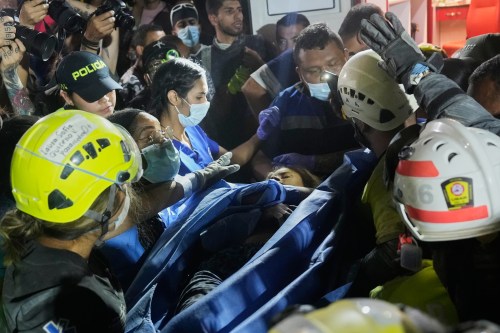
After an earthquake, how long can trapped people survive?

Advertisement

Advertise with us

NEW YORK (AP) — For those trapped in rubble after an earthquake, survival depends on many factors, including weather and access to water and air.

Read this article for free:


or

Already have an account? Log in here »

To continue reading, please subscribe:

Subscribe and receive a limited-edition Free Press branded hat or tote.

Digital Subscription

One year of digital access for only $205*

  • Enjoy unlimited reading on winnipegfreepress.com
  • Read the E-Edition, our digital replica newspaper
  • Access News Break, our award-winning app
  • Play interactive puzzles

*First annual payment billed as $205.00 + GST for one year. This annual subscription will automatically renew at $233.00 + GST every 52 weeks (10% off the regular annual price of $259.35). Offer available to new and qualified returning subscribers only. Cancel any time.

To continue reading, please subscribe:

Add Free Press access to your Brandon Sun subscription for only an additional

$1 for the first 4 weeks*

  • Enjoy unlimited reading on winnipegfreepress.com
  • Read the E-Edition, our digital replica newspaper
  • Access News Break, our award-winning app
  • Play interactive puzzles
Start now

*Your next Brandon Sun subscription payment will increase by $1.00 and you will be charged $17.95 plus GST for four weeks. After four weeks, your payment will increase to $24.95 plus GST every four weeks.

NEW YORK (AP) — For those trapped in rubble after an earthquake, survival depends on many factors, including weather and access to water and air.

If their injuries aren’t too severe, victims can survive for a week or more, assuming the weather isn’t too hot or cold, experts say.

Two days after a powerful deadly earthquake struck western Colombia, rescue teams are racing against the clock to search for survivors.
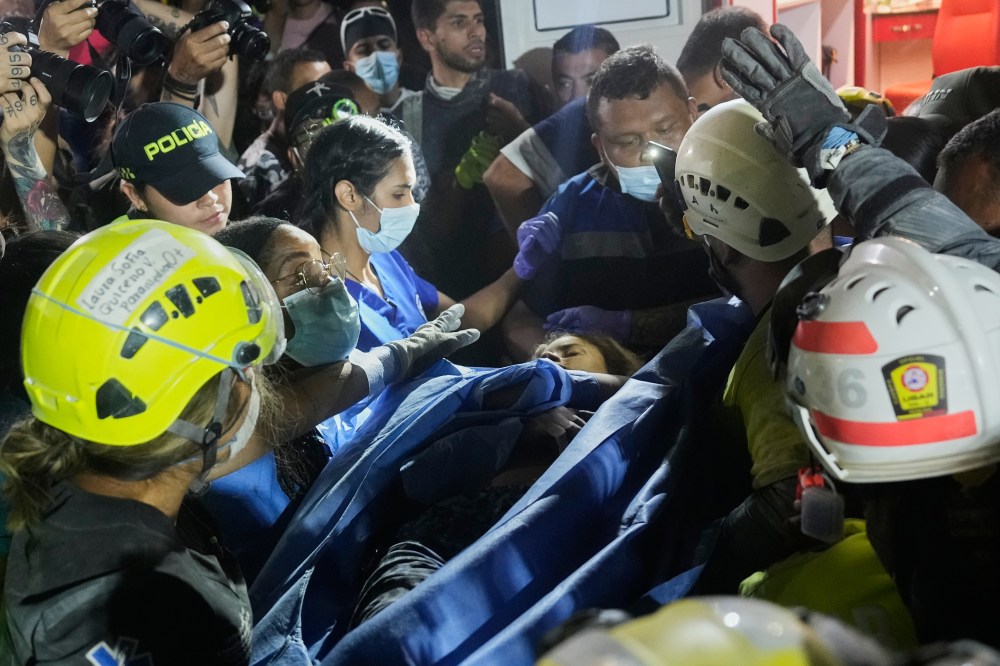
Rescue workers carry a survivor Daniela Largo after pulling her from the rubble the day after an earthquake struck Pereira, Colombia, Tuesday, Aug. 11, 2026. (AP Photo/Fernando Vergara)

Most rescues happen in the 24 hours after a disaster. The chances of survival drop with each day after that, experts say. Most victims are badly injured or buried by falling stones or other debris.

After the 2011 earthquake and tsunami in Japan, a teenager and his 80-year-old grandmother were found alive after nine days trapped in their flattened home. And the year before, a 16-year-old Haitian girl was rescued from earthquake rubble in Port-au-Prince after 15 days.

Water and air are crucial as time passes

Trapped victims are more likely to survive if they are in a debris-free pocket that prevents major injury while they await rescue, like under a sturdy desk, said geophysicist Victor Tsai from Brown University. Experts call this a survivable void space.

If fire, smoke or hazardous chemicals were released as a result of the building collapse, they may decrease a person’s survival odds, said emergency response expert Dr. Joseph Barbera at George Washington University.

Beyond that, having air to breathe and water to drink are crucial as the days go on.

“You could survive a while without food,” Barbera said. “You could survive less without water.”

Temperatures where someone is trapped may affect survival, and temperatures outside the rubble can affect rescue missions.

In Colombia, where governments across Latin America have offered help, authorities have said most of the earthquake deaths occurred in the cities of Cali, Pereira, Manizales and Quibdo, but there is less information about rural areas.

There have been signs of hope, including a 32-year-old woman who was pulled from a collapsed building in Pereira after being trapped for 36 hours.
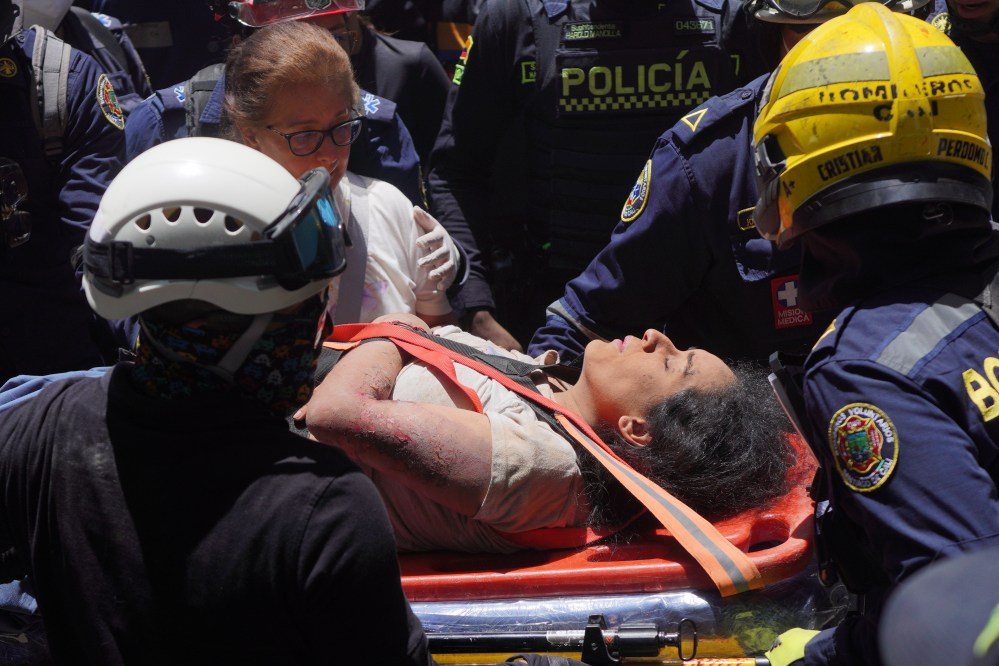
Rescue workers carry Diana Troncoso after pulling her from the rubble the day after an earthquake struck Cali, Colombia, Tuesday, Aug. 11, 2026. (AP Photo/Ivan Valencia) CORRECTION: Changes city to Cali, not Pereira.

It can be important for survivors to receive vital medical care before they are removed from the rubble, Barbera said. If not, the buildup of toxins from crushed muscles could make them go into shock after they are rescued.

What to do during an earthquake

The best practices for survival during an earthquake depend on where you are in the world. Building codes in regions with active fault lines are often designed to withstand earthquakes, but that doesn’t hold true everywhere.

In many countries, including the United States, the best practices are to drop, seek cover and hang on unless you are close to a building exit. Seek shelter under a heavy table or near sturdy furniture that may yield a survivable pocket if the roof collapses. Cover your face with cloth or a mask to protect from dust and debris.

If you are trapped in the rubble after an earthquake, save your energy and don’t overexert. Ration food and water, listen for rescue calls and search for something near you to make noise. If you have a phone with you, conserve its battery and try for help in short spurts each day.

___

The Associated Press Health and Science Department receives support from the Howard Hughes Medical Institute’s Science and Educational Media Group and the Robert Wood Johnson Foundation. The AP is solely responsible for all content.

Report Error Submit a Tip

More Stories

AI bio-weapons loom

Gwynne Dyer 4 minute read 2:00 AM CDT

‘Artificial intelligence’ based on large language models is shaping up to be the most efficient destroyer of value since the South Sea Bubble. After “the Crash”, which is inevitably coming, some specific functions of AI will eventually turn out to be genuinely revenue-generating, and a lot of jobs will duly disappear. But the biggest winner (and potentially biggest loser) is medical science.

Dr. Brian Hie, a chemical engineer at Stanford University in California, has just revealed that his team has made the first viruses designed by artificial intelligence. They are ‘bacteriophages’, viruses that only infect bacteria and are widely used to treat people with infections that resist other treatments.

However, natural bacteriophages sometimes fail, so Dr. Hie used generative AI to design new ones that might do the job. The AI generated thousands of designs for new genomes that more or less fit the bill, and he chose around 300 of them to build in the lab. It’s hard work, not magic, but he ended up with 16 ‘novel’ bacteriophages that might work.

He applied them to petri dishes containing two harmful strains of E. coli, a common bacteria that lives in the human gut, and they killed the bacteria off. It’s still early days, but if it is truly becoming possible to tailor-make bacteriophages that target specific bacteria, then we may be getting a major new weapon in the struggle against antibiotic resistance.

Ducks Unlimited makes province’s largest-ever conservation-land purchase

Zoe Pierce 3 minute read Preview

Ducks Unlimited makes province’s largest-ever conservation-land purchase

Zoe Pierce 3 minute read Yesterday at 12:11 PM CDT

A Manitoba landscape that helped save the Giant Canada goose from extinction has now been permanently protected in the province’s largest conservation land purchase in history.

Read
Yesterday at 12:11 PM CDT

Poilievre’s simplistic bluster a desperate bid for attention in a serious moment for nation

Tom Brodbeck 6 minute read Preview

Poilievre’s simplistic bluster a desperate bid for attention in a serious moment for nation

Tom Brodbeck 6 minute read Yesterday at 12:35 PM CDT

Conservative Leader Pierre Poilievre’s suggestion that Mark Carney needs more “backbone” to negotiate with Donald Trump would be easier to take seriously if anyone had actually figured out how to negotiate with the U.S. president.

Read
Yesterday at 12:35 PM CDT

A mission to make hearing care easier to access

Aaron Epp 5 minute read Preview

A mission to make hearing care easier to access

Aaron Epp 5 minute read 2:00 AM CDT

Armando Di Lello was four years old when he was diagnosed with hearing loss in both ears and received his first hearing aids. He doesn’t remember that moment, but he recalls moments that followed.

“Going through elementary, middle school, high school — it was definitely something that was not a positive experience for me,” he said.

Di Lello’s hearing aids were big, bulky and noisy, and he chose not to wear them much of the time.

“I didn’t perceive the benefit as a kid,” he said. “No kid wants to appear different.”

Read
2:00 AM CDT

Student union coalition scrutinized, accused of providing minimal benefit for fees paid

Maggie Macintosh 5 minute read Preview

Student union coalition scrutinized, accused of providing minimal benefit for fees paid

Maggie Macintosh 5 minute read Updated: Yesterday at 8:36 AM CDT

Despite being labelled as “permanently closed” online and maintaining a website filled with outdated information, a coalition of student unions is defending itself as an active entity deserving of fees in spite of its low profile.

The Canadian Federation of Students and its local chapter, better known as CFS-MB, collect annual membership dues from campuses across the province to support their advocacy work.

Alan Saji Koshy’s advice to new and returning students to the University of Winnipeg? “Start asking questions.”

“We pay hundreds of thousands of dollars for practically no benefit and students don’t even know (CFS-MB resources) exist,” the recent graduate and former student association president said.

Read
Updated: Yesterday at 8:36 AM CDT

Today’s horoscope

Georgia Nicols 4 minute read Preview

Today’s horoscope

Georgia Nicols 4 minute read 2:00 AM CDT

MOON ALERT: Caution! Avoid shopping or major decisions after noon today. The solar eclipse (new moon) in Leo peaks at 12:37 p.m.

ARIES (March 21-April 19)

This is the perfect time to hatch some new ideas and plans, perhaps related to vacations, your kids or an artistic project that appeals. Even though it’s a sudden decision, it might lead to more stability in the future.

TAURUS (April 20-May 20)

Read
2:00 AM CDT