Radiation vest tested on NASA moonshot can cut astronauts’ exposure in solar storms, study suggests

Advertisement

Advertise with us

CAPE CANAVERAL, Fla. (AP) — A new study suggests a protective vest tested on a manikin during NASA’s first Artemis moonshot could drastically cut the radiation exposure of lunar astronauts during severe solar storms.

Read this article for free:


or

Already have an account? Log in here »

To continue reading, please subscribe:

Subscribe and receive a limited-edition Free Press branded hat or tote.

Digital Subscription

One year of digital access for only $205*

  • Enjoy unlimited reading on winnipegfreepress.com
  • Read the E-Edition, our digital replica newspaper
  • Access News Break, our award-winning app
  • Play interactive puzzles

*First annual payment billed as $205.00 + GST for one year. This annual subscription will automatically renew at $233.00 + GST every 52 weeks (10% off the regular annual price of $259.35). Offer available to new and qualified returning subscribers only. Cancel any time.

To continue reading, please subscribe:

Add Free Press access to your Brandon Sun subscription for only an additional

$1 for the first 4 weeks*

  • Enjoy unlimited reading on winnipegfreepress.com
  • Read the E-Edition, our digital replica newspaper
  • Access News Break, our award-winning app
  • Play interactive puzzles
Start now

*Your next Brandon Sun subscription payment will increase by $1.00 and you will be charged $17.95 plus GST for four weeks. After four weeks, your payment will increase to $24.95 plus GST every four weeks.

CAPE CANAVERAL, Fla. (AP) — A new study suggests a protective vest tested on a manikin during NASA’s first Artemis moonshot could drastically cut the radiation exposure of lunar astronauts during severe solar storms.

Scientists reported Wednesday on the radiation-shielding vest worn around the moon by a female test dummy in 2022. No one was aboard that Artemis I debut flight, which paved the way for humanity’s long-awaited return to the moon in April by a flyby crew of four.

Radiation remains one of the biggest threats to astronauts as NASA works toward a moon base. Shielding garments could keep lunar crews safe when solar storms strike and even allow them to venture beyond their shelters if necessary, the U.S., German and Israeli team reported in the journal Science Advances.
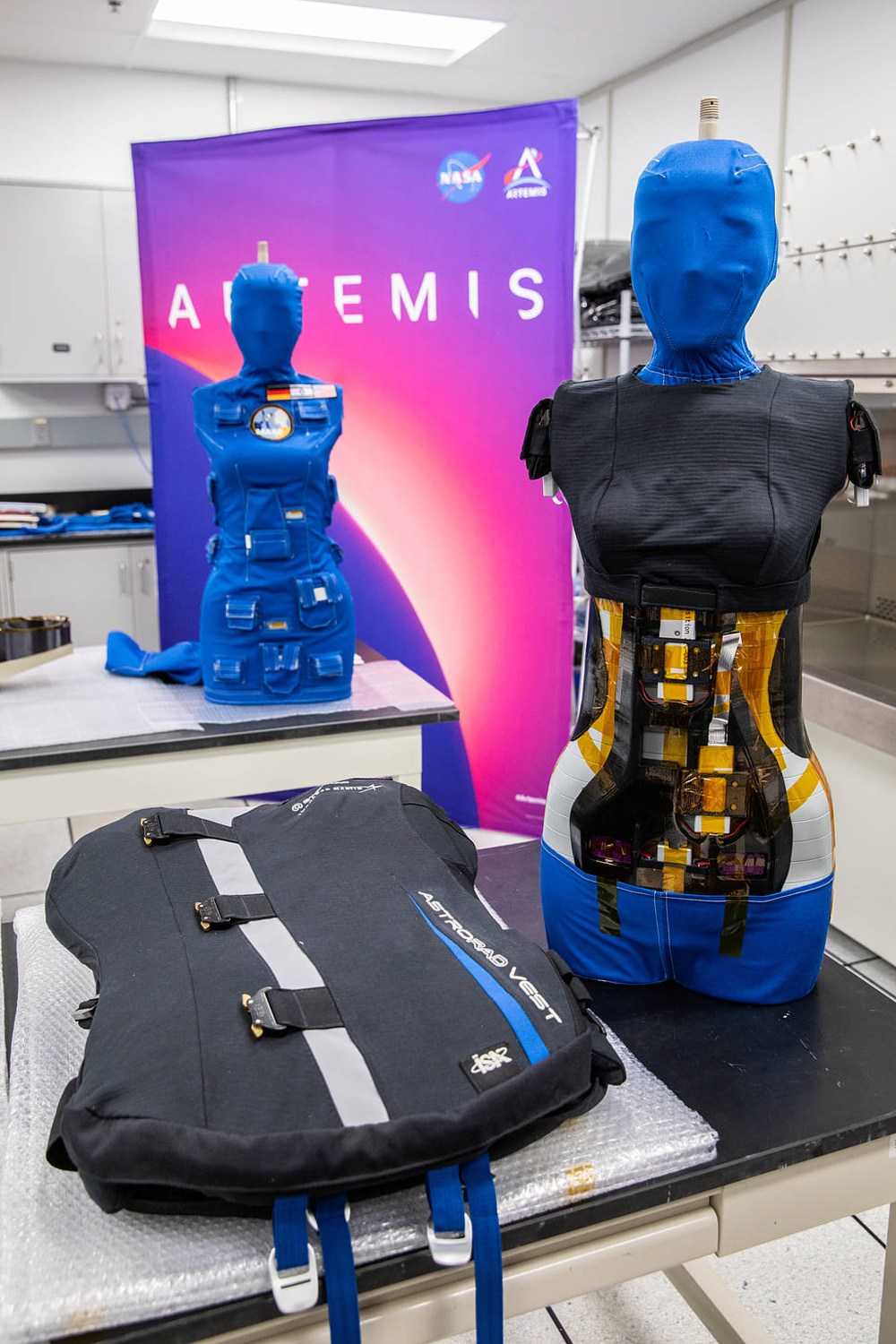
In this photo provided by NASA, Helga and Zohar, two female manikins in the Matroshka AstroRad Radiation Experiment investigation, undergo post-flight payload inspections, Jan. 17, 2023, inside the Space Station Processing Facility at Kennedy Space Center on Merritt Island, Florida. (Kim Shiflett/NASA via AP)

A version of the vest was previously tested on the International Space Station. It didn’t travel with the Artemis II astronauts since it was a short 10-day mission with limited room, but may wind up a carry-on for future moon crews.

Meant to be worn only during high-radiation and potentially cancer-causing solar events, the vest covers the most vulnerable human organs and tissue: lungs, stomach, bone marrow, breasts and ovaries. Women are believed to be especially susceptible to radiation-induced cancer.

Artemis I carried two female manikins that spent nearly a month flying to the moon and back. Dubbed Zohar and Helga, the manikins — each a life-size 3 feet from head to lower torso — were strapped into the passenger seats of NASA’s Orion capsule.

Zohar wore the 57-pound (26-kilogram) AstroRad vest, developed by the U.S.-Israeli startup StemRad and Lockheed Martin. The companies had already tested a prototype on the space station for comfort and function, modeling it after gear worn by nuclear disaster teams.

Helga flew vest-less, but like its companion contained thousands of radiation sensors.

The study’s lead author, StemRad’s Jordan Houri, called it “the largest experiment ever conducted to determine astronaut radiation exposure beyond low-Earth orbit.” NASA, the German Aerospace Center and the Israel Space Agency provided the funding. Radiation exposure is much less for space travelers closer to home, thanks to Earth’s protective atmosphere and magnetic field.

Artemis I encountered no major solar outbursts. But based on measurements gathered as NASA’s Orion capsule zipped through the inner Van Allen radiation belt, Houri and his team simulated how much protection the vest would provide during extreme solar particle events like those in 1972 and 1989 that detonated magnetic sea mines and collapsed a power grid.

Lucky for NASA, the 1972 solar outburst occurred in between that year’s two moon landings, keeping the crews of Apollo 16 and 17 safe from potentially lethal radiation exposure.

The latest findings showed the vest could reduce an astronaut’s radiation dose by about 60% in a solar storm as fierce as the one in 1972 and by nearly 40% in a calamity mirroring 1989. That’s equivalent to 193 days and 131 days, respectively, of unnecessary deep space radiation exposure, the scientists noted.

While none of the Apollo moonshots exceeded two weeks, the moon-base stays envisioned by NASA will likely last weeks, if not months, driving up the risk of enduring a dangerous solar storm. Mars expeditions will last even longer — months, years and possibly entire lifetimes if SpaceX CEO Elon Musk achieves his goal of building a city on the red planet.

The scientists are using their observations to trim more weight from the vest without sacrificing protection. They’re also investigating how to make radiation shielding from items already aboard a spacecraft — recycling that could save the lives of crews.

Houri doesn’t anticipate a need for further deep-space testing anytime soon, since Zohar and Helga “provided us with an exceptionally large, high-fidelity dataset.”

Zohar and her vest are now on display at Florida’s Kennedy Space Center, where their journey to the moon began.

___

The Associated Press Health and Science Department receives support from the Howard Hughes Medical Institute’s Department of Science Education and the Robert Wood Johnson Foundation. The AP is solely responsible for all content.

Report Error Submit a Tip

More Stories

Manitoba family finalist for cattle producers environmental award

Aaron Epp 4 minute read Preview

Manitoba family finalist for cattle producers environmental award

Aaron Epp 4 minute read Saturday, Aug. 15, 2026

A family in western Manitoba is one of seven finalists for a national environmental award honouring beef cattle producers.

Connor and Kyla English, alongside Connor’s parents, Brian and Leanne English, are nominated for the Canadian Cattle Association’s Environmental Stewardship Award. The 30-year-old award is presented to beef farmers and ranchers who explore innovative ways to protect, preserve and enhance their operations and the environment simultaneously.

This year’s recipient will be announced on Wednesday during a banquet at the Canadian Beef Industry Conference in Winnipeg.

The English family’s roots near Bradwardine — about 265 kilometres west of Winnipeg — date back to 1898. Today, Connor, Kyla, Brian and Leanne manage a herd of about 320 breeding cows on nearly 445 hectares (1,100 acres) of owned and rented pasture and forage land.

Read
Saturday, Aug. 15, 2026

Indigenous peoples are deeply invested in Canada

Niigaan Sinclair 5 minute read Preview

Indigenous peoples are deeply invested in Canada

Niigaan Sinclair 5 minute read 6:00 AM CDT

Elections Canada released a report this week that stated that, in the 2025 federal election, approximately 41 per cent of eligible First Nations, Inuit and Métis voters cast a ballot and contributed significantly to the federal Liberals and Prime Minister Mark Carney making a political comeback.

For anyone curious about how Manitoba fared, the numbers in this province were slightly lower — but still very strong, with 34 per cent participation.

This is a far cry from the highest rate of Indigenous participation in a federal election — that would be the 60 per cent who cast a ballot in 2015, when Justin Trudeau’s Liberals defeated Stephen Harper’s Conservatives — but it’s still higher than the abysmal numbers seen in decades previous.

First Nations voters have only been allowed the legal right to cast a ballot in Canadian elections since 1960, but many in the past — perhaps rightly — felt a sense of complicity in the country’s colonization or, worse, that voting didn’t make a difference.

Read
6:00 AM CDT

Radiation vest tested on NASA moonshot can cut astronauts’ exposure in solar storms, study suggests

Marcia Dunn, The Associated Press 4 minute read Preview

Radiation vest tested on NASA moonshot can cut astronauts’ exposure in solar storms, study suggests

Marcia Dunn, The Associated Press 4 minute read Wednesday, Aug. 12, 2026

CAPE CANAVERAL, Fla. (AP) — A new study suggests a protective vest tested on a manikin during NASA’s first Artemis moonshot could drastically cut the radiation exposure of lunar astronauts during severe solar storms.

Scientists reported Wednesday on the radiation-shielding vest worn around the moon by a female test dummy in 2022. No one was aboard that Artemis I debut flight, which paved the way for humanity’s long-awaited return to the moon in April by a flyby crew of four.

Radiation remains one of the biggest threats to astronauts as NASA works toward a moon base. Shielding garments could keep lunar crews safe when solar storms strike and even allow them to venture beyond their shelters if necessary, the U.S., German and Israeli team reported in the journal Science Advances.

A version of the vest was previously tested on the International Space Station. It didn't travel with the Artemis II astronauts since it was a short 10-day mission with limited room, but may wind up a carry-on for future moon crews.

Read
Wednesday, Aug. 12, 2026

Puzzles Palace

1 minute read Monday, Jul. 27, 2026

To solve our puzzles, please subscribe with this special offer: |

Today’s horoscope

Georgia Nicols 4 minute read Preview

Today’s horoscope

Georgia Nicols 4 minute read Yesterday at 2:00 AM CDT

MOON ALERT: There are no restrictions to shopping or important decisions today. The moon is in Libra.

ARIES (March 21-April 19)

The day is a mixed bag. For the most part, it’s romantic, friendly, congenial and a great time to socialize with others and enjoy playful activities with kids. Nevertheless, you might meet a real sourpuss or someone who is a wet blanket. Keep things light!

TAURUS (April 20-May 20)

Read
Yesterday at 2:00 AM CDT

Shelters overwhelmed as rising vet costs forcing some owners to surrender pets

Tiago Resko 4 minute read Preview

Shelters overwhelmed as rising vet costs forcing some owners to surrender pets

Tiago Resko 4 minute read 6:00 AM CDT

In the fall of 2022, Tara Miller was faced with a difficult decision: keep her car or sell it to pay for a second knee surgery for her dog.

Ultimately, she needed her car to commute during the winter and decided to manage her dog Corby’s arthritis with medication and home therapy.

“Mentally it probably broke me,” said the 54-year-old.

While insurance covered two-thirds of the dog’s initial $6,000 surgery, Miller had to pay the remaining $2,000. That was on top of the $500 checkup before the surgery and the monthly $175 pet insurance premium.

Read
6:00 AM CDT