What beats seeing eclipses from space? Try the northern and southern lights
Advertisement
Read this article for free:
or
Already have an account? Log in here »
To continue reading, please subscribe:

Digital Subscription
One year of digital access for only $205*
- Enjoy unlimited reading on winnipegfreepress.com
- Read the E-Edition, our digital replica newspaper
- Access News Break, our award-winning app
- Play interactive puzzles
*First annual payment billed as $205.00 + GST for one year. This annual subscription will automatically renew at $233.00 + GST every 52 weeks (10% off the regular annual price of $259.35). Offer available to new and qualified returning subscribers only. Cancel any time.
To continue reading, please subscribe:
Add Free Press access to your Brandon Sun subscription for only an additional
$1 for the first 4 weeks*
- Enjoy unlimited reading on winnipegfreepress.com
- Read the E-Edition, our digital replica newspaper
- Access News Break, our award-winning app
- Play interactive puzzles
*Your next Brandon Sun subscription payment will increase by $1.00 and you will be charged $17.95 plus GST for four weeks. After four weeks, your payment will increase to $24.95 plus GST every four weeks.
Read unlimited articles for free today:
or
Already have an account? Log in here »
CAPE CANAVERAL, Fla. (AP) — Eclipses may be wondrous, but nothing beats seeing the northern and southern lights from space.
That’s the word Wednesday from a pair of NASA astronauts living aboard the International Space Station for the past six months.
Astronauts Jessica Meir and Jack Hathaway told The Associated Press that the space station’s position prevented them from seeing totality during last week’s solar eclipse, but they still enjoyed a partial eclipse. They said they’ll try to catch next week’s lunar eclipse, too.
“We’re hoping for the best. It should be pretty awesome,” Hathaway said.
Meir said the best cosmic shows are auroras. The sun is coming off its busy season, making the northern and southern lights more dramatic and brilliant, she noted.
After one especially large blast of plasma from the sun, “the green dancing aurora” appeared right beneath them instead of off in the distance near the poles, she added.
“It looked like a snake making its way right beneath us and that was a really extraordinary one,” said Meir, the space station’s commander. “You could see the green light bouncing off the white outside exterior of the space station.”
Meir has also taken special pleasure in whipping up culinary delights in orbit, donning a space cat-adorned apron while sampling some of the station-grown mustard greens and kale. She joined crewmate Anil Menon, wearing a chef’s toque, for his first cooking episode of “Chez ISS” this week.
Arriving last month in a Russian capsule, Menon packed the apron and toque for his more-to-come cooking show. Meir’s luggage included a piccolo: She performed John Philip Sousa’s “The Stars and Stripes Forever” with the Boston Pops on July 4. Her part was prerecorded in space.
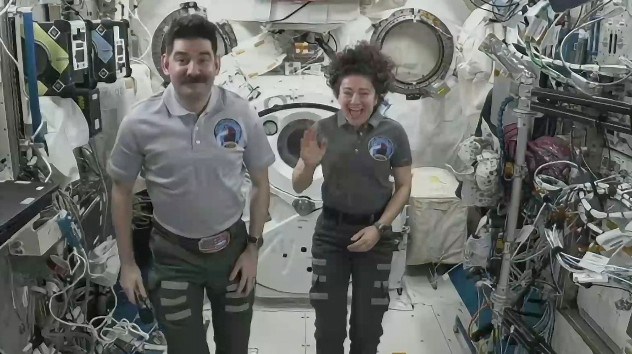
Meir also took up a fancy scarf and glittery violet bell bottoms, considerably more casual than the dress she flew on her last station trip that saw her take part in the first all-female spacewalk.
While Hathaway’s culinary and musical talents may be lacking, he said he’s never bored. “There’s always something to do,” he said, including weekend karaoke nights featuring the guitar and other musical instruments.
Launched in February, Meir, a marine biologist, and Hathaway, a Navy captain, are due to return to Earth via SpaceX once their replacements arrive next month. The current crew includes three Americans, three Russians and one French astronaut.
The Associated Press Health and Science Department receives support from the Howard Hughes Medical Institute’s Department of Science Education and the Robert Wood Johnson Foundation. The AP is solely responsible for all content.