Rescuers use new tech to save caver trapped vertically in Alberta’s ‘Psych Squeeze’
Advertisement
Read this article for free:
or
Already have an account? Log in here »
To continue reading, please subscribe:

Digital Subscription
One year of digital access for only $205*
- Enjoy unlimited reading on winnipegfreepress.com
- Read the E-Edition, our digital replica newspaper
- Access News Break, our award-winning app
- Play interactive puzzles
*First annual payment billed as $205.00 + GST for one year. This annual subscription will automatically renew at $233.00 + GST every 52 weeks (10% off the regular annual price of $259.35). Offer available to new and qualified returning subscribers only. Cancel any time.
To continue reading, please subscribe:
Add Free Press access to your Brandon Sun subscription for only an additional
$1 for the first 4 weeks*
- Enjoy unlimited reading on winnipegfreepress.com
- Read the E-Edition, our digital replica newspaper
- Access News Break, our award-winning app
- Play interactive puzzles
*Your next Brandon Sun subscription payment will increase by $1.00 and you will be charged $17.95 plus GST for four weeks. After four weeks, your payment will increase to $24.95 plus GST every four weeks.
Read unlimited articles for free today:
or
Already have an account? Log in here »
A caver has been rescued after being trapped underground at the Rat’s Nest Cave in Canmore, Alta., in an operation that deployed volunteer-built underground radio technology for the first time.
Search and Rescue Alberta said the man became pinned in a tight spot known as the “Psych Squeeze” around 11:30 a.m. last Saturday.
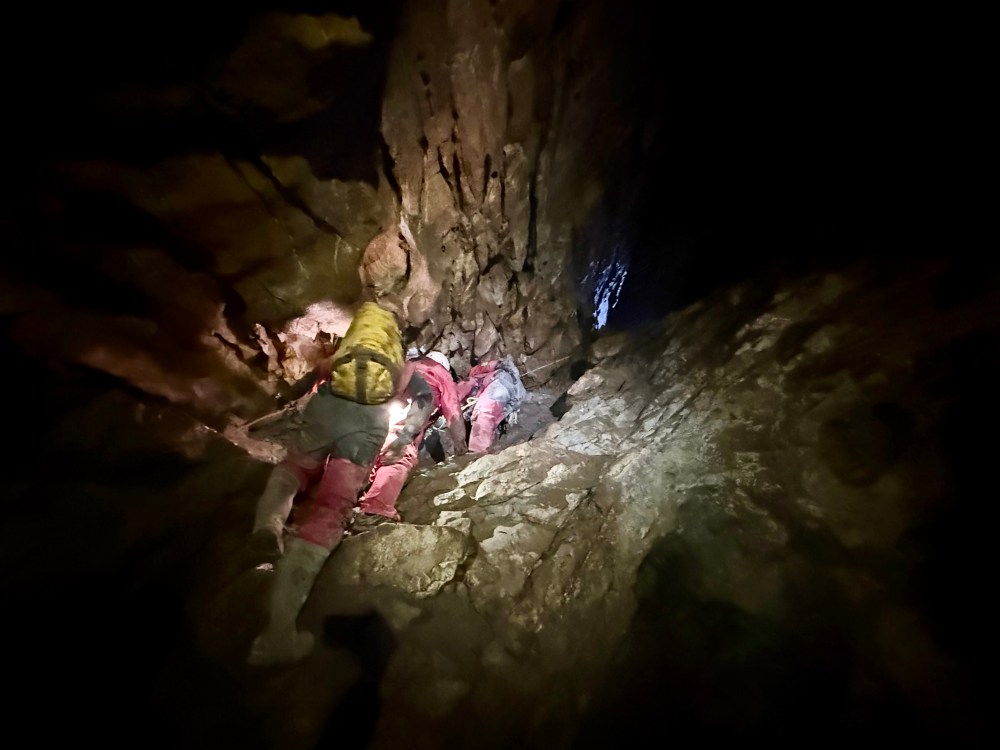
The Alberta/BC Cave Rescue team was called in, and hammer drills were used to remove rock. The caver, who was trapped vertically, was eased out in a process measured in “inches per hour.”
“Cave rescues are very rare and it’s even rarer to have to have someone stuck in a tight space and can’t free themselves,” said Christian Stenner, provincial coordinator with the Alberta/British Columbia Cave Rescue Service, in an interview Friday.
According to the Travel Alberta website, Rat’s Nest is Canada’s fourth-longest cave. The website says it is only accessible via a guided tour, and features “incredibly tight passageways” with names like The Laundry Chute. Another passageway has a 20-metre rappel.
“Both of these tours can be work, and are not for the out of shape. Expect bruises after your foray into the cave,” the website warns.
Stenner said the caver made his way a few hundred metres into the cave. He said it varies from an area where you can walk upright to spots which can require crawling on your hands and knees.
Stenner said he was wedged in the area about three metres down the cave, which was likely 30 to 40 metres from the actual surface of the ground. The man was freed around 10 p.m. and he finally emerged from the cave around midnight, after an operation involving 13 cave rescuers, 10 firefighters and two Kananaskis Mountain rescue members.
“I think he was pretty relieved. In the end he didn’t require to go to hospital or anything — it was just that physical entrapment. Once he was freed from that he was maybe a bit bruised, sore and tired because being trapped for many hours and trying to move exerts a lot of energy,” said Stenner.
“I don’t know if there was a cheer but certainly some relief and happiness.”
Stenner said a cave radio that transmits signals through rock was used in a live operation for the first time.
The technology was developed by members of Alberta/BC Cave Rescue, which is part of Search and Rescue Alberta, in response to the difficulty of using traditional communication methods like phones, radios or GPS underground.
“The ultra-low frequency radio wave is so wide it can penetrate through material like rock. It can go up to a half-kilometre … whereas the wave from a regular radio signal or a cellphone is such a narrow wave that when it hits material … it gets blocked,” he said.
It allows users to text through the dense rock and Stenner said if you compare the old way of doing things, this is much quicker.
“If you have to wait for a person to come out of the cave, tell the commander what the status is and then you have to send a person back into the cave to send the message or to get the resources that they need, it’s time consuming. So, to have the way to communicate almost instantaneously cuts down the time,” he said.
Work on the technology has been underway for years and this was its maiden voyage.

Stenner said that because cave rescues are rare, the radios had not actually been deployed on a live rescue. The latest version of the hardware was only recently finished.
“It worked perfectly. We couldn’t be happier,” Stenner said.
Stenner said the radio tech has already drawn interest from cave rescue groups around the world and it could have other useful applications in events including mine cave-ins.
John Alexander, the CEO of Search and Rescue Alberta, said the Rat’s Nest rescue “is a display of what can be achieved when multiple emergency response agencies come together in collaboration, and of the incredible innovation and initiative taken by our 1,500 volunteer search and rescue professionals who defy odds and overcome barriers every day, so others may live.”
This report by The Canadian Press was first published Aug. 21, 2026.