Flights to and from Indonesia’s capital resume after volcanic eruption forced a 2-day closure
Advertisement
Read this article for free:
or
Already have an account? Log in here »
To continue reading, please subscribe:

Digital Subscription
One year of digital access for only $205*
- Enjoy unlimited reading on winnipegfreepress.com
- Read the E-Edition, our digital replica newspaper
- Access News Break, our award-winning app
- Play interactive puzzles
*First annual payment billed as $205.00 + GST for one year. This annual subscription will automatically renew at $233.00 + GST every 52 weeks (10% off the regular annual price of $259.35). Offer available to new and qualified returning subscribers only. Cancel any time.
To continue reading, please subscribe:
Add Free Press access to your Brandon Sun subscription for only an additional
$1 for the first 4 weeks*
- Enjoy unlimited reading on winnipegfreepress.com
- Read the E-Edition, our digital replica newspaper
- Access News Break, our award-winning app
- Play interactive puzzles
*Your next Brandon Sun subscription payment will increase by $1.00 and you will be charged $17.95 plus GST for four weeks. After four weeks, your payment will increase to $24.95 plus GST every four weeks.
Read unlimited articles for free today:
or
Already have an account? Log in here »
JAKARTA, Indonesia (AP) — Flights to and from Indonesia’s capital and nearby regions resumed Tuesday after ash from a volcanic eruption forced two days of airport closures that halted nearly 3,000 flights.
Soekarno-Hatta International Airport and Halim Perdanakusuma Airport serving Jakarta and three other regional airports reopened just after midnight, Transportation Minister Dudy Purwagandhi said. Two resumed normal operations by late morning after one reopened Monday.
Purwagandhi said the airports were allowed to resume operations only after authorities determined conditions were safe for aviation. He said airport authorities and airlines were required to inspect all aircraft before flights resumed.
“Pilots and flight crews were also instructed to remain aware of restricted airspace zones established around areas affected by volcanic ash,” Purwagandhi said.
Aviation authorities temporarily restrict aircraft from areas where ash has been detected because volcanic particles can damage engines and other critical systems.
The continuous eruption of Anak Krakatau with lava fountains and loud booms ended Sunday but the volcanic island remained active Tuesday, with four eruptions recorded between dawn and midday. The latest two eruptions lasted 19 seconds and 17 seconds, according to Indonesia’s Geology Agency.
Following that episode, Anak Krakatau’s activity transitioned back to strombolian eruption characteristics, which include intermittent explosions ejecting lava, ash and incandescent volcanic material from the crater, unlike continuous eruptions that can last for many hours or days.
Four strombolian eruption earthquakes were recorded at Anak Krakatau on Tuesday, said Lana Saria, head of the Geological Agency.
“The return to strombolian activity signaled the end of the prolonged continuous-eruption phase,” she said.
None of Tuesday’s eruptions could be observed visually because the volcano was shrouded in dense fog, but all four events were confirmed by seismographs that recorded volcanic tremors, the agency said.
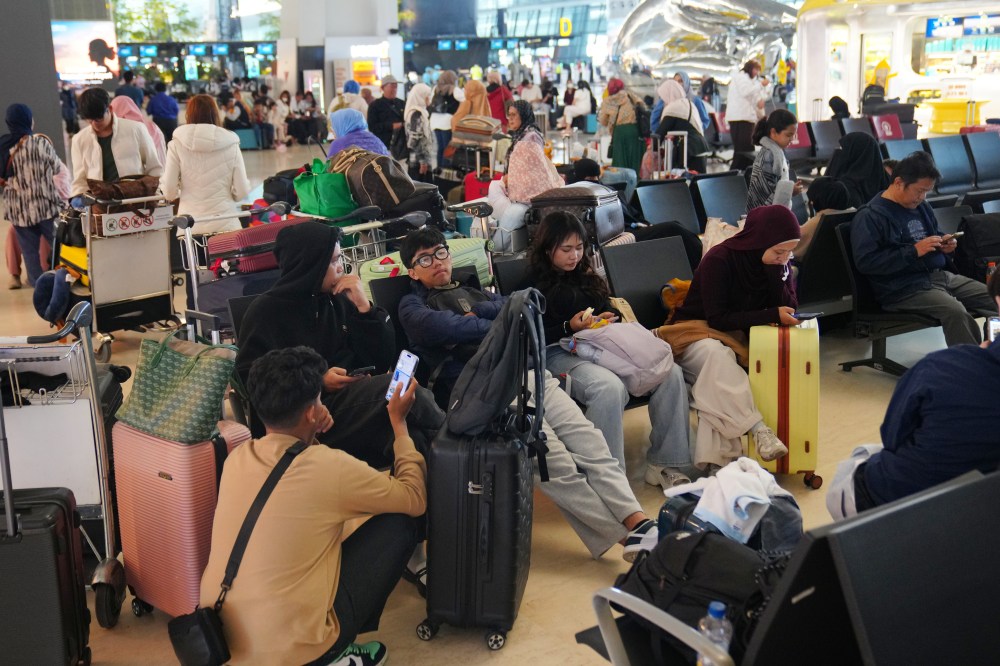
The airport closures Sunday and Monday disrupted nearly 2,961 flights, including 622 international services, and affected about 341,000 passengers.

The government also authorized schools in areas affected by volcanic ash to shift temporarily to online learning to reduce students’ exposure to ash.
Anak Krakatau is a volcanic island in the Sunda Strait between Indonesia’s main islands of Java and Sumatra. Its name means “child of Krakatau,” and the volcano is the offspring of the infamous Krakatau, whose monumental 1883 eruption triggered a period of global cooling.
An eruption of Anak Krakatau in 2018 caused a tsunami that killed at least 430 people in Sumatra and Java. Researchers believe volcanic activity triggered an underwater landslide and caused a large chunk of Anak Krakatau’s southwest slope to collapse and displace a large volume of water.
The volcano remained at Indonesia’s second-highest alert level since July, and authorities advised residents, tourists and fishermen to stay at least 3 kilometers (1.9 miles) from the active crater.
Indonesia has more than 120 active volcanoes and frequently experiences eruptions due to its location along the Pacific “Ring of Fire,” the series of seismic faults around the Pacific Ocean where most global seismic activity occurs.