Wes Moore forms bipartisan governors group on AI, citing federal inaction
Advertisement
Read this article for free:
or
Already have an account? Log in here »
To continue reading, please subscribe:

Digital Subscription
One year of digital access for only $205*
- Enjoy unlimited reading on winnipegfreepress.com
- Read the E-Edition, our digital replica newspaper
- Access News Break, our award-winning app
- Play interactive puzzles
*First annual payment billed as $205.00 + GST for one year. This annual subscription will automatically renew at $233.00 + GST every 52 weeks (10% off the regular annual price of $259.35). Offer available to new and qualified returning subscribers only. Cancel any time.
To continue reading, please subscribe:
Add Free Press access to your Brandon Sun subscription for only an additional
$1 for the first 4 weeks*
- Enjoy unlimited reading on winnipegfreepress.com
- Read the E-Edition, our digital replica newspaper
- Access News Break, our award-winning app
- Play interactive puzzles
*Your next Brandon Sun subscription payment will increase by $1.00 and you will be charged $17.95 plus GST for four weeks. After four weeks, your payment will increase to $24.95 plus GST every four weeks.
Read unlimited articles for free today:
or
Already have an account? Log in here »
BALTIMORE (AP) — Gov. Wes Moore of Maryland is forming a bipartisan group of governors to respond to mounting concerns about the threats posed by artificial intelligence as he argued that states need to fill a void left by the federal government’s inaction on the issue.
In an interview, Moore, a Democrat, criticized President Donald Trump’s meeting with AI executives at the White House this week as a “billionaire boys club.” He was also critical of Congress for leaving Washington until after next month’s midterms without addressing the rapidly evolving technology.
“The federal government has a unique leadership role that they have to play and that includes both the White House and Congress,” Moore said after speaking at an innovation conference in Baltimore. “In the absence of that, the governors cannot just sit on our hands.”
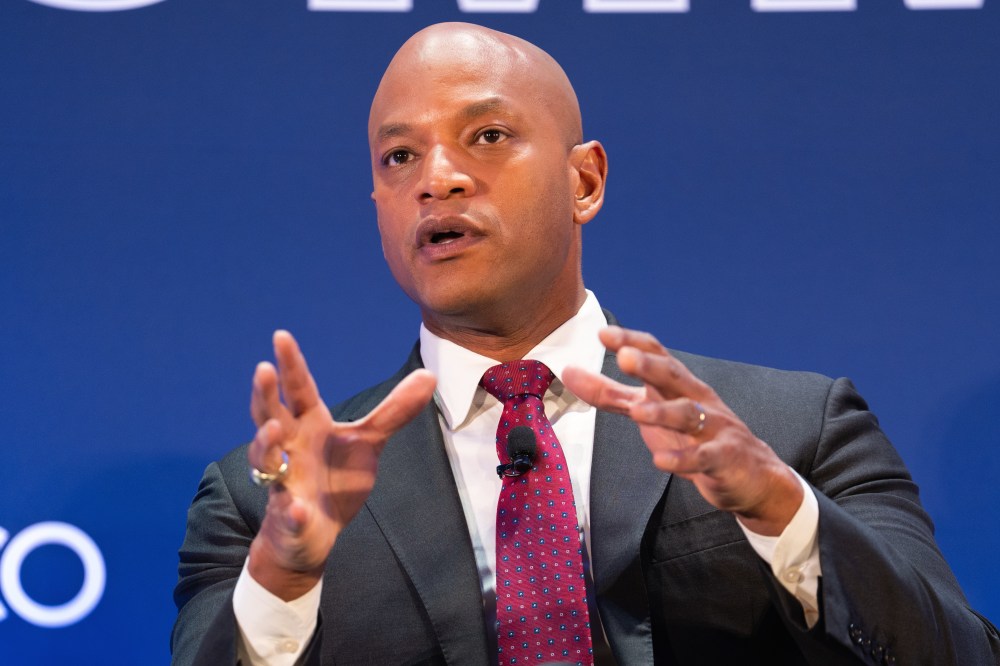
Moore is the chair of the National Governors Association this year and said his co-chair, Republican Gov. Mike Braun of Indiana, would partner with him in developing an AI framework. Other governors from both parties are planning to participate, Moore said.
Increasingly dire warnings from tech executives that AI could pose an existential threat to humanity have tested the ability of governments at all levels to respond nimbly to fast-moving developments. So far, states have been more active than the federal government, but their power is limited when it comes to dealing with a technology that spans the country and the globe.
In the past month, governors in Maryland, California, Illinois, Oregon and Virginia have issued executive orders or taken other steps intended to create some standards for the technology. Republicans have been among those taking action at the state level with governors including Spencer Cox of Utah and Greg Abbott of Texas cracking down on data center development.
However, the action has been much slower in Washington. Sen. Bernie Sanders, I-Vt., hosted a briefing with lawmakers and experts last month and Sen. Josh Hawley, R-Mo., has launched an investigation into OpenAI. There has been little agreement, however, on a legislative response.
At the White House, Trump has dismissed AI fears as a “hoax” and emphasized the need to remain competitive with technology developed in China. He is one of the few prominent leaders who continues to boost data centers.
Trump and tech leaders signed a voluntary accord this week that he called “morally binding” and will include internal and external reviews. After meeting with the leaders, the president praised the industry for engaging in “tremendous self-policing.”
“Who in the room was advocating for more transparency or more regulatory guardrails?” Moore said of the White House meeting. “What the president did in no way, shape or form made me feel like what the governors are now doing was now unnecessary.”
The White House didn’t immediately respond to a request for comment.
The debate over responding to artificial intelligence could play an important role in the early stages of the next presidential campaign. Moore has said he’s not running for president and is focused on this year’s midterms, when he is on the ballot for reelection in Maryland.
Whoever enters the field could face scrutiny for past moves including support for data centers, which were once seen as economic booms for states but have since become broadly unpopular. Moore is among the governors who has become more critical of data centers, signing an executive order last month establishing new rules to govern them.
He has also called on state lawmakers to repeal a tax exemption that was passed before he took office.
In the interview, Moore acknowledged the “speed of this technology that is moving at such a rapid clip.” He said that elements of an AI executive order he signed in 2024 are “antiquated now.”
“The operations might move,” he said. “But my values will never move.”