Experts eye Alberta referendum as case study on impacts of artificial intelligence
Advertisement
Read this article for free:
or
Already have an account? Log in here »
To continue reading, please subscribe:

Digital Subscription
One year of digital access for only $205*
- Enjoy unlimited reading on winnipegfreepress.com
- Read the E-Edition, our digital replica newspaper
- Access News Break, our award-winning app
- Play interactive puzzles
*First annual payment billed as $205.00 + GST for one year. This annual subscription will automatically renew at $233.00 + GST every 52 weeks (10% off the regular annual price of $259.35). Offer available to new and qualified returning subscribers only. Cancel any time.
To continue reading, please subscribe:
Add Free Press access to your Brandon Sun subscription for only an additional
$1 for the first 4 weeks*
- Enjoy unlimited reading on winnipegfreepress.com
- Read the E-Edition, our digital replica newspaper
- Access News Break, our award-winning app
- Play interactive puzzles
*Your next Brandon Sun subscription payment will increase by $1.00 and you will be charged $17.95 plus GST for four weeks. After four weeks, your payment will increase to $24.95 plus GST every four weeks.
Read unlimited articles for free today:
or
Already have an account? Log in here »
EDMONTON – On any given day, says Aengus Bridgman, if you ask a popular artificial intelligence chatbot and a search engine whether taxes in an independent Alberta would be higher, it might say yes.
A few hours later, it could be no.
Responses from Google AI Overview and OpenAI’s ChatGPT can change, because data used to predict responses is always changing. “(It’s) not because any of the underlying reality has changed,” said Bridgman, director of Media Ecosystem Observatory.
In a report released last month, the Ontario-based initiative documented mixed responses to questions about what an independent Alberta could look like.
“We asked, ‘Will my taxes go up?’ ‘Will my pension go up?’ ‘Is this fiscally advantageous to me?'” Bridgman said.
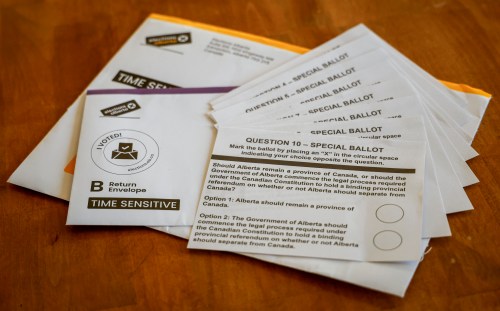
The report tracks how AI technologies are being harnessed in the online discourse ahead of the Oct. 19 referendum.
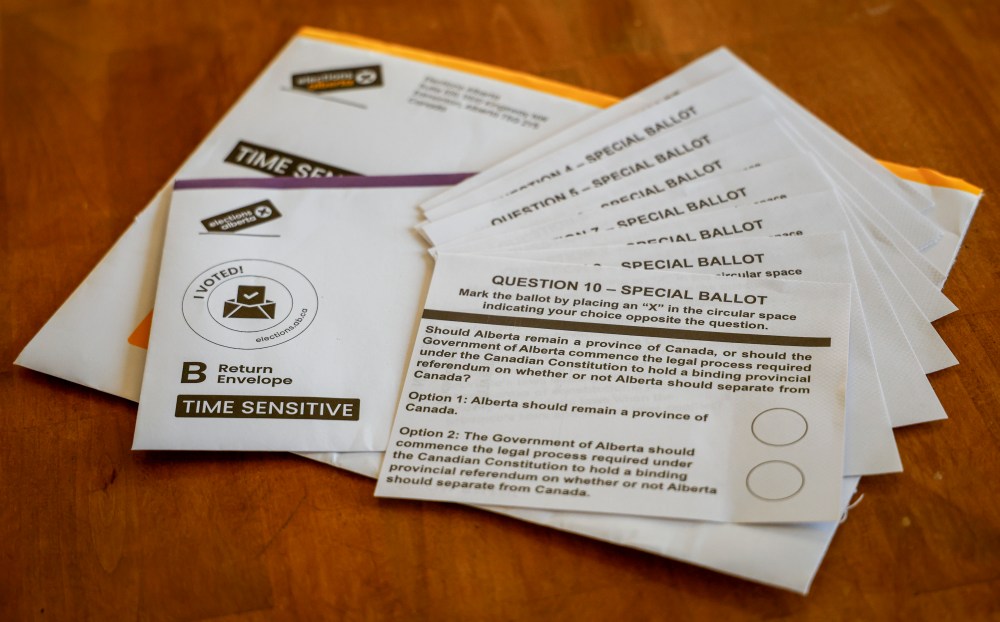
Albertans are voting on 10 questions, including whether they want to stay in Canada or to have a second, binding referendum on leaving Confederation.
The report says the vote is a case study in how AI could influence future elections when it comes to where people get their news.
“Year over year, online influencers have been accumulating relevance and engagement at the expense of news media and elected officials,” says the report.
“We now have a case study of what a democratic vote looks like squarely in the influencer era.”
Bridgman said social media and AI have vastly expanded debates on separation.
“It’s good in terms of a lively democracy.”
But, he added, technologies have also made tracking the referendum, and elections generally, more complex.
It’s likely because of the maxim: garbage in, garbage out.
Elections Alberta says on its website that AI-powered chatbots and search engines are increasingly being used to find and summarize information found online.
The agency warns: “They are not official sources of election information and frequently cite incorrect information sources.”
OpenAI and Google didn’t respond to requests for comments on Media Ecosystem’s report.
OpenAI spokesperson Nate Evans shared a May blog the company posted on its website outlining what technologies the company has partnered with to ensure its chatbot produces accurate information during votes.
“This year is the world’s second major election year since generative AI became widely available, and we’re continuing to build on the foundation we laid in 2024 to help protect elections in countries and territories around the world,” the post said.
The Media Ecosystem study also found an uptick in content about Alberta separation produced in other countries, including the United States. But there’s not enough evidence of foreign interference, Bridgman said.
The study says foreign actors are producing content largely for financial profit, and the millions and millions of views they get suggest they are cashing in.
Pro-separation influencers also dominate the online discourse, the study found, despite polls showing a large majority of Albertans would vote to remain in Canada.
Bridgman said it’s unclear why there are more pro-separation social media accounts than federalist accounts.
“My attribution of this is generally because these (separatist) voices have not felt represented in more traditional media.”
Many influencers are also using AI to generate content, the study found.
University of Alberta political science professor Blair Attard-Frost said the increased use of AI in the separation debate is concerning.
The AI chair with Canadian Institute for Advanced Research said when search engines became popular in the early 2000s, so did information campaigns about media literacy.
With the advancement in AI, a new wave of media literacy needs to be implemented because of how big tech markets its search engines and services.
“These are really deceptive products,” Attard-Frost said. “They’re marketed as intelligent tools.”
She said she’ll be paying attention to how the current technologies might affect the referendum results and the future of Alberta’s separation movement.
“A lot of people could be getting incomplete, inaccurate, false or misleading information about the potential consequences of separatism, and using that information to make decisions about how to vote,” she said.
Alberta Premier Danielle Smith, asked this week whether she’s concerned about AI-generated misinformation swaying votes, said her government has turned to traditional media to get out information.
It recently launched an ad campaign and mailed out booklets outlining and explaining the 10 referendum questions.
The first nine ask if the government should have more authority to push for Constitutional reform and impose limitations and financial guardrails around some newcomers.
The last question is about separation.
“We are making sure that Albertans know exactly what the questions are and some of the context for them,” Smith said Monday.
On Friday, Alberta Opposition NDP Leader Naheed Nenshi said anyone looking for misinformation should look no further than Smith’s United Conservative Party government.
Nenshi pointed to the booklets that arrived at homes this week as an example of the government putting its thumb on the scale.

The booklet uses uncontextualized numbers and information to urge voters to give the government a mandate for the first nine questions, while it’s silent on the 10th
For example, said Nenshi, the booklet says temporary residents cost Alberta taxpayers $1 billion a year in health care and education. It doesn’t say where the number comes from or that temporary workers, by definition, have to have a job to stay and must also pay taxes.
“For the first nine questions, (Smith) tells you how to vote,” Nenshi said. “That doesn’t feel like direct democracy to me. It feels like propaganda.
“This (booklet) is garbage — $4 million worth of taxpayer-funded garbage.”
This report by The Canadian Press was first published Oct. 3, 2026.