AI, resources and water bombers: Draft document maps Canada, EU path to closer ties
Advertisement
Read this article for free:
or
Already have an account? Log in here »
To continue reading, please subscribe:

Digital Subscription
One year of digital access for only $205*
- Enjoy unlimited reading on winnipegfreepress.com
- Read the E-Edition, our digital replica newspaper
- Access News Break, our award-winning app
- Play interactive puzzles
*First annual payment billed as $205.00 + GST for one year. This annual subscription will automatically renew at $233.00 + GST every 52 weeks (10% off the regular annual price of $259.35). Offer available to new and qualified returning subscribers only. Cancel any time.
To continue reading, please subscribe:
Add Free Press access to your Brandon Sun subscription for only an additional
$1 for the first 4 weeks*
- Enjoy unlimited reading on winnipegfreepress.com
- Read the E-Edition, our digital replica newspaper
- Access News Break, our award-winning app
- Play interactive puzzles
*Your next Brandon Sun subscription payment will increase by $1.00 and you will be charged $17.95 plus GST for four weeks. After four weeks, your payment will increase to $24.95 plus GST every four weeks.
Read unlimited articles for free today:
or
Already have an account? Log in here »
MONTREAL – Canada and the European Union are laying out concrete steps to strengthen ties around digital security and defence as well as critical resources and a would-be fleet of Canadian-made water bombers, according to a draft joint statement ahead of a summit at month’s end.
The document, seen by The Canadian Press, states that Ottawa and Brussels aim to let Canadian companies bid on cloud and artificial intelligence infrastructure contracts typically reserved for European companies in another push away from dependence on the United States.
Dubbed an “alliance for the future,” the renewed partnership also launches plans for Canada to join in Europe’s Galileo satellite navigation system and wraps up a deal to facilitate European investment in Canadian critical minerals, according to the leaked statement.
It also heralds the joint purchase of 50 Canadian-made De Havilland water bombers it claims will be ready for use in fighting wildfires in 2030.
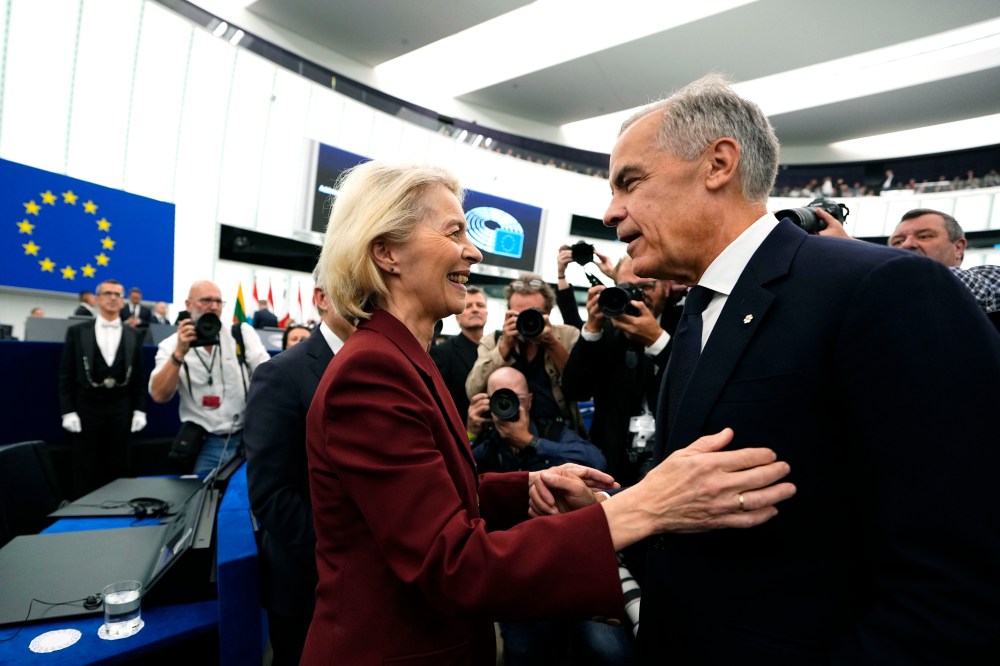
More broadly, the statement showcases Prime Minister Mark Carney’s ongoing effort to shore up Continental links in areas ranging from trade to education and the military, as Canada and the European Union try to guard against a less reliable America and take up the flag of the rules-based international order.
The challenge lies in fending off backlash from the White House and continuing to bolster cross-Atlantic bonds beyond the next election cycle, said Patrick Leblond, an associate professor of public and international affairs at the University of Ottawa.
“The Americans, they’re playing a power game. For them, if Canada and other countries band together in a way to reduce their dependence on the U.S., the current U.S. administration — and potentially others in the future — will try to prevent that from happening,” Leblond said.
“Divide and conquer, that’s the power approach.”
The draft statement, dated Sept. 22, pledges to “strengthen digital sovereignty” and align emerging regulatory frameworks “through associated country status for Canada” under the European Commission’s proposed Cloud and AI Development Act.
That means Canada would be treated as a member country when it comes to bidding on contracts for critical digital infrastructure.
“Whether it’s Google, Amazon, Microsoft, we’re very dependent on these platforms. And as we know, it could be weaponized against our economy, against our governments,” said Leblond.
“The message here is, let’s work together. We trust each other.”
The provision comes after European Commission President Ursula von der Leyen proposed last month that Canada become the first associate member of the European Union.
Where possible, European contractors are already inclined to work with Canadian firms over American ones because of the export controls the United States tends to impose on sales to a third-country market, said Wendy Gilmour, vice-chair of the Conference of Defence Associations Institute.
However, persuading U.S.-oriented tech firms in Canada to cast their eyes toward Europe could pose a hurdle.
“There’s been a slow take-up by Canadian business because Canadian business has just been so used to working with the American market,” Gilmour said.
“It’s easy. It’s English-speaking. It’s just a simpler prospect than to work in a European regulatory environment with 27 different countries.”
The push for greater distance from Canada’s next-door neighbour extends to space, with the draft document kicking off talks for Canadian participation in the EU’s Galileo satellite navigation system. The move carries military implications.
Canadian Forces currently rely on America’s Global Positioning System for an encrypted U.S. military signal designed to resist jamming and spoofing. Galileo has its own encrypted signal, but access for any non-EU country requires a formal agreement.
The joint statement, which may undergo revisions before the summit kicks off in two weeks, further says the two sides have hammered out a deal that makes it easier for investment in Canada’s critical resources — “in particular, critical minerals” — by the European Investment Bank, and for their export to Europe.
The measure responds to Canada’s need for greater diversity of both buyers and sources of capital for its natural resources, Gilmour said. Specifically, it marks an attempt to reduce dependence on the U.S. market and Chinese supply chains and to spur more mining and processing at home.
“We rely too heavily on offshore processing,” she said, noting that China enjoys a near-stranglehold on critical minerals refining.
On disaster preparedness, the joint purchase of water bombers from De Havilland marks a win for the Calgary-based plane maker. But it remains unclear whether the 50 planes would be in addition to the 38 already ordered by six EU countries and three Canadian provinces since 2024.

A De Havilland spokesperson said in an email the company was “not engaged in these discussions.”
The summit statement lays out other commitments ranging from the specific — new talks for participation in Erasmus, the popular EU student-exchange program — to the aspirational: “We will fight to protect and promote human rights everywhere, for everyone.”
While stressing “unprecedented geopolitical challenges,” the document doubles down on middle-power co-operation. “Our partnership may become a model for other countries seeking friendship in a challenging world,” it reads.
The Canada-EU summit, set for Oct. 29 and 30 in Montreal, will see Carney host von der Leyen as well as European Council president António Costa and other EU leaders.
This report by The Canadian Press was first published Oct. 15, 2026.
Related Articles
France open to defence deals with Canada despite its push for arms autonomy: envoy


Advertisement Advertise With Us
Advertisement Advertise With Us