Skin in the game
Protesters enjoy right to bare arms (and more)
Advertisement
Read this article for free:
or
Already have an account? Log in here »
To continue reading, please subscribe:

Digital Subscription
One year of digital access for only $205*
- Enjoy unlimited reading on winnipegfreepress.com
- Read the E-Edition, our digital replica newspaper
- Access News Break, our award-winning app
- Play interactive puzzles
*First annual payment billed as $205.00 + GST for one year. This annual subscription will automatically renew at $233.00 + GST every 52 weeks (10% off the regular annual price of $259.35). Offer available to new and qualified returning subscribers only. Cancel any time.
To continue reading, please subscribe:
Add Free Press access to your Brandon Sun subscription for only an additional
$1 for the first 4 weeks*
- Enjoy unlimited reading on winnipegfreepress.com
- Read the E-Edition, our digital replica newspaper
- Access News Break, our award-winning app
- Play interactive puzzles
*Your next Brandon Sun subscription payment will increase by $1.00 and you will be charged $17.95 plus GST for four weeks. After four weeks, your payment will increase to $24.95 plus GST every four weeks.
Read unlimited articles for free today:
or
Already have an account? Log in here »
Hey there, time traveller!
This article was published 06/04/2019 (2670 days ago), so information in it may no longer be current.
Sometimes, the best way to get maximum exposure is by going completely uncovered.
Consider the scene earlier this week in Britain’s House of Commons, where about a dozen protesters were arrested after stripping down to their underwear to protest climate change while lawmakers were debating Brexit.
It took police about half an hour to remove and arrest all 12 protesters, some of whom had glued their hands to a glass barrier in the public gallery and had slogans such as “stop wasting time” painted on their chests.
The activist group Extinction Rebellion said the nearly naked protest — two protesters sported grey body paint and elephant masks — was an attempt “to draw politicians’ attention to the climate and ecological crisis.”
Conservative MP Nick Boles made light of the situation, joking whether it was a “coincidence” that among his colleagues were “noted naturists.”
“But, Mr. Speaker, it has long been a thoroughly British trait to be able to ignore pointless nakedness and I trust that the House will now be able to return to the issue that we are discussing,” he added.
One of the climate change protesters said the group doffed their duds “because the most important and pressing issue of our time is being flagrantly and recklessly ignored by our government and media.”
There is a long, strange history of people protesting around the world without the benefit of clothing, as you’ll see when we reveal today’s totally buff list of Five Famous Naked Protests and/or Protesters:
5) The nude protest: The World Naked Bike Ride
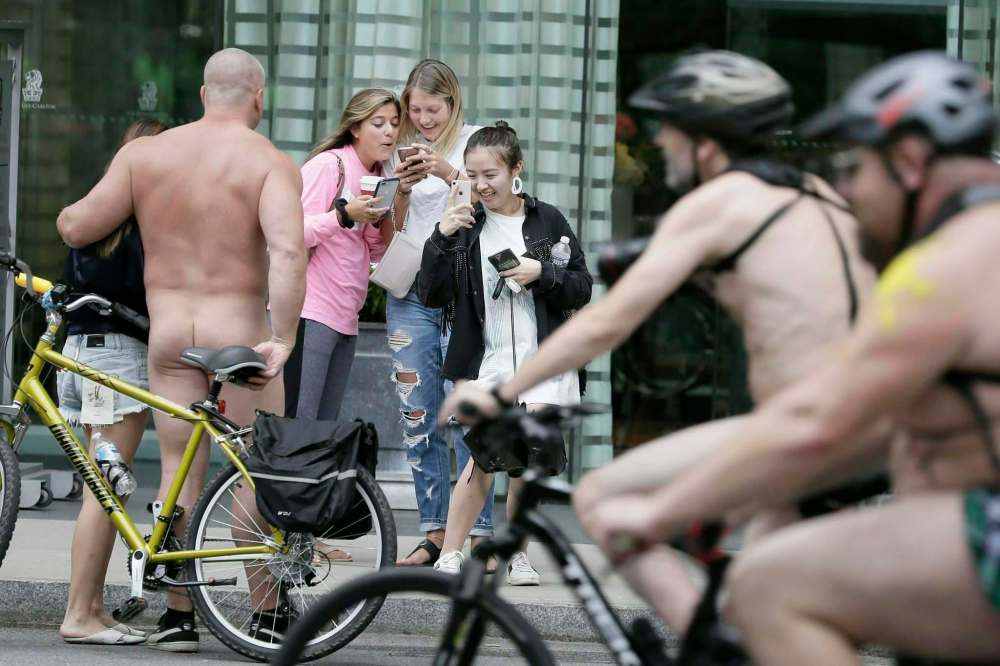
The naked truth: The bottom line — no pun intended — is that this event involves a bunch of naked people riding bikes. And get ready to feel a sense of unbridled patriotism, because this international event is homegrown.
It was created in 2004 by Vancouver social activist Conrad Schmidt, the same guy who organized a protest in 2003 wherein 50 demonstrators from Artists Against War formed a peace sign with their naked bodies to protest against the looming U.S. action in Iraq.
It began as an opportunity for a handful of naked bikers to roll along and protest the global dependency on oil. It has grown to the point where it now involves thousands of buff bike riders streaking along on two wheels in more than 70 cities across more than 20 countries. Held on different dates in different cities, it has become less of a protest and more of an opportunity for organizers to promote “a cleaner, safer, body-positive world.”
The official dress code is “bare as you dare,” but nudity is not mandatory and, thankfully, helmets are encouraged. Over the years, some cyclists have criticized the naked ride for trivializing serious issues surrounding car culture, but organizers counter that the concepts of having fun and public protest are not mutually exclusive. On one U.K. site, organizers declared: “It’s a global clothing-optional protest against oil dependency and car culture and a celebration of cycling and the power and individuality of our bodies. Basically it’s as much fun as you can have on a bike in one day, it’s free and in a great cause!”
Arrests are rare and, yes, there have been naked bike rides in Winnipeg. “Better find a place to bring your wallet or at least some identification, if the police do have to deal with you,” a police spokesman quipped before the 2008 ride in Winnipeg.
4) The nude protester: Victoria Bateman
The naked truth: When you think about a Cambridge University academic, you typically imagine someone wearing flowing robes who looks as if they just walked out of a Harry Potter movie. You typically do not think about someone in their birthday suit with political messages painted on their naked body.
Well, meet Victoria Bateman, a fellow and lecturer in economics at Cambridge who has skyrocketed to fame because of her dedication to protesting naked against Brexit, the U.K.’s controversial withdrawal from the European Union.
Bateman usually reserves naked protests for specifically feminist issues — from burqa bans to lack of access to birth control — but she has put Brexit squarely in her sights. “If we remove our clothes, we might better also see the way in which we are all equal human beings. We shouldn’t be putting up divisions between one another,” Bateman recently told Zoe Williams, a columnist with the Guardian newspaper in Britain. The controversial academic first grabbed headlines in July 2016 when she walked naked into a faculty meeting of economists with the words “Brexit leaves Britain naked” famously scrawled across her bare breasts.
In 2018, the academic protested economic gender inequality by appearing at a function in the buff, with nothing but a few strategically placed banknotes over her intimate areas. Last June, she was more covered up, attending an end-of-term supervisors dinner wearing a see-through body suit, with the words “my body, my choice” written on her torso. Earlier this year, she delivered an hour-long lecture against Brexit at the Cambridge Junction without the benefit of clothing, then asked the audience to sign her body, turning her into a human petition. She has also challenged high-profile Brexit supporters to debate naked.
“When we remove our clothes, there is a sense in which we realize that we are all human beings and so actually, perhaps if Brexiteers were to strip off, they might wake up to that basic humanity,” she told the Cambridge News.
3) The nude protests: Nude activists target Trump
The naked truth: It is probably no surprise U.S. President Donald Trump has found himself at the centre of more than a few naked protests, even before he was elected to the highest office south of the border. At the 2016 Republican National Convention, more than 100 women posed nude outside Quicken Loans Arena in downtown Cleveland to protest the convention, and then-candidate Trump, who is famous for rhetoric that outrages feminists.
The women — who held up large, round mirrors facing the arena — were participating in a performance art piece from photographer Spencer Tunick called “Everything She Says Means Everything.” It was intended to target “the hateful repressive rhetoric of many in the Republican party towards women and minorities.” More than 1,800 women signed up for the 100 available spaces to bare their anger.
“By holding mirrors,” the project’s website explained, “we hope to suggest that women are a reflection and embodiment of nature, the sun, the sky and the land.” In November 2016, a reported 100 semi-naked protesters marched to Trump Tower, partly to express fear that, under Trump, women would become a marginalized group.
Last year, as Trump was heading to an armistice ceremony in Paris, a topless woman with the words “Fake Peacemakers” scrawled on her torso with black paint ran toward the president’s limousine, before being dragged away by police.
The radical feminist group Femen — based in Paris but born in the Ukraine — took responsibility. “Femen’s methods are fairly straightforward: topless women in flower crowns, their bodies painted like protest signs, disrupt public events by yelling feminist slogans and throwing their bodies at politicians and church leaders,” the Washington Post reported.
As the Independent newspaper in Britain noted in 2016: “Donald Trump’s road to the White House has been punctuated by a series of naked protests… These protesters continue a long history of naked demonstration — and nakedness has long been employed as a gesture of defiance, highlighting the plight of the oppressed.”
2) The nude protesters: The Manipur grandmothers
The naked truth: There is a long tradition of nude protests around the world, and many have been spawned by horrific events. A nude protest by a group of 12 Indian mothers and grandmothers stunned the world in 2004. Their courage paved the way for change in the troubled northeastern state of Manipur.
In July 2004, the gang-rape and murder of a 32-year-old woman — believed carried out by paramilitary soldiers — had the state on edge. “Manorama was picked up from her home at midnight on 11 July by soldiers from the Assam Rifles, a paramilitary force deployed in Manipur to fight insurgents,” according to the BBC. “A few hours later, her mutilated, bullet-riddled body was found by the roadside. It bore telltale signs of torture and rape. The Assam Rifles denied any role in her death, but the state witnessed unprecedented anger and at the centre of that was the ‘mothers’ protest.’”
It prompted a group of women called Meira Paibis (“torch-bearers”) to take action. They were all from poor families; the oldest was 73, the youngest 45. They had 46 children and 74 grandchildren. They decided to strip in front of the iconic Kangla Fort, the Assam Rifles headquarters, on July 15, because “desperate times call for desperate measures.” At 10 a.m., they walked in twos and threes to the fort gate and before anyone could realize what was going on, they threw off their clothes, beat their chests, rolled on the ground and wept. Some famously carried banners that read “Indian army, rape us” and “Indian army, kill us.”
The women tried to storm the fort, but soldiers locked the gates. The nude protest lasted 45 minutes, but those minutes helped turn the tide of public opinion. The mothers and grandmothers became heroes, but were also harassed by the government. “Nine of the women were accused of arson and waging war against the country and were sent to jail for nearly three months,” the BBC reported. “Their protest, however, did have the intended impact of putting the spotlight on the Manipur problem.”
1) The (partly) nude protester: Gwen Jacob
The naked truth: There is a long history of nude protests in Canada, ranging from PETA protesters to Montreal students upset over tuition hikes to the infamous demonstrations of the Freedomites sect in B.C. But the champion for the right to appear topless in public was Guelph university student Gwen Jacob.

When Jacob removed her top to cool off on a sweltering summer day in July 1991, it launched a movement to give all women in Ontario the legal right to bare their breasts. Then-19-year-old Jacob was charged with committing an indecent act after walking home with her top off in 33 C weather.
“Police had acted on a complaint from a mother who was concerned after her young children had seen Jacob walking topless,” CBC News recalled in 2011, the 20th anniversary of the incident. In 1991, she told the CBC: “There were men (who were topless) walking right past the officers who arrested me and they didn’t do anything about them… But being a woman and having slightly different-shaped breasts, I was arrested for it.”
Jacob was found guilty of one count of committing an indecent act and fined $75. At the time, the judge said a woman’s breast is “part of the female body that is sexually stimulating to men both by sight and touch” and should not be uncovered in public. In 1996, however, the Ontario Court of Appeal overturned Jacob’s conviction, declaring “there was nothing degrading or dehumanizing in what the appellant did. The scope of her activity was limited and was entirely non-commercial. No one who was offended was forced to continue looking at her.”
The court didn’t rule on the constitutionality of the issue, but her lawyer argued Jacob had the same constitutional right to go topless as men did. Ontario’s government chose not to appeal.
doug.speirs@freepress.mb.ca